Health plans and providers continue to look for ways to transition to value-based care (VBC) models. Limitations on data availability and information blocking will soon be considered legacy components within healthcare as the date for the CMS interoperability mandate draws nearer. The mandate will serve as a key pillar to success in moving to value-based models.
How interoperability can unlock the potential of value-based care
The CMS mandate will serve as a key pillar to health plans’ success in moving to value-based models.
Interoperable data offers many benefits:
- Enhanced member attribution by leveraging additional data sets
- Integrated financial and quality measurement reporting
- Improved patient experience as care providers create a seamless, personalized experience
- Better patient outcomes as care providers access a longitudinal member record
- Decreased administrative and care costs
- Ability to coordinate care among stakeholders improves the efficacy and efficiency of care
Interoperability and VBC are uniquely positioned to work synergistically across the continuum of care to increase provider confidence in VBC models, realize the benefits of VBC and enhance clinical decision-making at the point of care
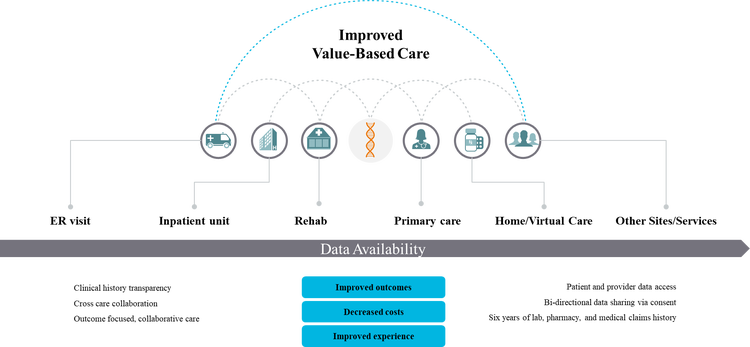
Health plans can use the following strategy for an interoperable VBC solution:
There are three main parts to a successful interoperable VBC solution strategy.
Prepare and consume
- Compile member, provider, claims and clinical data sources into the enterprise data lake to enable capabilities
- Complete member attribution calculations
- Consume the data into quality measurement processes, including reporting
- Enable quality and financial performance measurements

Implement and communicat
- Implement a technology stack that can support standardization of multisource health data
- Develop a VBC standard model for providers
- Create an onboarding strategy for providers
- Create incentives for providers to transition to a VBC model
- Implement new communication channels with providers based on preferences

Report and reconcile
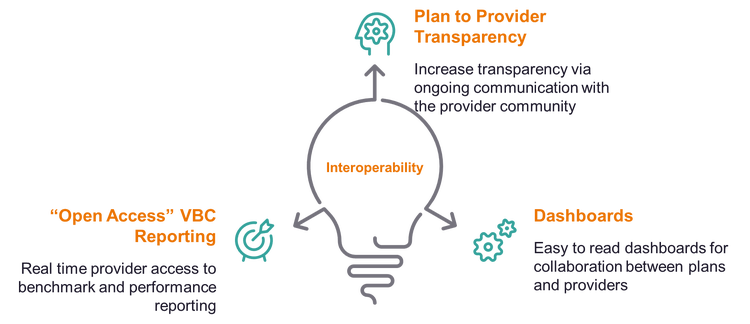
- Give providers open access to VBC performance data
- Create dashboards to track provider performance
- Build transparency between the plan’s model and the provider’s capabilities via ongoing communication through the care continuum
As the CMS interoperability compliance measures are achieved, health plans and providers will need to invest in strategic areas of opportunity to differentiate themselves in the market and develop competitive advantages. Value-based care is a key area poised for disruption, made possible via interoperability and new methods of data exchange.
zs:topic/value-&-access,zs:
