5 actions CIOs should take today to transform patient technology for scalable impact
The patient engagement ecosystem is at a rare inflection point. As digital expectations surge and AI matures, CIOs must make foundational decisions now that transcend platform selection, making an impact on their business for years to come. This is the moment to reimagine patient services not as a support function, but as a strategic growth lever.
In an era where personalized, timely and seamless experiences define brand trust and treatment adherence, effective patient engagement can unlock measurable business value: Stronger outcomes, higher satisfaction, reduced attrition and improved operational efficiency. For CIOs, leading this transformation means moving beyond system integration to architecting experiences—designing data-driven, scalable solutions that put the patient at the center.
ZS’s approach to next-generation patient services
ZS’s vision for next-generation patient services is anchored in a modular, AI-native architecture. Our vision infuses intelligent workflows, human-centered design and interoperable data to deliver proactive, personalized support at scale. But technology is only part of the equation. Success requires strategic clarity, disciplined execution and a relentless focus on outcomes that matter to patients and to the business.
5 actions CIOs should take today
To achieve this vision, we outline five actions CIOs can take today. These actions will empower them to modernize patient engagement, unlock enterprise value and achieve a broader vision of patient-first transformation across the life sciences value chain.
Action 1: Baseline your engagement landscape for patient services
The goal: Understand where you stand today and identify high-friction moments in your patient services processes.
Start with a current-state assessment of digital and human channels, apps, contact centers, field personnel and healthcare-professional-driven interactions. Map patient archetypes and their journeys to reveal experience gaps, redundant touch points and missed opportunities for support.
FIGURE 1: Key touch points in the patient journey: Enhancing support and engagement at every step
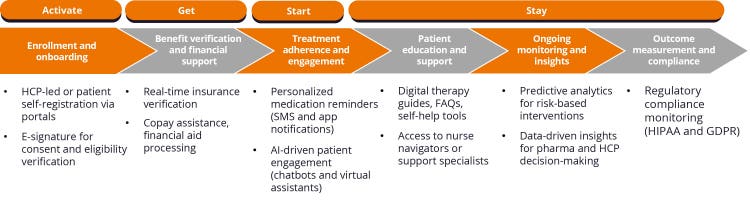
The impact: You’ll be armed with full, detailed clarity on the engagement landscape you’re empowering today. It will also surface opportunities to remove friction and elevate patient engagement through focused innovation and future investments.
Action 2: Orchestrate a balance of digital and human support for your patient services
The goal: Create intelligent, coordinated experiences across every interaction for the patient through a balance of digital and human support.
Break down silos between digital agents, service apps and field teams. Design orchestrated systems where each role works from the same data and goals, adjusting in real time to patient preferences and behaviors. Enable adaptive workflows and contextual triggers to deliver seamless, personalized engagement.
FIGURE 2: Select examples of balancing human and digital engagement in patient services
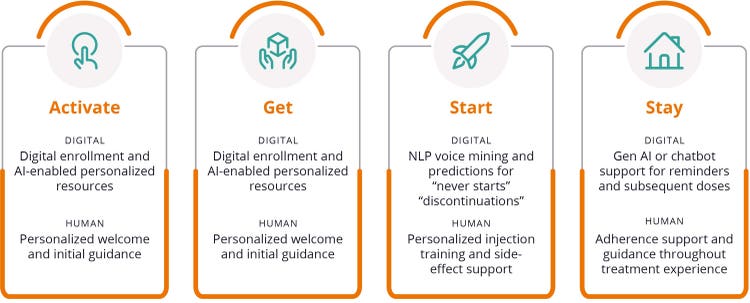
The impact: Patient engagement experiences feel seamless across human and digital interactions, elevating the patient experience while optimizing your team’s focus on the highest patient needs.
Action 3: Modernize core technology systems intelligently
The goal: Build a composable, AI-ready technology backbone.
Invest in API-first, interoperable platforms that integrate with patient and HCP CRMs, EHRs and third-party tools. Embed AI into patient workflows, not just analytics dashboards. Enable digital agents with persistent memory and continuity to collaborate with human agents across the patient journey.
FIGURE 3: Core capabilities in a modern patient support services system to drive AI-powered patient support, efficient workflows and compliance across functions
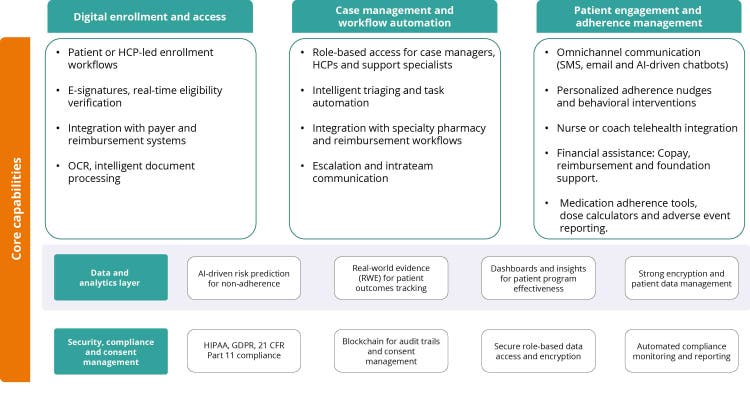
The impact: Your technology ecosystem scales within compliance to allow organizations to gain intelligence and take action based on patient insights.
Action 4: Define success metrics for your patient technology up front
The goal: Anchor each initiative in measurable, strategic outcomes for patients and the business.
Establish success metrics early to ensure every patient engagement initiative is guided by meaningful impact—not just implementation milestones. Prioritize KPIs, such as therapy initiation, adherence, NPS, digital activation and cost reduction. These indicators reflect both patient behavior and operational efficiency. Track experience and behavioral changes over time, not just system usage or go-live events. Build structured checkpoints into delivery cycles to evaluate value realization and make agile adjustments based on real-world data.
Here are a few critical metrics to consider adopting:
- Therapy initiation and adherence: Indicators of clinical engagement and program effectiveness
- Net Promoter Score (NPS) and patient satisfaction: Measures of experience, trust and loyalty
- Digital activation and usage: Insight into the reach, adoption and usability of digital tools
- Cost-to-serve and operational efficiency: Key for demonstrating ROI and justifying future investment
These metrics should track not only static outputs but also dynamic behavior changes, such as improved onboarding, reduced drop-off or faster resolution times. It’s also important to measure these results at key patient journey moments to understand where support is resonating and where friction remains.
The impact: Defining success upfront creates a clear performance baseline and aligns stakeholders around outcomes that matter. It prepares CIOs to demonstrate tangible ROI, scale what works and continuously evolve patient services based on live insights—turning engagement into a long-term strategic asset.
Action 5: Start small, scale fast
The goal: Deliver quick wins with a clear path to enterprise adoption of patient services innovations.
CIOs driving innovation in patient services should focus on high-impact, manageable use cases—like automating benefit verification or optimizing prior authorization—that deliver immediate value. These quick wins demonstrate how patient tech can improve workflows and patient engagement without large upfront investments.
Using agile pods, teams can rapidly pilot, learn and iterate on these solutions. Building on a modular, AI-native architecture allows these capabilities to scale seamlessly across brands and geographies, avoiding costly replatforming.
The impact: Rapid momentum in engaging patients with new capabilities that can be launched, measured and scaled quickly, turning patient services into a scalable, strategic asset.
Call to action: Your moment as a CIO to lead patient services transformations
The transformation of patient services is no longer optional. It’s a strategic mandate.
As healthcare shifts toward more personalized, tech-enabled experiences, patient services must evolve into integrated, data-driven platforms. This isn’t just about system upgrades—it’s about redefining how support is delivered, coordinated and measured.
CIOs are uniquely positioned to drive this change. The opportunity is clear: Lead the shift now to meet rising patient expectations and unlock long-term enterprise value.
To achieve this, CIOs must:
- Define the blueprint: Align investments to patient outcomes and business value
- Unify execution: Break silos across IT, ops, compliance and patient services
- Fund for impact: Secure enterprise-level budgets tied to KPI delivery
- Infuse agility: Pilot fast, learn faster and scale what works
The path to next-generation patient engagement begins with a strategic, connected vision that redefines the CRM as an intelligent operating system, not just a record-keeping tool. CIOs have a pivotal role to play in this transformation. Those who act now will not only meet evolving patient needs but also create lasting enterprise value.
Related insights
zs:topic/customer-experience,zs:topic/data-digital-and-technology