Agentic AI for healthcare payers: A new model for decision making
Better insights haven’t improved outcomes—healthcare payers need AI-native workflows
Himanshu M. Arora coauthored this article.
Health plans have adopted and evolved using AI over the past few years. Payer analytics, predictive models and workflow tools have advanced. Claims insights are richer. Utilization analytics are more advanced. Dashboards refresh faster.
Yet core performance metrics such as medical cost, access to care and member experience remain constrained by how decisions are made.
Here, we’ll share why advances in analytics have not translated into better outcomes for health payers and outline how redesigning decision execution, with AI-native workflows, can drive meaningful performance improvement.
Framing the problem: Payer decisions slow down as they become more complex
Payers make a wide range of operational decisions every day, spanning simple, rule-based determinations to more complex, judgment-driven actions. Many decisions are deterministic and binary, such as eligibility checks and approve or deny outcomes, where established policies clearly dictate the result.
Others require selecting the most appropriate option from multiple valid alternatives, such as choosing the right care pathway or site of care based on clinical guidelines, cost and quality considerations. In more complex situations, payers must exercise judgment to interpret or override standard rules, particularly when individual member circumstances warrant exceptions, appeals or special consideration.
Together, these decision types reflect varying levels of complexity, discretion and reliance on automation versus human oversight. Information flows faster. Decisions do not.
Consider care management. Early risk signals appear quickly in the data, but action often waits. Risk lists refresh weekly, cases queue for review and outreach decisions lag emerging need. By the time intervention begins, deterioration has already occurred—not because the risk wasn’t visible, but because the decision to act was bound to episodic review cycles.
How AI scales inefficiency rather than solving it and pushes decision execution beyond its limits
Most payer AI programs are organized around tools: models, dashboards and point automations. These investments generate insight, but they rarely change how decisions are executed at scale. They simply layer AI onto static clinical criteria, outdated escalation paths and governance models designed for slower, committee-based operations.
The result is manual bottlenecks and structural friction:
- Analysts still assemble insights manually from disparate sources and legacy systems
- Nurses review fragmented clinical cases without context, leading to variability, rework and delayed intervention
- Operations teams spend significant time routing exceptions through manual queues, handoffs and committees
Transformation requires a different starting point.
Without redesigning the decision layer itself, AI scales inefficiency rather than resolving it.
The problem is not a lack of intelligence, but a lack of focus on payer value streams, which are the end-to-end flows of decisions and actions through which health plans actually deliver cost control, access and experience.
Instead of isolated deployments or incremental productivity gains, leaders must focus on the recurring decisions that drive performance across value streams. This is the shift from AI-enabled analysis to AI-native decision systems.
Change how decisions work, and outcomes begin to move.
How agentic AI enables a new model for decision-making
Agentic AI is not just a conversational layer added to existing processes, nor is efficiency pursued for its own sake. Agentic systems are designed to advance outcomes, coordinating multiple steps, invoking tools, triggering actions and adapting based on results.
For health plans, this supports three operational shifts:
- From analysis to decisions: Beyond producing better reports, agentic systems formalize how decisions are made—clarifying trade‑offs, thresholds, escalation rules and decision authority—so action no longer depends on manual interpretation.
- From decisions to execution: Once a decision is reached, governed workflows execute it automatically where confidence is high, escalating only when risk, ambiguity or regulation requires human judgment.
- From retrospective review to continuous improvement: Instead of waiting for quarterly retrospectives, outcomes and overrides are captured in real time and fed back into decision logic so future decisions improve systematically.
In regulated environments such as health insurance, agentic AI enables controlled, auditable decision-making at execution speed, with human involvement where judgment and oversight are essential.
Start with the outcome. Design backward from the decision.
Effective decision redesign starts with a clear outcome and works backward from there. For health plans, the outcome is typically defined in performance terms:
- Improving medical margin without compromising access
- Reducing avoidable acute utilization and improving outcomes for high‑risk members
- Shortening authorization turnaround times and reducing administrative friction
- Reducing member service costs while improving net promoter scores and trust
- Reducing variation in clinical and operational decision‑making
The objective is not comprehensive optimization. It is to identify the small set of recurring decisions that materially shape outcomes and redesign them as systems.
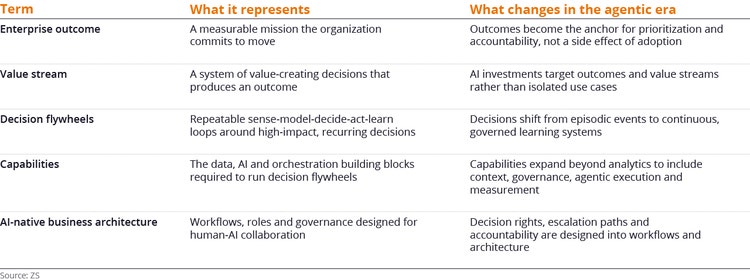
FIGURE 1: A practical vocabulary for AI-native payer transformation
Replacing episodic decisions with decision systems that sense, model, decide, act and learn
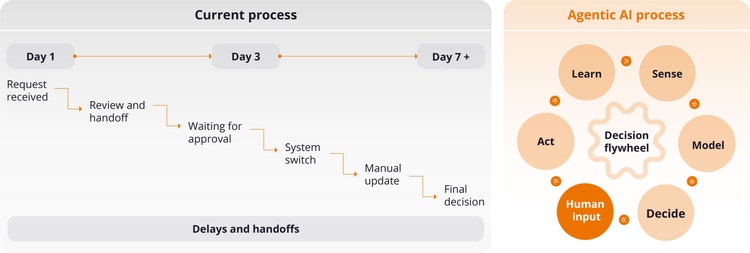
Today, many critical payer decisions are managed as scheduled events. Teams review trends, debate implications and assign follow‑up work. Execution lags. Feedback arrives late. Improvement depends on individual experience.
Decision systems, which use a flywheel effect, can be created for the recurring decisions that drive performance outcomes.
In these systems, signals are monitored continuously. Options are evaluated dynamically. Actions are initiated across teams, under predefined constraints. Results are measured and reintegrated so the next decision reflects what actually worked.
FIGURE 2: The same decision, 2 architectures
Designing these systems for the outcomes you’re driving requires intentional choices:
- Which signals must be monitored continuously?
- Which trade‑offs should be explicitly modeled?
- Where can agents act independently, and where must humans intervene?
- What regulatory, clinical and contractual boundaries apply?
- Who owns outcomes when confidence is low?
This is where technology stops supporting the process and starts shaping performance.
What this looks like in practice: An AI-native decision system for care management (early identification of high-risk members)
Care management highlights how agentic systems move health plans upstream from reacting to risk to identifying it earlier. Most care management programs rely on periodic risk stratification and static member lists that surface risk after it has already materialized. Agentic systems enable continuous, early identification of emerging risk across the member population.
Here’s an illustration of how this system functions on a sense-model-decide-act and learn loop:
- Sense: Monitors claims, pharmacy activity, utilization patterns, care gaps and recent events such as hospital discharges, missed refills or repeated emergency visits as they occur.
- Model: Builds a dynamic view of early risk by learning which combinations and sequences of signals tend to precede deterioration or avoidable utilization, rather than relying on static risk scores alone.
- Decide: Identifies which members are becoming high risk now and determines whether early intervention is likely to change outcomes given clinical context and care team capacity.
- Act: Flags high‑risk members early and initiates targeted actions such as outreach, care coordination, benefit navigation or escalation to clinical teams before avoidable events occur.
- Learn: Uses intervention outcomes such as engagement success, avoided admissions or missed connections to continuously refine how early risk is detected and which actions are most effective.
The capabilities that make agentic decision systems work
Decision systems require more than analytics. The following capabilities and enterprise enablers are what health plans need to make agentic AI intelligent, scalable and operationally real:
This capability codifies how decision loops are designed, executed and improved across the health plan, including:
- Decision intelligence. Formalize decisions, signals, logic and escalation. This determines what inputs matter, how competing objectives like cost and access are balanced and under what conditions decisions can be automated versus requiring human judgment.
- Model-first trade-off simulation. Pressure-test options before committing resources by modeling trade-offs, constraints and downstream impacts on capacity, access, cost, quality, etc.
- Decision-to-execution agent orchestration. Governed workflows that translate intent into action—coordinating tasks, triggering downstream workflows, generating communications and enforcing service-level expectations across vendors, platforms and internal teams with minimal manual handoffs.
- Outcome capture and learning loops. Feed outcomes back into models by capturing results, overrides, exceptions and downstream impacts so decisions improve systematically over time instead of being reset episodically.
This capability allows for scale, compliance, firm context and trust by design, including:
- Enterprise context and knowledge layer. Integrate structured data, unstructured signals and institutional clinical, claims, provider and policy knowledge into the system so each decision is made in context.
- Trust, compliance and decision rights. Codify guardrails, traceability, auditability and accountability so decisions are defensible at the individual-case level and aligned with regulatory, contractual and clinical constraints.
- Decision performance and value measurement. Use leading indicators plus outcome impact to see whether decisions are working and identify where logic, escalation and workflows should be improved.
- Reusable data and AI components and standards. Shared foundations create speed to value. Build reusable components, data products and patterns that can be applied across lines of business without reengineering.
This capability aligns structure, incentives and execution for human-AI collaboration, including:
- Human-AI workforce design. Define judgment, oversight boundaries and roles so clinicians, nurses and operators can review, challenge and override decisions and serve as accountable owners of the learning system, not passive recipients of recommendations.
- Change and incentive architecture. Align metrics, training, standard operating procedures and adoption mechanisms to ensure decision quality, appropriate override behavior and sustained use in day-to-day workflows.
- Forward-deployed innovation and scale teams. Enable rapid experimentation with real workflows, then harden and scale what works across the enterprise with clear governance and reusable components.
- Operating cadence. Embed decision flywheels into daily work—review exceptions, overrides and performance regularly signals so improvement is continuous rather than quarterly or episodic.
Designing agentic systems for real-time accountability
Unlike other industries, health plan decisions are continuously subject to external scrutiny from CMS, state regulators and accreditation bodies. This creates a unique design requirement: decision systems must be auditable at the level of each decision, in real time.
Effective agentic systems are designed with:
- Clearly bounded authority for automated action
- Transparent reasoning and auditability for consequential decisions
- Explicit human accountability where uncertainty or risk remains
Governance is not a constraint on speed; it is what makes speed sustainable.
Where should leaders start—without disrupting operations?
Health plans do not need to transform everything at once. Progress comes from focused, high-impact redesign. Health plans can start with a few steps:
- Leadership transformation lane: Define and own enterprise outcomes by prioritizing value streams (e.g., medical management, care management, risk adjustment), identifying the critical decisions within them and committing to measurable improvements in cost, quality and performance.
- Innovation lane: Design, test and validate AI-native decision systems within real workflows, ensuring they operate effectively within regulatory, compliance and contractual constraints.
- Embed and scale lane: Operationalize what works by integrating solutions into day-to-day workflows, aligning roles and incentives, and establishing governance to sustain and scale new ways of working.
Each lane moves at a different speed. Together, they create coordinated momentum.
Practical questions to assess your health plan’s AI transformation roadmap
To assess whether your organization is redesigning decisions, or merely adding tools, ask:
- Which high-impact decisions across core health plan functions—utilization management, care management, provider network strategy and risk adjustment—have the greatest potential to improve your medical loss ratio and total cost of care?
- Do you have a clearly defined health plan transformation strategy that aligns clinical, operations and administrative teams while enabling consistent execution across lines of business (e.g., Medicare Advantage, Medicaid, commercial)?
- Are your data and technology teams equipped to move beyond traditional claims processing and data warehousing toward enabling AI-driven decision-making—applying longitudinal member data, clinical context and real-time orchestration?
- Where are the biggest gaps between your AI ambition and current capabilities, and how can strategic partners help accelerate adoption while ensuring compliance with Centers for Medicare & Medicaid Services regulations, National Committee for Quality Assurance standards and audit requirements?
If you cannot clearly answer these questions, you’re likely relying on disconnected tools instead of a unified, AI-powered decision framework.
Payers that can answer them effectively are typically advancing toward integrated decision systems that drive measurable improvements in cost, quality and member outcomes.
If you’d like to learn more about how ZS creates decision systems for an intelligent enterprise, please get in touch.