Agentic AI in life sciences: Designing decision systems for an intelligent enterprise
Redesign the right decisions
AI will transform life sciences only when it changes how companies operate day to day.
For years, we have layered intelligence onto data, models and workflows. Yet the decisions that shape risk, speed and value still move through committees and slide decks. Insights may be faster. The operating rhythm is not.
Agentic AI creates the opportunity to change that rhythm.
Not just for what the technology is, but because it enables decision systems that sense change, evaluate trade-offs before resources are committed, trigger governed action and learn from results over time. In regulated environments, using agents is not about autonomous systems. It is about reliable decision-to-execution with traceability and explicit human accountability.
Agentic AI for enterprise transformation
Decision systems are a structurally different way to approach enterprise transformation. Instead of organizing around AI use cases or productivity gains, leaders must redesign the small number of recurring, high-impact decisions that determine performance inside each value stream.
When those decisions operate as continuous sense-model-decide-act-learn loops, execution connects directly to insight and performance begins to compound.
Redesign the right decisions, and outcomes move.
What ‘agentic’ changes (and what it doesn’t)
Agentic AI is not a better chatbot. It is not automation for its own sake.
Agentic systems are designed to pursue outcomes. They can plan across steps, call tools, take action and adapt based on results.
In practice, agentic systems enable three shifts for business operations:
- From insights to decisions: It’s not just about better reporting and recommendations; it’s a shift toward decision systems with explicit trade-offs, escalation paths and decision rights built in.
- From decisions to execution: Here, decision systems connect directly to governed workflows, initiating actions quickly and consistently. When activity falls outside established guardrails, the system automatically escalates it to the appropriate human owner.
- From episodic learning to continuous, compounding learning: Outcomes aren’t reviewed months later in a slide deck. They’re captured, fed back into models and used to improve the next decision. Over time, decision quality improves on itself.
- Which 5-10 recurring decisions actually determine performance in a priority value stream?
- Where do those decisions break today—signals, trade-offs, governance or execution pathways?
- What would change if sensing were continuous, decisioning were model-first and execution were connected by design?
Redesign work around the decisions that drive outcomes
When we design for enterprise outcomes, we start with the result you need to move and trace the chain of decisions that determines it. Those decisions live inside each value stream.
A value stream is the end-to-end sequence of value-creating decisions that produces a measurable business outcome, supported by the workflows that carry them out.
Outcomes are defined in performance terms, for example, accelerating time to launch, improving year-one patient uptake, increasing market share without proportional cost growth, improving demand predictability or increasing submission throughput.
The point is not to perfect every decision in the value stream. It’s to identify the few decisions that recur frequently, materially shape outcomes and can be redesigned as decision flywheels.
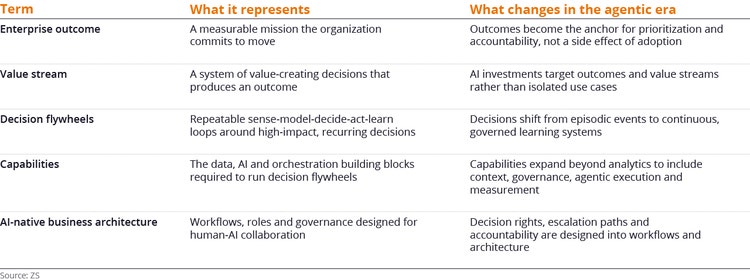
Figure 1 offers a practical way to see how this comes together with agentic AI—linking value streams, how the decisions that drive them can be designed as systems and what’s needed to make those decisions work differently.
FIGURE 1: A practical vocabulary for AI-native enterprise transformation
How one-off decisions become learning systems: Decision flywheels
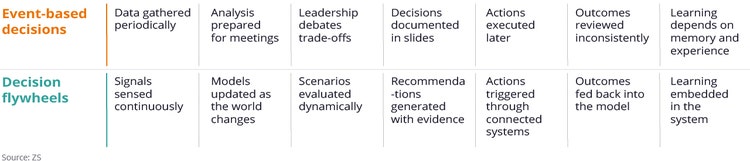
In many organizations, major decisions are treated as one-off events. Teams gather data at set intervals, prepare analyses for meetings and present their findings on slides. Leaders debate trade-offs and align on a path forward. The real work, however, often comes later—sometimes months later. Outcomes are reviewed inconsistently and learning depends on memory and experience.
A decision flywheel turns these events into a system (see Figure 2). Signals are sensed continuously. Models update as conditions change. Scenarios are evaluated dynamically. Recommendations are generated with evidence. Actions are triggered through connected systems under guardrails. Outcomes are measured and fed back into the model so decision quality improves over time.
FIGURE 2: Event-based decisions vs. decision flywheels
Architecting a flywheel requires explicit design choices:
- What must be sensed continuously?
- What trade-offs must be modeled?
- What can be agent-orchestrated—and what requires human judgment?
- What governance guardrails apply?
- What humans own, what agents execute and when must the system escalate?
This is where technology shifts from enabling transactions to shaping how decisions are made, executed and improved.
How to run agentic systems at scale with a capability stack
Decision flywheels do not run on dashboards alone. They require an integrated foundation that connects decision logic, enterprise context and execution.
The capability stack breaks into three integrated layers—each essential to making decision systems intelligent, scalable and operationally real.
This capability codifies how decision loops are designed, executed and improved, including:
- Decision intelligence. Formalize decisions, signals, logic and escalation.
- Model-first trade-off simulation. Pressure-test options before committing resources.
- Decision-to-execution agent orchestration. Governed workflows that translate intent into action.
- Outcome capture and learning loops. Feed outcomes back into models.
This capability allows for scale, compliance, firm context and trust by design, including:
- Enterprise context and knowledge layer. Integrate structured data, unstructured signals and institutional knowledge.
- Trust, compliance and decision rights. Codify guardrails, traceability, auditability and accountability.
- Decision performance and value measurement. Leading indicators and outcome impact to refine performance.
- Reusable data and AI components and standards. Shared foundations for speed to value.
This capability aligns structure, incentives and execution for human-AI collaboration, including:
- Human-AI workforce design. Define judgment, oversight boundaries and roles.
- Change and incentive architecture. Align metrics, training, standard operating procedures and adoption needed to ensure decision quality.
- Forward-deployed innovation and scale teams. Enable rapid experimentation, hardening and scaling of proven systems.
- Operating cadence. Embed flywheels into daily work and continuous improvement.
Be clear on roles: The AI-native business architecture
Scaling decision flywheels requires an AI-native business architecture, one built around what both people and AI do.
Workflows are redesigned to take advantage of automation and real-time modeling. The workforce expands to include both AI agents and people whose expertise, judgment and contextual understanding guide and govern the system.
And human-AI collaboration is intentionally designed at the right level for the decision: sometimes humans are in the loop, sometimes on the loop, sometimes above it, and in other cases, the human is the loop itself.
Decision systems: Early evidence of the payoff
When organizations redesign value streams around agent-enabled decisions, measurable impact follows. Results vary by starting point and scope, but the pattern is consistent: When the right decisions move, outcomes move.
The examples below reflect outcomes observed in select engagements; ranges vary by starting point, scope and degree of workflow integration.
Outcome to move: Accelerate brand adoption by making faster decisions that remove barriers.
Decision focus: A recurring decision loop—which healthcare provider (HCP) barriers matter most now? And how should targeting, content and resource deployment adapt?
What changed: ZS designed and deployed an agentic decision system that continuously surfaced real-time, n=1 HCP barriers and linked those signals directly to forecasting models and governed execution pathways. Targeting and resource decisions moved seamlessly from insight to action, reducing cycle time in select cases.
Observed impact: Organizations saw decision cycle time reductions of up to 50% and a reported 5%-10% lift in brand/portfolio performance in select contexts.
Outcome to move: Deliver trusted, decision-ready data at a lower operating cost.
Decision focus: A recurring decision loop—what data issues threaten decision reliability today? What actions should be taken immediately versus escalated?
What changed: ZS rearchitected the data-to-decision flow, streamlined pipelines and used “AI for data,” deploying agents to continuously detect and remediate data issues with defined escalation paths.
Observed impact: Reported outcomes included enterprise data operations cost reductions of up to 40%, alongside improvements in data quality and insight accuracy.
Outcome to move: Increase the speed and reliability of complex document creation and maintenance.
Decision focus: A recurring decision loop—what must be drafted, reviewed and corrected next to maintain submission readiness under compliance constraints?
What changed: ZS designed the documentation workflow, embedding agentic drafting, review and quality control directly into the process. Governance guardrails and structured quality checks were built in from the start, ensuring traceability and compliance while moving work forward.
Observed impact: Reported outcomes included up to 50% efficiency gains in creating and maintaining complex documents. In select implementations, teams reduced cycle times by weeks.
How to move fast with agentic systems without breaking operations
Enterprise transformation must happen fast enough to matter, without destabilizing the business you still need to run. We advocate a three-lane transformation model that balances ambition with pragmatism, value with scalability and innovation with adoption.
Each lane has its own purpose, speed, metrics and governance
Senior leaders in the transformation lane set and own outcomes. Leaders decide which value streams matter most, which decisions within them truly drive performance and what enterprise outcomes they are willing to commit to. They define the vision for the future-state business architecture and hold the organization accountable for delivering results.
The innovation lane is where AI-native decision systems are designed and proven inside real workflows. Teams ask: What needs to be sensed continuously? What must be modeled? How do we make this work under real constraints and for what people need? The goal isn’t experimentation for its own sake. It’s measurable impact in production-like environments—solutions that are hardened and ready to scale.
The embed and scale lane is where what works becomes how the business runs. This lane integrates decision systems into daily operations, defines changes in incentives and roles and focuses on sustaining the trust needed for adoption. The question here is simple: How do we make this business as usual?
Each lane moves at a different speed. Together, they create coordinated momentum.
Practical questions for what to do next
Nearly every life sciences company is investing in AI and modernizing parts of the enterprise.
Progress accelerates when leaders step back and reconsider the unit of transformation: Which recurring decisions determine performance in a value stream, and how should those decisions work if AI were native to them?
A 60-second diagnostic: Are you redesigning decisions—or just deploying AI?
- Have you identified the few decisions in a priority value stream that, if improved, would materially change performance?
- Do you have a clear transformation model? One that defines the mission, aligns functions and drives consistent execution across the enterprise?
- Have you empowered your data and technology organizations with an expanded mandate? Not just to manage platforms, but to enable AI-native decision systems through contextualized data, orchestration, measurement and governance?
- Where does your ambition outpace your current capabilities and where should ecosystem partners help you accelerate safely and credibly?
If these questions are hard to answer, the work may still be centered on use cases or workflows. If you’re answering yes, you’re likely on your way to building decision systems.
To learn more about the recurring decisions that drive performance in core value streams, please get in touch.
Related insights
zs:topic/strategy-and-transformation,zs:topic/data-digital-and-technology,zs:topic/ai-and-analytics,zs:topic/research-and-development