From AI-assisted authoring to agentic clinical content systems
Faster clinical authoring is just the beginning
AI-assisted authoring for clinical submissions is already delivering measurable impact.
In our own work, we’re proving that each approved document strengthens the system, with the potential to drive 30%-60% faster authoring cycles and cut review timelines for complex documents, from eight to 14 weeks to roughly two to six weeks.
Others such as Merck have reported similar results, with teams cutting first-draft effort from an average 180 hours to 80 hours and reducing drafting errors by half.
While the ultimate goal is to stand up AI authoring solutions at scale, spanning the entire portfolio and all document types, most organizations aren’t there yet.
Here, we’ll share what’s working in creating AI-assisted authoring systems, what’s breaking and what it takes to move toward a more content-centric model, with AI at the center.
If you’re stuck moving beyond pilots, this is what it takes to scale AI-assisted authoring and make it deliver.
What’s changing with AI in clinical document authoring—and why it matters to sponsors
Clinical content is inherently interconnected. Downstream documents rely on upstream data, decisions and design. A single protocol amendment can cascade across informed consent forms, case report forms, statistical analysis plans and regulatory submissions.
Yet most organizations still operate with a document-centric model. Teams create, review and maintain content within individual documents instead of using a data-centric model, where information is managed and can be reused across different outputs. The result is duplicated effort, slower updates and an increased risk of inconsistency.
Creating a new model for clinical document authoring matters to sponsors on several fronts:
Leveraging prior work is messy. Medical, technical and regulatory writers already author content both within and across studies. However, this reuse is largely manual and unstructured. Only a limited amount of key language is codified in templates, and authors may opt for a similar prior document over the latest template. This process is messy and difficult to systematically trace. To address these issues and scale with AI, content needs to be organized and structured in a way that supports both continuity within a study and cross-study reuse, moving beyond today’s copy-paste workflows.
Changes are pervasive and slow. For example, approximately 76% of protocols require amendments, each triggering downstream updates across the document ecosystem. Amendments can take ~260 days to fully implement, with sites operating on different protocol versions for months.
Review dominates effort. Clinical study report timelines average eight weeks, but they can extend up to 33 weeks, with as much as 73% of time spent on review cycles rather than initial drafting. AI can begin to streamline parts of this process by helping flag inconsistencies, track changes across documents and surface targeted sections for review, reducing some manual effort and supporting faster alignment.
Regulators are shifting toward a data-centric model, placing greater emphasis on well-governed data, traceable knowledge and consistent lineage. This shift is accelerating with initiatives like the FDA’s pilot for real-time clinical trial data submissions, signaling a move toward continuous, data-driven oversight. As regulators advance toward more data-first submissions, sponsors will need systems that can natively generate both document and structured data outputs that are fully aligned.
The core concepts of an agentic clinical content system
At its core, an agentic clinical content system is built around a clear end goal: documents become a byproduct of structured clinical knowledge.
Instead of creating and updating content across multiple files, clinical teams maintain a single, connected source of truth that updates once and stays consistent everywhere.
It’s based on an integrated framework with three basic concepts working together.
Agentic workflows that improve over time: Best-in-class solutions use coordinated agents to perform specialized tasks, including drafting, reviewing, validating and refining content. These agents collaborate with human authors and continuously improve through feedback loops, creating a governed system where quality increases alongside speed.
Domain-specific knowledge and reusable templates: This layer provides the definition and structure needed to generate content. It embeds regulatory ontologies, sponsors’ own internal templates and reusable content libraries into the system to ensure that outputs are consistent, compliant and aligned with scientific and regulatory expectations.
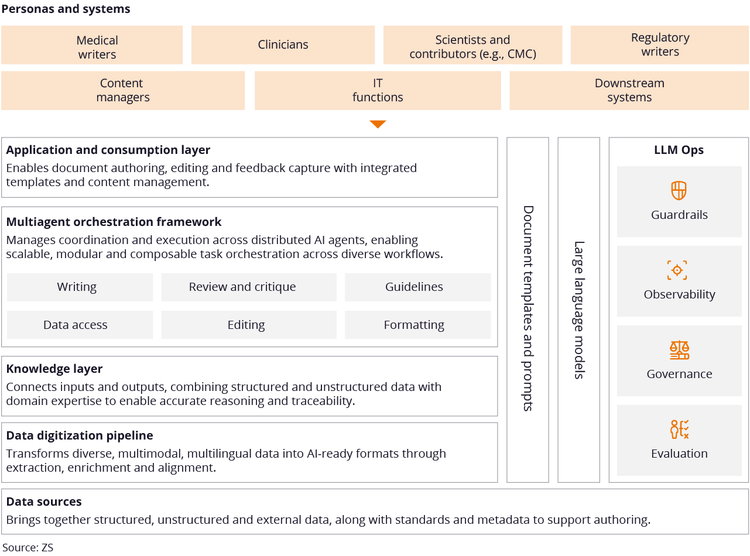
A scalable enterprise architecture, anchored by a knowledge layer: The most critical and often overlooked capability is the underlying architecture that connects data, content and AI under governed interoperability. This is the system’s connective tissue.
The knowledge layer here is so important because it’s simultaneously feeding agents rich, contextual information to maximize factual accuracy, consistency and scientific integrity while keeping a concrete record for traceability and auditability.
This layer enables several things simultaneously:
- Traceability: Every output can be linked back to its source data and generation process
- Consistency: Content updates propagate across documents rather than being manually reconciled
- Reuse: Content becomes a persistent asset for reuse rather than a one-time deliverable
In more advanced implementations, this system can extend into the clinical data pipeline itself to ensure alignment between data and narrative from the outset.
Importantly, the value of the knowledge layer extends beyond document authoring: the same governed clinical knowledge assets can support adjacent value streams across R&D and into medical and commercial functions, creating a stronger foundation for reuse across the enterprise.
Proof from our practice: An example of AI in clinical document authoring
We’ve been working with one of our global pharmaceutical clients to develop their clinical authoring system. Here, biostatistics teams were generating datasets, while authors were developing documents. They were working in parallel but not fully connected.
Our role has been to connect data generation and content authoring from the start, coupling automated pipelines with an AI-enabled authoring platform.
By linking shared components across the platform, knowledge layer and agentic AI, we can support an end-to-end flow from structured data (SDTM), analysis-ready data (ADaM) and analysis-ready datasets through to the outputs (TLGs) and into the final narrative of the clinical study report. The end-to-end system will both increase consistency and reduce authoring timelines.
How it all comes together: The clinical authoring system
To make this model work, the underlying system must connect data, content and AI in a coordinated way. The following diagram shows how this comes together—from the end-to-end information architecture that enables intelligent authoring across the clinical life cycle to the knowledge layer that standardizes rules, templates and domain context.
FIGURE: Framing up a clinical authoring system
Real-world lessons we’ve learned using AI for clinical authoring
After more than two years of learning how this all comes together for clinical authoring, a few clear lessons have emerged:
Start with the right documents. The right prioritization drives ROI. Not all documents deliver equal value for automation. ZS uses a structured, data-driven framework that considers time savings, complexity, frequency and downstream dependencies to focus on high-impact opportunities first (see more here). This enables faster early wins and supports an agile, iterative path to stand up AI authoring solutions at scale, spanning the entire portfolio and all document types.
Point solutions can create fragmentation. Ecosystem thinking is required for scale. Many existing tools focus on automating individual documents. While useful, this approach creates fragmentation and limits broader impact. To scale effectively, sponsors need solutions that connect across document types and support the full clinical content ecosystem, not just isolated use cases.
Governance should be considered in the design. For your MVP, look at aligning your solution to enterprise AI requirements. This includes guardrails, observability and governance. AI governance is growing, and full implementation is likely needed for scaling or validation. Putting these in place early helps create a secure, scalable environment for automation.
Delaying integrations can lead to breaking the user experience; don’t defer this step. Asking users to manually input data for each document may work during proof of concept, but it quickly becomes frustrating at MVP and beyond. Build integrations from the start to avoid rework and poor user experience.
Ridgid knowledge models age quickly. Flexible foundations can keep a better pace with AI. Avoid overstructuring your knowledge layer. It’s costly and quickly becomes outdated as AI capabilities evolve. Instead, build a flexible foundation that can adapt as requirements and technologies change.
Workflow transformation starts when the system can carry it. As AI reduces manual drafting and coordination work, the opportunity is not simply to do more of the same tasks faster. The real value comes from redirecting that capacity toward supporting a larger pipeline, faster and more confident decisions, and evolving roles across clinical teams. Without clear direction, productivity gains may not translate into meaningful changes toward faster submissions.
Alignment becomes the real work. Successful adoption requires early alignment across clinical, regulatory, safety, biometrics and quality teams, along with the coordination, process changes and governance needed to support AI at scale. SOPs, governance and training can keep pace with advancing technology with the right level of support.
How to start (or restart) your efforts: diagnostic questions for leaders
Leading organizations are moving forward with targeted use cases for AI-native clinical document authoring while deliberately building architectures that preserve flexibility.
The starting point is not technology selection, but clarity on what’s needed to make the model work. Senior leaders should ask:
Are we prioritizing for the highest value? Are we focusing on document-heavy areas with clear impact, or selecting use cases without fully considering value and time to impact?
Are we thinking end to end? Are the solutions designed to span the full content life cycle, enabling traceability and reuse, or are they optimizing isolated steps?
Is the architecture built for flexibility? Have we designed a modular, interoperable system that can evolve with changing AI capabilities, data standards and regulatory expectations?
Is the knowledge layer truly connected? Are we bringing together structured and unstructured data, integrating domain assets and enabling AI to generate high-quality, context-aware content?
Are we engaging for trust? Are subject matter experts involved early to shape the solution, build trust and ensure a smoother transition to AI-enabled authoring?
To learn more about how ZS is developing clinical document authoring systems or to have a conversation about how we can help, get in touch with our team.
Related insights
zs:topic/data-digital-and-technology,zs:topic/ai-and-analytics,zs:topic/portfolio-strategy-and-management,zs:topic/research-and-development