Market research transformation: Why simulated panels matter now
Key takeaways
- AI in market research is moving insights from slow, one-off studies to faster, always-on decision support. Simulated panels help teams test structured stimuli, compare options and make decisions with greater speed and confidence.
- Simulated panels are not AI personas. Personas help explore ideas, while validated simulated panels produce quantitative, decision-grade outputs that more closely mirror real market research.
- Market research transformation depends on using each tool for the right job. Synthesis engines recover what’s known. AI personas explore the why. Simulated panels support structured testing. Real research remains essential for depth, novelty and validation.
Market research has always had a clear job: Help commercial and brand teams make better decisions. But the model behind it is under pressure. Studies are costly, timelines are long, key audiences are harder to reach and most teams can only afford to test a small fraction of the options in front of them. As markets move faster, that constraint is becoming harder to accept.
At the same time, the conditions for a different model have matured. AI can now replicate the patterns that shape complex decisions, and most organizations hold years of qualitative and quantitative research that can be reused in more powerful ways. Together, these advances make simulated market research possible. Today, synthetic respondent panels can return decision-grade, quantitative reactions to structured stimuli in hours rather than months.
The opportunity of simulated market research isn’t to entirely replace real research. Instead, simulated panels can add a fast, repeatable and validated layer that expands what insights teams can test, while reserving traditional research for novel questions, deeper human understanding, absolute measurement and final validation.
Synthesis engines, AI personas and simulated panels: What you need to know
Before transforming how you do market research, it helps to separate three solutions that are often grouped together but serve different purposes.
- Synthesis engines help teams explore and access fast, structured and sourced results.
- AI personas help teams brainstorm novel ideas.
- Simulated panels help teams make structured decisions when validated, real-world accuracy is important.
The distinctions matter because each tool has a different architecture, output and level of reliability.
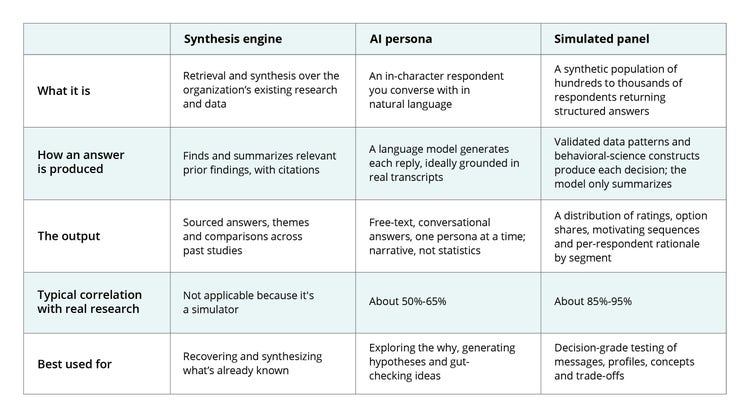
A synthesis engine is an analysis-and-retrieval system, often paired with a chat function, that consumes an organization's existing research and data and returns structured, sourced answers quickly. It ingests reports, transcripts, decks and tracked studies, then indexes them for semantic search. From there, it can answer questions with traceable citations, surface themes and compare findings across studies, time and segments.
A synthesis engine performs like a very fast member of the research team. You should use it when you need to recover and synthesize what the organization already learned. But its limit is intrinsic. It can summarize and connect prior findings, but it cannot produce a credible reaction to a stimulus that was never tested, because it has no model of how a respondent would decide.
An AI persona is an in-character respondent that a researcher converses with in natural language. It can ask open-ended and follow-up questions and probe rationale. The most basic version pastes a short profile into a general-purpose model and relies on the model's fluency.
A more rigorous version, sometimes called an engineered persona, is grounded in real interview transcripts. It extracts structured decision points, rationales and supporting quotes, before scoring their stance and confidence. It also detects contradictions and conditions the model on all this evidence so that answers trace back to source material. In every version, the language model is the engine that produces each answer. The output is free-text and conversational, one persona at a time, rich in narrative but without statistics. It’s an archetype, not a calibrated sample.
Personas are well suited to exploring potential reasons for “the why,” generating hypotheses, screening drafts for obvious problems and rehearsing a conversation. But its architecture requires two notes of caution:
- Because the model generates the answer, a basic persona can produce fluent, confident text that carries little real signal, and it tends to score a superficially impressive claim too highly.
- Because the answer leans on the model’s reasoning, variation across personas is often muted and a given answer can shift between runs.
In benchmark comparisons against real market research, persona-style approaches typically correlate at roughly 50%-65%, and that ceiling is set by the absence of a calibrated method—rather than by the choice of model.
An example in pharma of this difference: When asked to rate a message describing a large percentage improvement on a secondary clinical measure, a general-purpose persona tends to rate it highly because the number is large. But a method grounded in how specialists actually weigh evidence rates it only moderately, because improvement on that particular measure is not the primary treatment goal. The second answer is closer to what real research returns.
A simulated panel is a synthetic population of hundreds to thousands of respondents that returns structured, comparable answers for stimulus testing at scale. It’s built from the bottom up. Individual respondent data, together with a proprietary, cross-market knowledge base of how professionals make decisions, is used to learn the relationship between respondent attributes and choices. The panel is then constructed so that its mix of attributes matches the real target population. Each synthetic respondent carries a specific profile, drawn across many dimensions such as experience, attitudes, professional profile, patient mix and practical constraints. That profile shapes how it decides.
The important architectural point is that validated patterns learned from data produce decisions. These decisions are supported by established behavioral-science constructs that predict choices rather than by the free reasoning of a language model.
The output is a full distribution of ratings, with the share of respondents choosing each option. The most motivating sequences of messages, and a written rationale for each respondent, are available at the level of the panel and of individual segments. In blinded validation studies, well-built panels have correlated with actual market research at roughly 85%-95%, exceeding the correlation produced by human domain experts who know the therapy area but not the specific brand.
A panel is deliberately specific. It’s built for one decision task and one domain, so a panel built to test messages cannot test product profiles. And a panel built in one therapy area doesn’t transfer to another. This is a design choice that protects accuracy, not a limitation.
For the same reason, a single panel member is a narrow construct that answers one kind of question and is meaningful only as part of the panel. It cannot be lifted out to serve as a conversational persona, and a persona cannot be aggregated into a calibrated panel.
FIGURE 1: The differences between synthesis engines, AI personas and simulated panels
The benefits of simulated panels in market research
The value of a simulated panel is concrete, with these five benefits underpinned by an economic model that improves with reuse.
1. Concept and message pretesting at scale. Brand and agency teams routinely generate more messages than a real study can evaluate. A panel can rate a broad set of claims on motivation, clarity and other dimensions. It can then rank them and identify the most motivating sequences for each segment, with a written rationale for every message.
Teams using this approach can test several times the range of messages that a traditional study would allow. In validation, messages refined this way have outperformed agency-refined messages on clarity and motivation, and the most motivating sequences the panel identified matched a follow-up qualitative study at around 85%. Teams can also use simulated panels to test competitor messaging.
2. Early hypothesis generation. Before any real fieldwork, a simulated panel lets a team explore many dimensions quickly and form strong initial hypotheses, which then shape a tighter, more purposeful study. This moves the insights manager from scoping research to a budget toward collaborating with marketing to shape the questions that matter.
3. Reaching constrained segments and testing sensitive stimuli. Where a real sample is constrained, a panel can supplement it to ensure that under-represented perspectives—such as hospital-based or integrated-network practitioners—are represented. It can also help when a team cannot or should not test a stimulus in live research, such as when a brand is the only product in a category and fielding the study could compromise blinding. In both situations, a simulated panel expands what can be tested, improves study design and reduces the risk of acting on an incomplete view.
4. Always-on, directional research. Because the panel is available on demand, it supports rapid what-if testing. For example, it can assess the impact of an uncertain label or a possible new entrant, and then execute a rapid competitive response by quickly testing a counter-message. It gives marketing, omnichannel and pricing teams a way to experiment continuously.
5. Derisking an expensive study. Used ahead of a major study, a panel prioritizes the stimuli and dimensions worth testing so that the real study can be smaller and sharper. A simulated panel can replace one phase of a multiphase design, enabling a lighter real study to be used to validate and refine. This has reduced research costs by roughly 30%-50% and cut timelines by roughly a third to a half. It’s also added the qualitative explanation that a quantitative study alone does not capture. Decisions before and after the study become more evidence-based and less reliant on assumption.
The economic realities of market research reinforce the importance of simulated research panels. A panel is a reusable asset, and while the first build carries a one-time cost, once the panel exists, each additional run on the same panel costs only a small fraction of that initial build—even after taking into account the periodic refreshes needed to keep the panel current.
In pharma, within a therapy area, a panel built for one brand can be extended (with a refresh) to a second brand. Across a portfolio, supplementing real research with panels can produce substantial savings, with the largest gains appearing from the second study onward.
How your organization can build a simulated panel
Building a simulated panel is less about creating a generic AI tool than assembling a validated decision system. The work starts by connecting the right data, extracting decision drivers, constructing a representative synthetic population and testing the panel against real research before it’s put into use.
Connect the data. The first step is to bring together every dataset that captures how the target audience makes decisions and what distinguishes one decision-maker from another. This includes past qualitative transcripts; tracking and attitude-and-usage studies; prior message and profile testing; the competitive and scientific landscape; and a proprietary, cross-market dataset built from many individual respondents. This proprietary layer matters because it carries decision patterns that no single brand study contains. The brand’s own data is what makes the panel specific to its brand and market.
Extract the decision drivers. Predictive algorithms then learn the patterns that link respondent attributes to decisions:
- Who responds to which kind of evidence
- How risk tolerance and guideline adherence shape choices
- How practice setting and patient mix matter
The result is an understanding—expressed across many attributes—of how a respondent’s profile drives the decision in question. This understanding is held in a decision knowledge graph that’s refreshed on a regular cadence to stay current.
Condition and construct the panel. The system then builds a panel of synthetic respondents whose distribution of attributes matches the real target population, ensuring the panel mirrors the market’s variability rather than a single average respondent. This is called conditioning and it consists of two actions leveraging several classical AI algorithms: Matching the synthetic population to the actual target list and aligning each respondent to the specific decision being tested.
Each respondent is assigned a decision pattern with an associated confidence score. This is the step that most clearly separates a panel from a persona, because the reasoning blocks are validated patterns from data rather than the open reasoning of a language model.
Validate against ground truth, then refresh. Before a panel is trusted, its outputs are compared against actual market research on the same stimuli. The benchmark exercises that anchor this work will show validated panels reproducing real research closely, while substantially outperforming both general-purpose model personas and human experts who don’t work on the brand.
Validation should be selective and rigorous, drawing on robust studies with large samples and methods that minimize human error. Because markets evolve, the panel should be retrained on a cadence matched to how quickly the market changes—for many panels, this should happen once to a few times a year.
A practical finding from early work is that a modest amount of recent data—say, 50-60 transcripts—can be sufficient when they’re combined with a strong proprietary decision dataset that already correlates well with real research.
The limits and risks of a simulated panel
For many leaders, the value of simulated panels is increasingly obvious. But a simulated panel is still just one tool in your tool belt. And its effectiveness depends on clear boundaries: The right task, sufficient data, honest validation, regular refresh and governance that keeps real research in the loop.
It’s not likely viable for one-time tasks. Building a simulated panel is likely going to be too expensive for a single task. It’s best suited for frequent activities.
It can’t provide general intelligence. A panel cannot answer any question for any brand or market. It’s accurate only on the task and domain for which it was built and validated.
It learns from the past. If there isn’t a historical analog, the panel has little to learn from. A first-in-class mechanism with no precedent is a poor fit, because the model would be extrapolating beyond the patterns it’s seen. The panel needs sufficient, relevant, recent data—and unless it’s retrained on an appropriate cadence, its accuracy declines as the market moves.
It doesn’t capture deep human experience. Questions about emotion, lived experience or the meaning a diagnosis carries are not the province of a simulated panel. It models decision patterns and rationale, not the full texture of human response. Not to mention it can’t read nonverbal cues.
It’s a supplement, not yet a replacement. Other than where budget or stimulus constraints make a full study impractical, a panel is best used alongside real research rather than in its place.
It must be validated honestly. To trust a simulated research panel, you need ground truth. Weak or error-prone benchmarks can undermine a panel, so validation must be treated as vital, not an afterthought. Low-confidence reads should be treated with caution, and human judgment should always be valued and prioritized.
It carries governance and data obligations. The proprietary decision data behind a panel often includes consented and identifiable respondent information that cannot be moved into another environment. This means panels are typically company-specific, isolated and not shared with partners. These constraints shape where panels can run and how data is handled, and it’s critical they’re understood before adopting a panel.
A framework for when and how to use simulated panels in market research
How can you decide when and how to use simulated research panels? Start with the job that needs to be done:
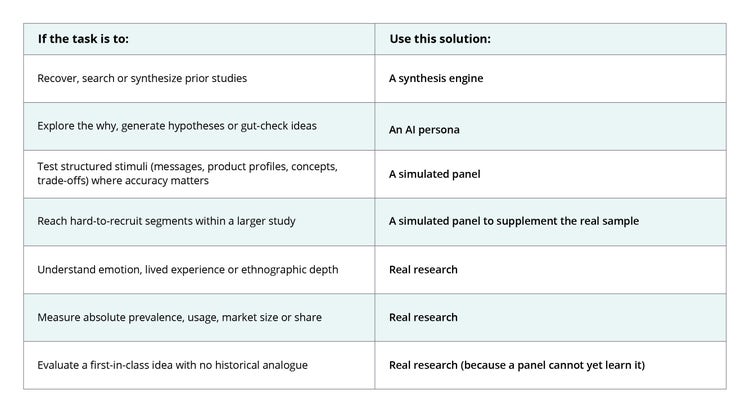
- If the task is to recover and synthesize what the organization already knows, use a synthesis engine
- If the task is to brainstorm and explore the why—meaning novel thinking matters more than precision—use a persona
- If the task is to make a decision that requires validated accuracy on defined stimuli, use a simulated panel
When making decisions, four questions determine fit:
- Is the stimulus structured and testable as discrete items, such as messages, profiles, concepts or trade-offs? If so, a simulated panel fits. If the question is open-ended, emotional or ethnographic, it does not.
- Is there a historical analog and enough relevant data in this domain? If so, a simulated panel can be built with confidence, but if the subject is genuinely first-in-class, use real research.
- Do you need a calibrated distribution and a segment-level read, or do you instead need a single exploratory voice? Panels give distributions while personas give a voice.
- Do you need an absolute, precise measurement of size, prevalence or share? If so, the panel is the wrong tool.
In our experience, the path to adopting simulated research panels is staged. You can begin with a pilot: Consider a decision for which robust real research already exists, so the panel’s outputs can be validated against that ground truth. If the outputs accurately validate, adopt the panel for ongoing pretesting and “what-if” work—this allows you to reserve real research for first-in-class questions, deep qualitative understanding, measurement and final validation.
In a typical workflow this means using simulation before research to form hypotheses, running a streamlined real study to validate and refine, and using simulation again afterward to test additional scenarios.
FIGURE 2: Understanding when to use a simulated panel in market research
AI in market research: What insights leaders and CMOs need to do next
For insights leaders and chief marketing officers (CMOs), the question is no longer whether simulated panels have potential. It is how to adopt them responsibly. The agenda starts with disciplined pilots, reusable capability-building, clear governance and an operating model that pairs simulation with real research.
Run a credible pilot. Choose a decision where you already hold robust, large-sample research to serve as ground truth, and pick a well-bounded task (message testing is the most common entry point). Then you’ll want to assemble the input data (favoring recent material from the past two to three years) and aim for a sufficient base of transcripts and prior testing. After that, judge the pilot on two criteria: The quantitative correlation with the held-out real research and the plausibility of the written rationale. Keep validation selective and rigorous.
Build the capability deliberately. Treat panels as reusable assets organized by therapy area and sequenced to business priorities and the pipeline. Plan for a one-time build cost and a low marginal cost-per-run. Next, set a refresh cadence matched to how dynamic each market is. Extend a validated panel to adjacent brands within the same area before assuming it can move further, because expanding to a different specialty requires a new model.
Govern its use. Decide explicitly which decisions are eligible for a panel and which require real research. You’ll want to create a policy detailing where panels can be used comfortably and where they should be used with caution. Set standards for validation and refresh. Manage data sourcing, consent and isolation, while keeping panels brand-specific and avoiding any cross-brand use of data. Require validation output as a standard artifact, in the same way that sample frames and weighting documentation became standard for survey research. Make sure to build the audit trail so that you defend a decision later. Keep a human in the loop for interpretation and for any low confidence read.
Evolve the operating model. The insights function shifts. Before, it was a gatekeeper that scopes research to a budget. Now it’s a partner that shapes hypotheses early and derisks decisions throughout. Real research becomes more purpose-driven, as teams go deeper on fewer but higher-value questions. Meanwhile, simulation carries breadth and rapid iteration. The benefit is better, more confident decisions with less reliance on assumption, and a closer partnership with marketing—not a reduction in people. Throughout the process, it’s vital to be candid with stakeholders about the limits of simulated research panels. Overclaiming erodes trust faster than the capability can earn it.
Simulated panels as standing tools: Validated, bounded and paired with real research
Looking forward, projecting the trajectory of your simulated research panels can be done with measured confidence. Panels improve as proprietary decision data accumulates and as methods mature. Accuracy tends to rise with more and better data, and the proprietary foundation alone already correlates well with real research, which reduces dependence on any single brand’s data.
Coverage will broaden across therapy areas and markets where sufficient data exists, expanding from a foundational panel to adjacent indications and additional geographies. The most likely near-term state is an integrated operating model in which synthesis engines, personas and simulated panels coexist. Each is used for its proper job, with real research reserved for what only it can do.
It’s equally clear what you can expect to not happen. A panel will not become a universal oracle. The structural limits—namely the need for a historical analog—the inability to capture deep human experience and the unsuitability for absolute measurement are expected to remain. Progress will be incremental and domain specific, governed by validation rather than by enthusiasm.
The reasonable expectation is that simulation becomes a standing part of the insights toolkit, used alongside real research. We expect a future where simulation is used for breadth and iteration, while real research is used for depth, novelty and ground-truth calibration.
Related insights
zs:topic/ai-and-analytics,zs:topic/marketing