How asset managers can make better decisions as data visibility declines
Key takeaways
- Data transparency is declining unevenly. Asset managers have stronger visibility and trust in mutual funds than in high-growth areas such as exchange-traded funds (ETFs), separately managed accounts (SMAs) and alternatives.
- The required level of certainty depends on the decision. Compensation and performance management demand line-item confidence, while digital, product, forecasting and AI applications can often use directional insight.
- Prepare the operating model for less transparency. Strengthen data foundations, broaden applications and reconsider incentives if individual sales outcomes become too unreliable to support traditional KPIs.
Asset management fund manufacturers have always been challenged to know exactly where, how and why their products were purchased. Because asset managers mostly distribute through intermediaries, they are often removed from the point of sale, seeing transactions only in aggregate and often facing long delays between money movement and reporting. To make matters worse, fund flows continue to shift toward opaque vehicles (like ETFs) while distribution platforms and partners increasingly monetize their data by restricting access unless hefty fees are paid.
Should these trends continue, asset managers will soon find themselves facing an observability problem: How do you steer when you cannot see?
Asset management data transparency is declining unevenly across distribution
ZS recently conducted a study of data transparency with asset managers focused on the U.S. wealth segment. The percentages reported below are unweighted averages across firms. We found the firms with the best transparency could trace about 85% of their own gross sales to a buying location, defined for this study as a physical office or location for a broker-dealer, bank or registered investment adviser. Top firms also tracked about 60% of total industry sales or assets under management (AUM), giving them at least some visibility into relative performance and market share.
But those were the best-case scenarios. The average firm in our study had visibility into only 75% of its own sales and 45% of industry assets. Firms with heavy fund flows into ETFs, which offer less visibility than mutual funds, tended to have less transparency. So, too, did firms that were unable or unwilling to stitch together a quilt of data across myriad providers, clients and platforms.
Also, on average, our survey showed that visibility drops by 25 percentage points when the asset manager needs to identify the specific adviser or team involved in the money movement. The average firm in our study could barely identify the buying unit or individual adviser for 50% of its new sales.
Unfortunately, the situation is unlikely to get better. The asset managers in our study predicted transparency would get worse in the next year, as custodians and established third-party providers fight to monetize their data.
Lower data trust limits how asset managers use distribution data
Asset managers—like nearly all large companies—want to be more data-driven and AI-enabled in how they run their businesses, whether to drive efficiency, improve effectiveness or both. Doing so requires trusted data. Here, the industry appears to be falling behind.
We asked asset managers to rate the trust and usability of their sales and industry AUM data. On average, trust was highest in mutual fund data and substantially lower for the high-growth categories that dominate company strategy: ETFs, SMAs and alternatives (Figure 1).
FIGURE 1: Mutual fund data earns the most trust and supports the broadest use
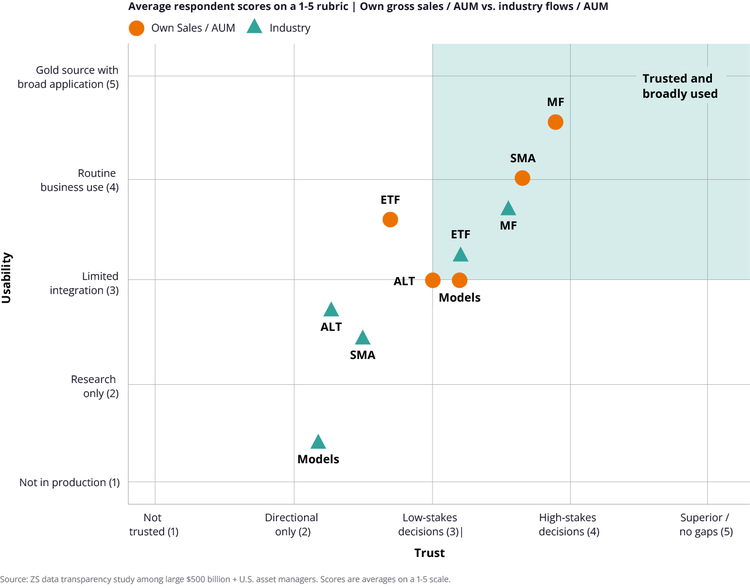
Many acquired data sources remain stuck in an “informational” state—not integrated into foundational data platforms or connected to gold-source data products. Not surprisingly, there was a strong correlation between the level of trust and the depth and breadth of usability.
Perhaps also due to this lack of trust, the average asset manager in our study was focused narrowly on just a few use cases for third-party data. As Figure 2 shows, most asset managers continue to prioritize sales incentives and sales management for their most essential data applications. One head of distribution analytics summed up the prioritization challenge: “We keep fighting to hold ground on incentives and performance management. Whenever the data shifts, we divert resources to keep our KPIs on track. Sometimes it feels like we’ll never get to the more ambitious ideas.”
FIGURE 2: Sales performance still dominates how asset managers use third-party data
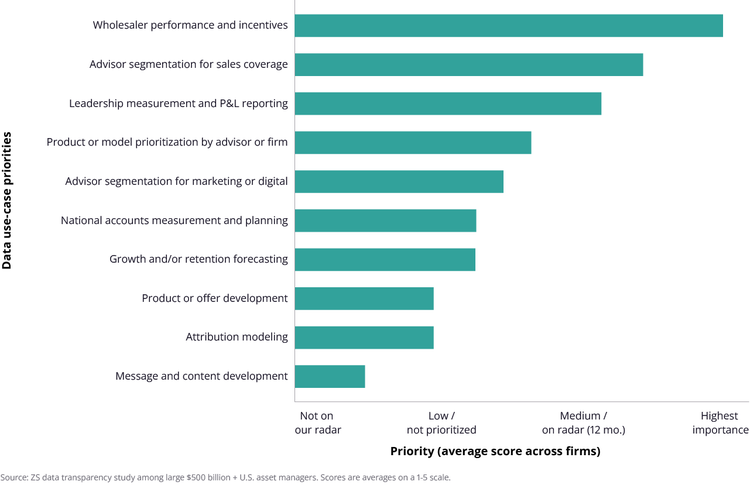
While sales performance management is no doubt important to running a successful distribution organization, focusing too heavily on performance management may inadvertently be eroding trust and limiting data applications. The bar for “trust” is high when someone’s compensation is on the line, since data accuracy in compensation or performance management is often scrutinized and challenged at a line-item level. The problem then is not only how much data asset managers can see, but also what level of certainty each decision requires. Transaction-level certainty is not necessary for data applications in digital, product development, forecasting or other arenas where directional insight can be valuable and used for AI agent or model development or leadership decision-making.
Different decisions require different levels of data certainty
Our research raises fundamental questions for most asset managers: How should we steer distribution? What data and data management capabilities are needed to see the road ahead? And what leadership model will best navigate the journey?
Below are three ways asset managers can navigate this data uncertainty.
1. Strengthen data management to improve distribution transparency
Many asset managers can improve transparency by investing in additional data sources and strengthening the integration and management of those sources. Modern data platforms now offer AI-enabled engineering capabilities that can help asset managers source data from dozens of providers, produce high-quality data products and tackle distribution use cases that once required unsustainable budgets or heavy information technology resources.
Our survey found firms with the largest in-house programs have the highest levels of transparency and trust and the broadest set of use cases. Executives are increasingly asking to see the ROI for data acquisition. The practical test is: Does this new source change how we make important decisions? If the answer is no, the data probably should not be acquired.
Building, maintaining and fully using a “quilt” of first- and third-party data can be expensive and expertise-dependent. But for many firms, it can close the transparency gap while broadening data products and applications.
2. Use directional distribution data when line-item precision is not required
Paying commissions on sales data that covers a small, shifting fraction of clients is a recipe for distraction, distrust and disagreement. But for a marketer, a product manager or an AI engineer? There’s a treasure trove of sales and market information that can be modeled, projected, applied, synthesized or packaged into data products, all of which can have an immediate, valuable impact on distribution decisions and processes.
To borrow a sports analogy: While sales still plays the role of striker for most asset managers, scoring increasingly relies on the buildup in the midfield—plays made by marketing, digital, specialists, practice management and others. These functions already rely on sparse data and inferences and are unlikely to be stopped by the transparency gaps in sales or AUM data. Here, trust can be earned and use cases can have outsized impact. This is especially true if these practices have had limited support from third-party data programs in the past, as seems to be the case based on the table in Figure 2.
3. Adapt performance management as sales data becomes less reliable
Asset managers should prepare for the possibility that data transparency continues to erode due to changes in the asset manager’s own product mix or changes among data providers (or both). Would it be possible to operate a sales incentive with less than 50% of pay driven by gross sales? Could performance management be run on KPIs that do not include sales outcomes at an individual contributor level?
For decades, ZS incentive best practice has been to focus incentives on sales results the salesperson directly influences. That best practice hasn’t changed. But if results aren’t clear, incentive plans will need to adapt. Half the results may be missing, direct influence may be unclear or the data itself may be consistently unreliable.
Any shift from gross commissions will feel more complex by comparison, but other industries have adapted incentives when sales outcomes are uncertain. Incentives, performance management and sales cultures can evolve and thrive with KPIs that include early-stage sales outcomes, team or divisional outcomes, client “wins,” manager ratings and a host of other alternatives.
For most asset managers, data trust and transparency have not yet reached the tipping point where something as important as incentives is transformed. But for many, trust and transparency are holding back data-led improvement.
Prepare for less data visibility by matching certainty to each decision
Asset managers may not be able to reverse every trend reducing data transparency. They can decide how much certainty each business decision needs. In the near term, that means strengthening data foundations broadening the use of directional insight and being explicit about where line-item accuracy is essential. Over time, it may also mean redesigning incentives and performance management around measures people can trust.
Asset managers can plan and prepare now by addressing key questions: Where does greater precision change the decision? Where is directional evidence enough to move? And which operating choices need to change if distribution visibility keeps eroding?
ZS helps asset managers navigate these trade-offs across distribution data, incentives and performance management. Reach out to compare notes on how declining visibility is affecting your organization.