B2B buying process: Why enterprise software buying demands a new sales model
Key takeaways
- Enterprise software buying now involves six buyers, including grassroots users and agentic AI procurement systems.
- The modern sales model depends on adoption, governance and ROI, not just deployment or product features.
- Agentic AI is accelerating fundamental shifts in B2B buying, software procurement and go-to-market strategy.
Marketing generates demand. Sales closes. Partners implement. Customer success retains.
For most of the enterprise software era, sellers could organize around a traditional sales model that resembled a linear funnel. This traditional sales model worked for sellers because they had more information than buyers. Buyers relied on sellers to explain the market, compare options and guide the decision-making process. As a result, sellers largely set the pace of the purchase.
That advantage has eroded in stages for sellers. Digital proliferation let buyers educate themselves long before a sales representative entered the picture. Consumption pricing then removed the “close,” the single event every handoff was built around in the traditional sales model.
Today, the sales model is more complex than ever. While AI may seem like the reason, it’s an accelerant—rather than a cause—for the shift away from the traditional sales model.
3 forces changing the traditional sales model in B2B buying
Force 1: Budget scrutiny. For years, companies added new software whenever a team found a tool that met its needs. But as costs rose, finance leaders began asking buyers to justify their decisions. Purchases that were once signed off on without CFO involvement now required approval, and utilization audits made every renewal a fresh argument.
Consumption pricing sharpened this shift. Under perpetual license models, scrutiny ended at signature. But under usage-based models, the spend is visible monthly and the justification is never finished.
Force 2: The adoption gap. Deployment used to be the commitment. Months of implementation and configuration made a tool choice effectively irreversible, leading buyers to overinvest in getting the decision right. Sellers played a critical role in helping buyers make the right decisions.
The technical last mile has since collapsed. Software deploys in days, integration standards have matured and vendors have productized the exact bespoke work that used to take months.
Adoption costs haven’t vanished, however. When standing up a tool takes two weeks instead of nine months, the bottleneck becomes workflow redesign, trust calibration, incentive changes and governance. Of course, none of these have gotten faster, and some have even become more difficult as software began changing what people do—rather than which tool they used. The difficult part moved from the seller’s invoice to the buyer’s own organization, where it’s harder to budget, harder to outsource and largely absent from the business case.
Deployment used to be considered the same thing as adoption. No longer. Today, the distance between “installed” and “actually used” is the entire risk surface, and the buyer absorbs it directly.
Force 3: The authority split. As tools spread across the business, more teams started buying software with their own budgets. But the people evaluating software and the people approving it moved in different directions. The people assessing the tools now sit lower in the organization than they did five years ago. The people signing off on enterprise contracts sit higher, as tighter budgets have pushed approval upward. In other words, the person who says yes is often no longer the person who signs.
That is what makes this environment harder than any single force suggests. Sellers must win two audiences with incompatible criteria: a practitioner who cares about workflow fit and time-to-value, and a CFO who cares about consolidation and defensible ROI. A pitch built for one weakens the case with the other.
AI in B2B buying: The role of AI in transforming the traditional sales model
AI didn’t cause any of these forces. But AI made behaviors that were previously too slow or expensive—such as exhaustive vendor comparisons, continuous utilization audits and unattended procurements—cheap enough to become the default. And by shifting software from tools that people operate to systems that act, AI widened the adoption gap it didn’t create.
Thanks to AI, purchases became easier to start, harder to land, harder to justify and split across more people. The final decision stopped being a decision. It became a standing negotiation.
Reexamining buyers in a new sales model
The traditional sales model typically focused on four buyers. But as that model has evolved in recent years, two additional buyers emerged: Grassroots buyers and agentic AI.
It’s tempting to treat all six buyers the same and sell to them at the same time. But sellers should refrain. The buyer who matters most depends on one thing: How much the purchase changes the way people work.
Here’s what me mean. Consider a marketing tool a practitioner uses at their own desk. Adopting this tool changes one workflow. It doesn’t affect anyone else, and walking away costs a subscription, so nobody watches it.
Meanwhile, an agent that acts inside a system of record changes the work of several teams, requires people to trust outputs they can’t fully inspect and creates audit surface. This agent deploys in days and takes a year to land, so everyone watches it. Same company, same quarter, both true.
FIGURE: The 6 buyers in the new sales model
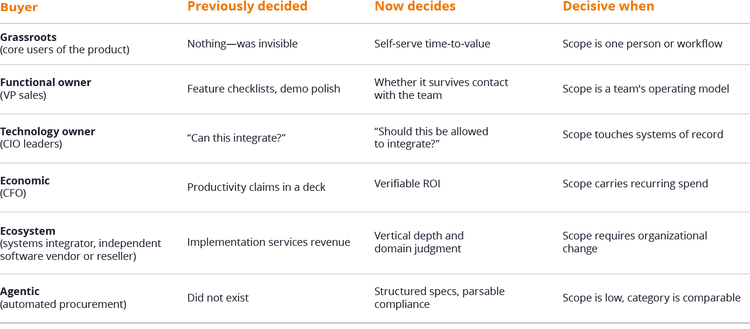
What these 6 buyers mean for sellers in a new sales model
In this new model, the first qualifying question sellers should ask is no longer “Who’s the economic buyer?” Instead, it’s “How much behavior does this change?”
If sellers get that question wrong, they risk using the wrong sales approach. They may bring too much governance to a practitioner who only wanted a trial. Or they may offer a self-serve path for a purchase that needed the chief information security officer involved from the start.
Here’s what you need to know about the six buyers:
The economic buyer
The economic buyer used to accept productivity claims at face value. Now they want a total cost of ownership (TCO) number they can verify—moving them toward outcomes and consumption rather than licenses.
The adoption gap is where economic buyers run into trouble: License costs are easy to see, but the cost of changing how an organization works is not. That means business cases often underestimate the full cost of a purchase. Sellers that are honest about those costs are more credible than those promising a clean payback period.
The functional owner
The functional owner has stopped weighing feature checklists. Deployment is cheap and several vendors can be live within a week, so features stopped differentiating. What matters now is whether the software survives contact with how the team works—which only a pilot can show. And pilots have replaced demos because piloting finally costs nothing.
This buyer is also often spending their own budget, which brings real decision rights and real exposure. One large life sciences company that ZS works with has historically routed every technology decision centrally. But for AI tools, they’ve changed their approach, moving to a fragmented model where business units choose their own tools. A vendor selling to this company now runs six evaluations instead of one, with no central sponsor to consolidate them.
The technology owner
The technology owner didn’t create the tool sprawl. They inherited it. When teams gained more control over budgets, those teams bought directly and looped the technology owner in afterward.
Cheaper pilots and deployments have shifted the job of a technology owner from asking if a technology should integrate to determining if it should be allowed to. When anyone can start anything, permission replaces feasibility as the top constraint.
For the technology owner, the remaining sources of friction are control, auditability and blast radius. These owners understand conversations need to happen up front, not once a deal is in motion.
The ecosystem buyer
The ecosystem buyer is splitting in two. Partners whose value was distribution—reselling, provisioning, standing things up—are being disintermediated, because that work is now inside the product.
Partners embedded in a domain are gaining influence, because the scarce capability moved across the adoption gap. Buyers no longer struggle with standing up a tool. Today, the bigger challenge is changing how the organization works around the tool. That transformation takes domain judgment, change management and enough proximity to know which workflows a business can absorb.
The pull runs both ways: Platform companies select partners for domain depth, and partners select technologies that solve the whole problem. That’s a different business, not an efficiency tweak to the old one.
The grassroots buyer
The grassroots buyer emerged in the last decade because starting a technology no longer required a commitment. A usable version self-serves in minutes, and the authority split removed the gatekeeper who would have stopped it spreading. By the time the economic buyer sees a proposal, the functional owner is often defending a tool their team has used for months.
This boundary is important to note: Grassroots adoption of a productivity tool has become a purchase, while grassroots adoption of something touching customer data has become a governance incident. Same motion, opposite outcome—and scope is the difference.
The agentic buyer
The agentic buyer is the most recent addition to the sales model. Of course, the agentic buyer isn’t a person, but automated procurement that discovers, evaluates and increasingly negotiates. Forrester projects that in 2026, 20% of B2B sellers will participate in agent-led quote negotiations in which they respond to buyer-side agents with counteroffers of their own. And 61% of purchase influencers say their organization has or will use a private generative AI engine to support purchasing.
The agentic buyer doesn’t care about the brand story. It cares whether specs are structured, compliance parses and pricing compares. If you fail that checkpoint, you’re filtered out before a human even sees you.
What constrains agentic buyers? The adoption gap. Agents are good at pricing specifications well but bad at pricing organizational change, so agentic procurement risks taking the long tail first and stalling precisely at the purchases that matter most.
What these 6 buyers mean for sellers’ B2B go-to-market strategy
Marketing no longer just generates as many leads as possible. It also has to make the company easy to find, understand and compare before a buyer—both human and automated—ever talks to sales. When so much of the decision happens before direct contact, persuasion has to happen through clear content and structured data—and not just in sales conversations.
Sales sheds its administrative layer and concentrates on architecting outcomes and defending ROI—which now means qualifying on behavior-change scope early, as scope determines who is actually decisive.
Partner teams focus more on solution partners rather than transactional partners. Partners’ vertical domain depth, change management and expertise in the operating reality of clients becomes more valuable. Partner economics shift from one-time implementation margin toward participation in consumption and expansion.
Customer success becomes an even more critical part of the go-to-market loop. Under consumption pricing, a stalled workflow costs revenue immediately, rather than at renewal. Customer success is no longer downstream of revenue, but is instead the revenue mechanism—and in most organizations it’s still staffed as an afterthought.
The future of B2B buying
None of the six buyers replaces the others. The chief experience officer still signs the check. But a sales model built on verifiable outcomes, cheap deployment, expensive adoption and split authority has added two key buyers.
The new sales model has also rewritten what the original four buyers will pay for. Which buyer decides depends on how much the purchase changes what people do.
A seller’s four GTM functions survive too. What doesn’t survive is the order they ran in. Marketing, sales, partnerships and customer success now operate concurrently against a buying process that starts before they know it and never fully resolves.
The traditional sales model—that linear funnel—didn’t break. But it’s no longer a sequence.
Related insights
zs:topic/marketing,zs:topic/sales,zs:topic/strategy-and-transformation