Stop selling, start solving: Why pharma needs barriers-driven engagement™ now
Pharma companies don’t lose market share for the reasons you might think. The real damage doesn’t come from weak science or lack of content—it comes from roadblocks that often go unnoticed. A diagnostic result buried in a PDF, difficult to search. A prescribing option missing from an electronic medical record system. A reimbursement process that drags on for weeks due to a single typo.
These aren’t minor glitches. They’re the friction points that frustrate healthcare providers (HCPs), delay care and keep treatments from reaching the patients who need them.
Leaders rarely notice them. Customers never forget them. And when those moments pile up, they don’t just create frustration—they erode trust, stall adoption and quietly cost patients the products they need most.
While AI is reshaping industries, customer expectations regarding healthcare and HCPs are increasing, customer experience is declining and provider expectations for pharma are increasing. The cost of ignoring these barriers has never been higher.
If there was ever a time to flip the script, it’s now.
Why now is the time for barriers-driven engagement™
Pharma is operating in real uncertainty—and customers feel the gap. In ZS’s 2025 survey, pharma’s overall net promoter score came in as low as -10%, a clear signal that traditional engagement isn’t building trust. At the same time, decision-making is shifting. Clinical decision support and AI “answer engines” increasingly shape choices and patient-directed access compresses the funnel so ease, not brand, wins.
More data, more content or more channels won’t fix this. Frankly, with the squeeze on selling, general and administrative costs, we need to play smarter, not broader, anyway. The advantage will come from identifying and solving barriers.
We love drivers, but barriers are where customers get stuck. These are places where patients fall out of our funnel, where the rubber meets the road in our ability to truly affect patient outcomes. Customer barriers exist across the end-to-end journey. When we turn the power of our organization toward addressing them by running plays that align roles, channels, content or solutions and insights, we don’t just remove friction for our customers. We also build durable cycles of trust, access and insight—and deliver behavior-changing personalization at scale.
What is barriers-driven engagement?
Barriers-driven engagement is the foundation of our customer model of the future. Why? It does two things that change our go-to-market model in profoundly effective and efficient ways. First, it provides clarity of the win-win for the customer and the company: remove the customer friction and advance the objective. Second, it cuts past structure and silos by pointing our people and resources toward common and measurable goals we can tackle with defined and clear plays. It replaces organizational complexity with shared purpose. And when we make those plays, we move the customer up the adoption ladder faster.
Barriers aren’t just about access or affordability. They include gaps in HCP belief, the clinical, operational and financial friction patients face across their journey and everyday workflow failures.
What does barriers-driven engagement look like?
Here’s an example. A company noticed a significant share of prescriptions were being canceled through the benefit verification process. The barrier happened after the script was written; patients weren’t answering calls to verify benefits or confirm next steps.
The company did multiple simple plays to overcome this barrier, including educating the office or health system staff to proactively prepare patients and providing patient leave-behind material.
Within the first few months of implementation, prescription cancellation rates dropped significantly, unlocking faster therapy starts and ensuring more patients who needed the medication received it.
How companies can put barriers-driven engagement into action
Identify the right barriers
It’s critical for companies to be able to identify customers’ barriers across priority brands. The starting point is understanding what’s truly holding customers back. Ask: What’s preventing the customer from moving on their journey with the product? And what might be driving them as they make decisions?
Don’t assume you already know what the barriers are. ZS has quantified 188 different barriers experienced by brands. We’ve compiled them into a unique library that can be filtered by barrier type, adoption stage or other factors and linked to proven plays.
To identify actionable opportunities, the key is to view barriers from the customer’s perspective, in their context—not your organization’s. Remember, barriers are what customers experience. A few tips:
- Take into account detailed operational and economic barriers, not just clinical. This requires a cross-functional approach, because every function has the detail you need to understand the customer.
- Ensure you’re capturing barriers across all contexts: patient type, customer segment, local healthcare market, digital channel preference, account archetype, etc. Barriers allow us to simplify all this complexity into concrete “possible” barriers for every HCP in context.
- Describe your barriers and drivers with as much detail as possible, so you can help develop the right solutions to the right problems. Specificity matters because you need to understand the reason behind the barrier.
Develop the plays to solve the barriers
Barriers matter only when they lead to action: the play. Plays are the real opportunity to involve the right role, channel and content—solving the real barrier, not just messaging around it. It’s a coordinated, role-based activation system.
Most pharma companies think they have the right plays, but evidence suggests otherwise. In one ZS assessment, a brand had strong plays for only eight of 65 identified barriers. In another recent case, it was five out of 28. On average, brands face 25-65 barriers depending on complexity and life cycle, yet meaningful responses exist for less than 30%-50% of them.
Ask five questions to design the play
To design the right plays, you must ask these five questions: What’s our customer goal? Which role or channel is best suited to achieve it? What should the primary role know? What can they use? And who can they tell? The answers become the execution blueprint—clear, compliant and repeatable.
Once plays are identified, companies can prioritize resources, upskill talent, evolve content, shift resource mix or accelerate orchestration engines to move to next-best-play logic. This is where CRM becomes an orchestrator—not a record keeper.
Measure effectiveness and drive impact
Once you identify the barriers and drivers, and develop and run the plays, it’s time to measure impact.
In a barriers-driven engagement world, there are only two metrics that will ever matter: 1) when we identified a barrier, how quickly did it take for us to run a play and 2) did the play work? Gone will be the days of measuring activity and quantity without any context for what actually happened in the discussion. Barriers-driven measurement moves us from counting what happened to understanding what changed.
What barriers-driven engagement looks like in practice
Identifying the real barrier and deploying the right play can change outcomes, as these real examples show:
Reframing access challenges
The barrier: The issue wasn’t just “unfavorable tier access,” but that patients were complaining to their HCPs they were receiving payer letters requiring patients to switch medications—creating administrative and clinical frustration all around.
The play: The company reframed the issue in the HCP’s context and deployed multiple coordinated plays: patient access liaisons supported affected patients, field reimbursement managers (FRMs) trained office staff on proper prior authorization protocols and payer key account managers (KAMs) negotiated improved access.
The impact: This comprehensive approach unlocked impact beyond a single-payer negotiation.
Simplifying roles and solutions
The barrier: HCPs and office staff were getting lots of prior authorization rejections due to a complex process. Sales reps were unclear whether they could address it compliantly and there were limited FRMs to handle every issue.
The play: The company created a single, simplified leave-behind on access that sales reps could provide to every HCP office. The guide included clear, step-by-step instructions, ensuring consistency and reducing role confusion. The company also provided more proactive support by the FRMs to dialogue, address and support these issues.
The impact: One streamlined solution ended up solving multiple access-related barriers and improving efficiency.
Field playbooks
The barrier: Field teams faced uncertainty about who should lead specific barriers-to-access conversations, leading to inconsistent execution.
The play: The company developed field playbooks that defined a primary role for each barrier, replacing abstract “responsible, accountable, consulted and informed” (RACI) matrices with actionable guidance.
The impact: Training on collaboration helped field teams execute with greater clarity and alignment.
Focus on relationships
The barrier: An account team discovered that a key thought leader was also the lead investigator for a competitor’s clinical trial, creating a relationship barrier to engagement.
The play: The team launched a play in which their head of medical from HQ engaged the thought leader in broader scientific and strategic discussions.
The impact: This play elevated the relationship and strengthened partnership credibility.
The benefits of barriers-driven engagement
In his book, Good to Great, author Jim Collins described how “the flywheel effect“ builds momentum with turn after turn until it achieves a breakthrough. We can think of the benefits of barriers-driven engagement as a flywheel, too.
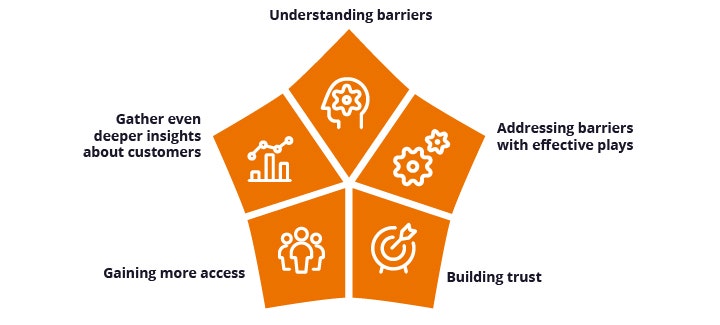
The impact of this approach is measurable—from market share gains to faster access and adherence.
Companies that combine barriers-driven engagement with a customer-first CRM to enable this at scale are likely to see measurable benefits. ZS estimates that companies could achieve 10% to 15% net revenue growth, along with faster adoption of products, stronger cross-functional alignment and the ability to capture unmet demand through patient journey solutions.
They also gain efficiencies, including an estimated 10%-15% lower selling, general and administrative expense costs, smarter resourcing by matching the right roles to the right plays, and clearer communication between field teams and headquarters enabled by better collaboration.
How can companies get started with barriers-driven engagement?
Customer engagement excellence is no longer a nice-to-have—it’s a competitive advantage. Barriers-driven engagement moves beyond theory to a practical, measurable model that reinvents how pharma goes to market. By grounding decisions in a deep understanding of customer context and barriers, ZS helps teams align roles, content, solutions and channels to remove friction at the moments that matter most. The result is faster problem resolution, smarter use of resources and more trusted customer experiences.
Companies can:
- Get the right people in the room to talk about adopting this approach. Keep in mind this isn’t an org design challenge; you don’t have to change every function, you just have to get every function to orient to barriers
- Identify the barriers your customers can face in their contexts across your priority brands
- Assess your current state of plays. How well are you positioned to overcome those barriers today?
- Prioritize resources and determine a strategic path to close gaps in your plays
The first step is to ask one crucial question: Do we have effective plays for all of our customer barriers? The organizations that answer “yes” first will capture sustainable differentiation.
zs:industry/pharmaceuticals-&-biotech,zs:topic/ai-&-analytics,zs:topic/marketing,zs:topic/sales,zs:topic/sales-compensation