Building the right commercial data foundation for first launch and future growth
Anuradha Roy, Knowledge Services Manager, ZS, co-authored this article.
Launching a new drug is a resource-intensive and high-risk endeavor for a biopharma company.
It can be even more challenging for smaller biotech, specialty firms and other first-time launchers as they often execute with lean teams and limited capital in an environment already defined by intense payer scrutiny, crowded therapeutic classes and narrow windows to capture prescribers’ attention.
A biopharma product launch is also hugely expensive, as single-product companies spend more than $125 million on selling, general and administrative expenses in the three years leading up to launch, with the majority directed toward launch readiness.
Given these expenditures, and the vast infrastructure and requirements for launch, emerging pharma must be extraordinarily structured and disciplined. Here are four learnings from other prosperous commercial launches they can bring to their own drug launch strategy to ensure success:
Learning 1: Biopharma drug launch strategy readiness is not a short-term undertaking, but a sustained discipline shaped by time-to-market realities.
Too often, organizations treat launch preparation as a one-time milestone to be checked off only in the months leading up to approval. But the window between regulatory approval and commercial availability is shrinking, which creates immense pressure to mobilize teams and systems almost instantaneously. Investor expectations and the race to maximize limited patent life make speed and scalability non-negotiable.
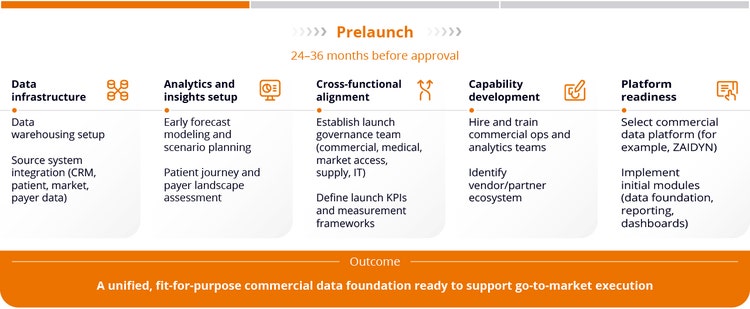
Companies that excel at launch success treat this critical success factor of time-to-market and view readiness as a continuum. They begin two to three years in advance to lay the foundation with pharma data and analytics, strategy and organizational readiness.
FIGURE 1: Prelaunch activities
Then, from six months prelaunch to around approval, they begin to execute and activate, to turn organizational capability development into real-time action.
FIGURE 2: Activities just prior to and around launch

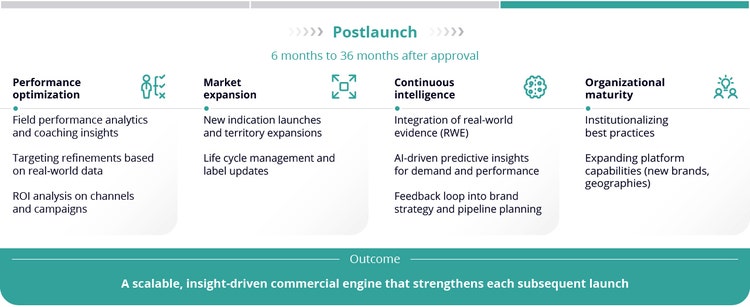
Finally, during the postlaunch period they rapidly scale and institutionalize for success.
FIGURE 3: Postlaunch activities
Learning 2: To enable a successful postlaunch commercial strategy, pharma data and analytics must be viewed as a critical differentiator.
Though emerging biopharma companies often operate under budget constraints, the challenge is not purely financial, it’s also an intelligence and infrastructure issue. Most organizations already possess the right ingredients for this with field data from commercial teams, expert opinions from medical affairs and payer perspectives from market access.
However, without the equivalent of a well-structured recipe, they often combine the ingredients haphazardly. The result is a patchwork of disconnected data streams that frequently deliver conflicting or delayed insights, which by the time they are reconciled, have lost their relevance.
Launch teams need a unifying framework to separate signals from all the data spread across dashboards, KPIs, bespoke reports and field updates so they can empower teams to make data-driven decisions, uncover opportunities and improve launch performance.
Learning 3: Designing biopharma drug launch strategy for end state and scalability, not experimentation, drives sustainable success.
What separates high-performing launchers from those that falter is their foresight to design their pharma launch readiness for the end state where scalability, flexibility and connected insights drive sustained success. They ensure their solutions are proven, integrated and purpose-built for commercial scalability from day one.
This is where an agile, integrated platform like ZAIDYN® delivers distinct value. By establishing a unified commercial data and analytics foundation that is both fit-for-purpose and scalable, organizations can reduce duplication, improve data quality and stay adaptive to the growing complexities that arise postlaunch.
ZAIDYN’s modular and extensible architecture enables organizations to begin with core prelaunch capabilities and launch readiness such as data warehousing, master data management and patient reporting to help organizations seamlessly expand into postlaunch functions like incentive compensation, targeting, alignment and other sales operations planning.
With all capabilities built on a single, integrated foundation, teams gain efficiency, eliminate silos and operate from one source of truth. The result is a cost-effective, future-ready model that transforms commercial operations, delivering not just a successful launch, but a scalable platform for sustained growth.
Learning 4: Companies need a partner that can provide both pharma-specific domain expertise and a best-in-class platform to manage commercial use cases.
Biopharma product launch is about establishing credibility in the market, attracting investor confidence and proving the company’s ability to operate on a scale. Yet studies show that two thirds of first-time launches fail to meet expectations and many underperform for years afterward .
To avoid this failure, many companies turn to various consultants and vendors to fill critical gaps. While this can enable speed to launch, it also creates a structural risk: companies become dependent on fragmented, one-off solutions that fail to scale.
Each vendor may solve an immediate need—whether in data management, sales operations or patient services—but without a unified, reusable foundation, the organization is left with silos, duplicated spend and an inability to replicate success across future launches. Regardless of the vendor chosen, that partner must bring a deep understanding of the regulatory constraints, payer dynamics, healthcare provider engagement and patient support involved in pharma launches—while also delivering the digital backbone that connects precommercial preparation to postlaunch operations.
This is where a platform-enabled vendor becomes a true differentiator. By offering end-to-end capabilities from data warehousing and master data management to launch readiness analytics, incentive compensation, targeting and ongoing field force operations, this vendor becomes more than a service provider.
It becomes a strategic enabler, ensuring that every launch decision is informed by connected insights and every postlaunch operation builds on the same scalable foundation. ZAIDYN is designed with AI-ready architectures, ensuring emerging companies can leverage the latest advances in automation, analytics and agentic workflows without incremental reinvention.
For first launchers, leveraging this type of partner can mean the difference between scrambling with external consultants for each new challenge and growing with confidence on a unified platform that evolves with their pipeline and future AI investments.