Site CRM in action: Improving clinical trial site engagement and performance
Ask a clinical research coordinator how things are going, and they’ll likely tell you they’re drowning in noise. Every trial, every sponsor and all their intermediaries bring a flood of emails, faxes, phone calls, data requests and contract demands.
For their part, sponsors often lack the ongoing, real-time visibility needed to understand the friction sites experience—friction sponsors could help remove. These barriers might include:
- Sites overwhelmed by repetitive feasibility surveys
- A site is asked to revise a contract, again, for a sponsor they just worked with
- An ethics committee’s approval is stalled, and timelines are unclear
- Patients keep screening out over inclusion/exclusion criteria
- A backlog of data queries piles up due to confusing case report language
This friction isn’t just frustrating for everyone helping patients, it’s costly, too. Today, one in three sites fail to enroll a single patient and 80% of trials are delayed, costing sponsors approximately $500,000 per day in unrealized or lost prescription drug sales. The result is slower timelines, strained infrastructure and declining performance across the board.
To reverse this trend, pharma can reset the model: from seeing sites as execution arms of protocols to valued partners in care delivery and innovation.
A reset like this is especially attractive for companies running multiple concurrent trials in a single therapy area that engage the same providers or patient populations. Moving from a trial-centric to a site-centric relationship model, supported by a modern customer relationship management (CRM) platform, can be both practical and achievable.
This approach makes it possible to tailor engagement—communications, services, operations—based on each site’s specific preferences, performance history and capacity, with the goal of creating more relevant, trusted and productive relationships.
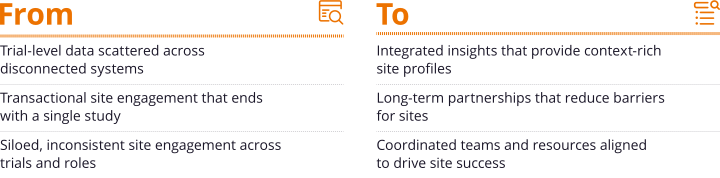
It may feel like a big shift, but it becomes manageable when broken down into three key pivots. Each one builds on the last, creating a clear path forward.
Together, they move sponsors toward an engagement model that looks very different from today’s approach (see Figure 1).
Figure 1: What a pivot toward site CRM looks like
With the destination defined, the next step is identifying what’s required to start the journey, beginning with Pivot one.
Pivot 1: From scattered insights to a holistic profile of clinical trial sites
Sponsors today have access to a wealth of profiling data, but it’s often scattered. Key information lives in isolated feasibility tools, site initiation visit (SIV) reports, case report forms, voicemails and inboxes. Some critical data even lives with the contract research organization, not the sponsor. It’s rarely standardized, reused across studies or shared between functions. Without a connected view, sponsors struggle to understand what sites need to succeed or which barriers are holding them back.
A Site 360 view helps address this. By curating operational, engagement and attitudinal data over time—including performance data, feasibility surveys, recruitment data, quality indicators, contracting and budgeting history, and even communication preferences—you can build a richer, longitudinal profile of each site.
With this more holistic, Site 360 view, teams can better understand not only which sites to partner with for an individual study, but also how to engage them effectively, both in the current study and over time.
Factoring in known preferences, past feedback and engagement behaviors adds context that goes beyond a site database. It does more than improve insight quality, it lays the groundwork for intelligently orchestrating an entire relationship strategy.
Pivot 2: Enable your teams to drive broader goals for clinical trial site management
The context from Pivot one provides the foundation for true digital transformation. With a shared context in place, sponsors can now design a more intentional relationship strategy. This strategy defines how to collaborate with each site, how existing roles may evolve and where new capabilities may be needed to drive success.
This is where a shift becomes essential: Instead of study-by-study execution as the sole focus, sponsors use new integrated site profiling they’ve built to take a long-term view of the sites or site networks they expect to partner with for years.
This change is not about adding complexity, it’s about reducing the friction that’s slowing performance and damaging relationships. It requires an approach focused on the barriers sites face and the coordination of internal teams and resources all under a long-term overarching site engagement strategy.
Roles like clinical research associates, medical science liaisons and site relationship leads remain central to site engagement—but with more tailored insights into each site’s needs, they’re better positioned to address real points of friction aligned to a long-range relationship strategy. That includes proactively resolving challenges like repeated contract revisions, delayed approvals, system access issues, training gaps and patient recruitment hurdles, all as part of a strategic effort to prioritize and support sites.
To act effectively, sponsor teams need more than data—they need the ability to respond in real time. A modern CRM platform makes this possible by helping teams tailor their engagement to each site’s unique context, while staying aligned with other channels and stakeholders.
Pivot 3: From disconnected touch points to orchestrated engagement with an agent-enabled site CRM
Understanding your sites (Pivot one) and shifting the focus of site engagement (Pivot two) are essential to what comes next. The third pivot builds on that foundation by turning strategy into action through an expertly configured, modern CRM platform. It’s the engine that brings your relationship strategy to life—making it scalable, repeatable and easy for teams to stay aligned.
Your platform is ideally connected to your commercial and medical organizations to ensure comprehensive site profiling. It’s configured to match your processes, role-specific workflows and engagement playbooks. Built-in intelligence helps identify barriers for sites, prompt the right actions and continuously improve.
Teams of AI agents make it all work through automated, orchestrated workflows and feedback for continuous learning:
- Profiling agents reveal site preferences, challenges, needs, capabilities and engagement history—across studies and the enterprise—providing the foundational data your site CRM needs to get started.
- Summarization and sentiment-analysis agents surface near-real-time insights from unstructured notes, records and performance signals, helping you spot risks and challenges early.
- Barrier-action agents power an intelligent next-best-action engine. This is powered by ZS’s proprietary ontology of barriers and tactics to prompt actions. Teams get automated recommendations on who to engage, when, how and with what content—always backed by relevant context.
- Productivity, training and orchestration agents automate critical workflows and streamline how data is captured, improving consistency and efficiency across roles.
- Performance measurement agents track which actions drive impact and which content resonates—so your strategy can continuously adapt and improve.
With these pieces in place, every touch point between a sponsor and a site becomes more intentional, more connected and more impactful.
Figure 2: A next-gen CRM ecosystem powers your overarching engagement strategy
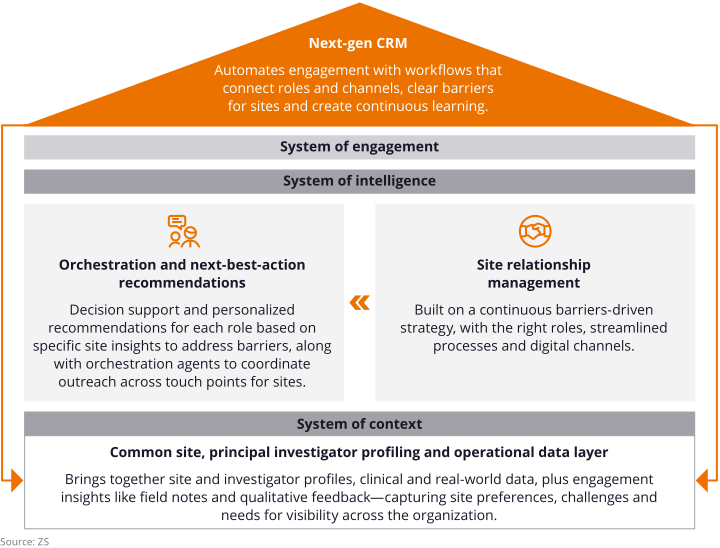
Together, these three pivots create a modern, data-backed model for intelligent site CRM
With a long-term partnership-based operating model supported by context-rich data, clear strategy and coordinated execution, pharma can use site CRM to put their scale to work. The result: reduced friction between sponsors and sites and stronger reputations as trusted partners.
Over time, this also opens the door to a future where clinical research is more connected to standard healthcare and where insights bring sites, patients and operations together seamlessly.
Together, we can improve day-to-day operations and more: site CRM can become a strategic investment in faster, better studies. And ultimately, it can carve out a meaningful competitive advantage by solving for true barriers, resulting in industry-leading relationships with sites.
At ZS, we help design and activate modern clinical trial site engagement models enabled by AI-driven CRM platforms. If your organization is ready to evolve how it supports sites, ZS is ready to help.
Related insights
zs:topic/technology-&-operations,zs:topic/research-and-development