Decision intelligence in life sciences supply chain
Nicolas Cardaci and Sathya Narayanan Kothanda Raman also authored this article.
Key takeaways
- Decision intelligence connects data, domain knowledge and reasoning to answer cross-functional supply chain questions in minutes, not days.
- Most decision intelligence initiatives fail by focusing on platforms too early. Success requires sequencing data, semantics, logic and platform in the right order.
- Organizations that want to implement decision intelligence should start with high-value cross-domain questions, and then build the foundation to answer them at scale.
What does decision intelligence actually mean? The phrase has been around for years. What has changed is the urgency behind it.
Supply chain leaders are sitting on more data than ever. Forecasting models run at scale. Dashboards multiply. And yet when a supply chain executive needs to answer a specific, cross-functional business question, it often still takes days to get them an answer. The gap between data availability and decision speed is precisely what decision intelligence (DI) is designed to close.
DI is not a product category. It is a discipline that connects data, domain knowledge and reasoning across functions so that the right insight reaches the right person at the moment a decision needs to be made. What separates DI from prior analytics approaches is the nature of the questions it can answer. DI doesn’t focus on what happened in a single domain, but what it means across all of them simultaneously.
Seemingly simple supply chain questions require cross-domain thinking
Consider a question that sounds deceptively routine: What is the true absorption cost and working capital impact of a safety stock reduction initiative across manufacturing sites?
Answering it requires connecting inventory parameters, production cost structures, site capacity profiles, demand variability data and financial planning logic—none of which live in the same system or share a common language. This is the type of question supply chain executives need answered regularly, and it’s exactly what traditional analytics architectures are not built to handle at speed.
DI gains traction when organizations recognize that their problem is not a lack of data or tools. It’s the absence of a layer that connects those assets into coherent, cross-domain reasoning.
The foundation for a decision intelligence platform in life sciences supply chain
Implementing a DI platform is within reach, but the most common way organizations fail at implementation is straightforward: They start with the platform and work backward. A platform is procured and it’s assumed the foundational work will follow. It does not.
DI platforms are intelligent amplifiers. They are only as capable as what sits beneath them. A platform sitting on top of inconsistent data, undefined domain logic and ambiguous business rules will produce fast answers—but the organization won’t be able to trust them. The sophistication of the output is not a proxy for the quality of the foundation.
What the foundation requires is four elements built in deliberate sequence:
- First, a unified and governed data layer spanning demand, supply, manufacturing, transportation and finance, with consistent definitions and reliable lineage.
- Second, a semantic layer and knowledge graph that encodes how the business actually works: what entities mean, how they relate and what constraints are real.
- Third, explicit supply chain logic that defines the trade-offs the organization needs to manage, including which products are critical to patients, what service level thresholds trigger escalation and how demand deviations should propagate into supply decisions.
- Fourth, and only then, does the organization need to select a platform that fits into its maturity and the decisions it most needs to accelerate.
Figure: The key elements of a decision intelligence approach
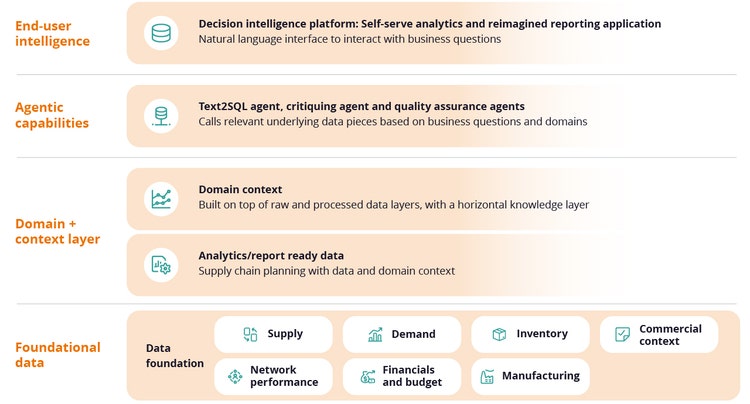
Organizations that sequence these layers correctly find that platform selection becomes a more tractable problem. But the organizations that skip building the foundation tend to produce pilots that perform well in controlled settings before eroding trust in production.
How to get started with a decision intelligence platform in life sciences supply chain
When you’re considering how a DI platform can impact your organization, consider which questions it can answer. To start, choose a question that’s relevant across domains and has real business consequences if answered slowly. Questions like these are what supply chain executives care about most—and analytics teams struggle to answer quickly. They are also the questions that reveal exactly which data needs to be connected and which domain logic needs to be encoded to make a DI platform work.
Once you’ve identified cross-domain questions, you can build the data foundation and semantic layer. You’ll want to scope to these questions, not the enterprise. Organizations that try to build the foundation for everything before delivering anything rarely reach the intelligence layer. Scope to deliver, then expand.
Shifting supply chain planning from calendar-driven to signal-driven
Think of a DI platform as if it’s a capable conversational interface like ChatGPT or Claude that understands your company's supply chain in detail. Ask a question such as, "If we shift ocean freight to air for product X, what is the impact on landed cost, inventory availability and this quarter's gross margin?" and you’ll get an answer in minutes with the trade-offs already clear.
As confidence builds, the program grows. New domains are connected. The knowledge graph deepens. Cross-functional reasoning becomes routine rather than exceptional. Over time, the planning cadence shifts from calendar-driven to signal-driven, and trade-offs that once required days of analysis surface in real time.
That’s the destination. Getting there is a matter of sequencing and discipline, not of selecting the right tool on day one.
For supply chain executives evaluating where to begin, the most useful starting point is simple: Identify the three cross-functional questions that require a multiday analysis effort from your team. These questions are your roadmap.