How emerging biotech company Soleno Therapeutics collaborates on AI and measures impact
Bharat Tandon coauthored this article.
While many life sciences organizations are still evaluating how to best integrate AI into their workflows, Soleno Therapeutics and other companies have achieved value in targeted areas and are planning expanded use.
ZS Principal Bharat Tandon spoke with Mayank Misra, VP, commercial strategy, analytics and operations at Soleno, about this and other trends in automated intelligence.
Here’s a summary of their conversation. You can also watch our webinar to experience the full conversation.
Bharat Tandon: Thank you for being here, Mayank, and for sharing how Soleno uses AI.
I’m encouraged when I see my team and clients treating AI as a member of their team. As these advanced systems take on more responsibilities, what changes has Soleno made to how people collaborate with AI, and what new skills do you think biotech should be focusing on when hiring?
Mayank Misra: The focus right now is around enabling skills and AI fluency that can help people use foundational models in their day-to-day work. We aren’t calling AI a digital employee yet, but we’re getting there in the sense that it’s more embedded in our workflows. For example, a market researcher can use large language models to search and translate information for synthesis and inference.
When I’m structuring a team, my aim has been to provide guidelines and good practices for using digital enablers to help individuals enhance their role, but also ensure there are guardrails and guidelines so we aren’t compromising our proprietary information. It’s also important to bring on people who have AI fluency in prompt construction and design so they can use the already available foundational models.
BT: It’s good to have both new and existing team members go through these competencies to ensure everyone has the same foundation, as change management is a significant barrier to AI adoption.
As we think about AI as a digital employee, it’s also good to treat it as a new employee in the life sciences industry that needs to learn and be trained. Have your employees check the work that’s delivered by the digital employee and treat it not as decision replacement—as strategic thinking and context should still sit with humans—but instead as decision support. This relationship will evolve as intelligence models are validated.
Mayank, how are you seeing AI becoming more of a strategic partner in decision-making in life sciences?
MM: I agree continued oversight of AI is important as the confidence level of its outputs isn’t there yet.
With decision-making, there’s a quality component and a quantity component.
What AI models do better is on the quantity side, as they sift through many volumes of data and provide support. But the quality comes from intuition, that ability to connect the dots from previous experiences—and this is where the models lack.
So, we aren’t comfortable assigning decision rights to them just yet. Like many other life sciences organizations, we’re just focusing on integrating AI for operational efficiencies right now, and we’ll slowly look at getting it to that inference part.
BT: Our survey also shows that 77% of life sciences organizations are currently focusing on integrating AI for operational efficiency. But many other strategy use cases are also becoming more prevalent. (See Figure).
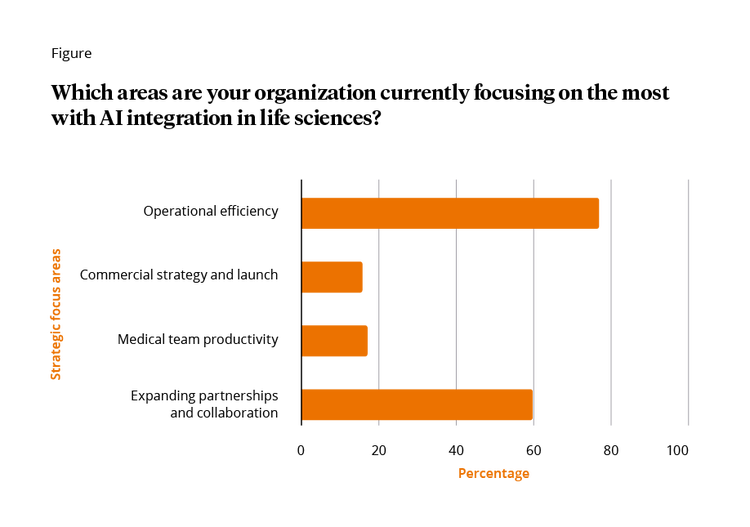
So, what emerging AI trends do you predict will shape growth pharma commercialization over the next three to five years, especially in how partnerships, outsourcing models or team structures may evolve for emerging biopharma?
MM: I think there will be a commoditization of use cases.
Foundational models will become more like operating systems, or a layer upon which many solutions and applications will be built. They’ll be focused on making traditional workflows more intelligent, such as those for order to cash processes, HR functions or transactional back-office work, where it’s very predictable.
With autonomous analytics, these workflows will talk to each other to trigger, for example, sales payout calculations and validate date eligibility. If they aren’t in agreement, it would surface a remediation. AI will also simulate launch scenarios and recommend resource allocation.
Also, there will be a commoditization of skillsets and resources, which will have an impact on partnership architecture. Instead of handing over transactional work to vendors, companies will codevelop AI systems with tech partners and share that innovation.
Lastly, we’ll see the augmentation of digital role twins across organizational structures with AI workflow and governance agents. For example, auditing is likely to get automated because that digital auditor will be always-on and surface only the outlier scenarios for review.
That freed-up bandwidth can then be allocated to other high-value areas in the organization.
BT: I think in the next one or two years, if organizations don’t have autonomous analytics, they’ll feel they’re missing out.
I also anticipate that cocreation, including consultants working together, will continue to be a trend, speeding up processes and resulting in more use cases.
MM: Yes, the winners will be those who partner with vendors not on implementation but on value. It’s not just about getting the analytics right but also about asking what the right business question is. And that will then drive the right set of capabilities.
The shift has to happen on the buy side, where companies aren’t just looking at getting the capability up and running the fastest but finding a way to shift and prioritize the business and incremental value.
BT: To add to that, where has Soleno delivered the most measurable impact with AI integration and how are you measuring that? How do those measurements guide performance expectations for future team members?
MM: There’s no concrete way to measure impact, especially in operations and analytics. I look at it through the lens of capacity and confidence. Is using AI increasing my capacity to do priority and high-value work? And is the work I’m doing, or my team, or function is delivering leading to decision confidence? Are we providing the right decision velocity, the right mix of capacity gain and quality insights?
Qualitatively, AI has expanded capacity by automating different things in marketing content generation and market research. We’ve also seen decision confidence rise, which has allowed us to reduce how fast we move from insight to action as we’ve become more trusting of AI-generated scenarios. That’s a good measure of productivity.
We’ve found the biggest measure has been the ability to respond to questions from leaders quickly with high confidence when we have to synthesize information. So, those are the ways we measure impact: the decision velocity, gain and capacity, along with the overall quality and speed of insights.
BT: We’ve also observed emerging biopharma companies using AI and predictive models in areas where there’s numerous patient datasets, such as determining whether it’s early enough to recruit patients for trials or identifying more demand. They’re also using AI to expand how they predict a patient event and act proactively before it happens. Another high-impact area is improving how they can serve patients more effectively. Some growth pharma companies are using AI to speed up research and expedite trials from years to months.
At ZS, we’re finding use cases for our ZAIDYN® life sciences intelligence platform, such as forecasting and conversion of analytics to insights. Internally, we’re using it for vacancy management and to speed up execution. There are also use cases for ongoing process monitoring and validation of the system, and the output to the consumers. We’re really seeing value in taking things that have broken and putting them in the knowledge of the workflow or the AI agent itself, so that it’s able to generate or predict what else could break in the future and act accordingly.
While many life sciences companies are still exploring AI integration, we’re also seeing some organizations use a combination of in-house and outsourced solutions.
MM: In emerging biopharma where there’s limited resources, there’s usually more of a hybrid approach, because firms like ZS and others bring that benchmark and have seen things that work and don’t work for other clients. This type of marriage is good for determining the right mix of skillsets, capabilities, data and technology to ensure emerging biopharma has the fastest, cheapest path of enabling decisions for patients and the brand.
In large pharma, however, they have specializations and centers of excellence that are inclined to build more in-house. But the challenge can be agility to scale AI, which often takes longer, so I’m not sure what’s the right way.
Consulting firms offer more transactional work that can fill specific gaps they may have as they’re building capabilities in-house. The hybrid approach suits this, versus building it from the ground up in-house, as the faster they can get up to speed on a capability and activate it’s better for business decision-making.
BT: When most organizations say hybrid, the strategic capabilities like context, domain, proprietary data and IP continue to be with them. Then the platform-driven partnerships evolve on the tech side, where data and analytics players like ZS are collaborating on shared infrastructures. In these cases, everybody brings their own secret sauce to the mix. For cocreation, the theme continues here: It’s a balance of where do they continue investing in their own, versus where do they trust somebody else to do the innovation?
MM: There’s a spectrum of those who partner with firms just on the tech stack or the data and developing models. But there’s also codevelopment where they’re bringing firms closer in terms of understanding the business, challenges and go-to-market strategy and then they codevelop the right set of capabilities. It’s how they walk through that large menu and determine the right combination of expertise, capabilities and tech stack. If they prioritize in that manner, they’ll be spending time on the right things, and therefore be faster out of the gate.
BT: What key piece of advice would you give to biopharma leaders just starting their AI transformation journey? And what are the biggest pitfalls to avoid and key success factors to prioritize when building a stepwise roadmap for the AI-powered future?
MM: My advice would be to think about the use cases in terms of trust. There are high-trust deliverables and low-trust ones where a little margin of error is okay. Start where there’s an acceptable margin of error, like market research, and move up in the value chain.
Anchor AI in value, not novelty. Pick two or three use cases that matter and scale from there. It’s important to build credibility and trust through wins and early success.
But there are also foundational things like investing in data readiness before model readiness. Biopharma companies should determine what’s the right data, how to get it ready, what is their mastery of that data and needs—all of that needs to happen first, because AI without clean, connected data is just noise.
Change management is also important. Improving communication and providing a space for people to ask questions is critical as you scale.
BT: After they start with a few high-value use cases and scale, we believe biopharma companies should evaluate how adoption is going so they can learn and pivot for their current and future use cases.
Every adoption journey might look very different, even in the same organization. What they bring from past adoptions allows them to do things faster, not just with the AI agent, but with the people who are going to be adopting the technology.
And when using AI as a digital employee, life sciences organizations must ensure there’s human involvement until they have extreme confidence in what they are getting is high quality, reliable information. It’s important to not let that new team member go on their own but instead continue to coach them appropriately.
BT: What do you view as the primary risk factor for proprietary information by using AI? What are some common measures used to safeguard against these risks?
MM: Ensuring that people understand what can and can’t be done is paramount. We need more automation to ensure mistakes aren’t made. It’s that employee education and partnering with firms to develop automated control so accidents don’t happen.
BT: This has been very insightful. Thank you for speaking with me today.
zs:topic/zaidyn,zs:topic/emerging-biopharma,zs:topic/ai-and-analytics