From fragmented capabilities to a customer-first medtech CRM
Medtech commercial organizations are navigating an increasingly complex environment, offering a diverse set of solutions to a broad set of stakeholders. The customer is no longer a single physician making an independent choice, it’s an ecosystem of health systems, IDNs, GPOs, value analysis committees, payers and patients, all of whom shape what happens before a procedure is ever performed.
The internal model has expanded to match that complexity. Sales reps, clinical specialists, key account managers (KAM), distributors, market access, marketing, support and service all impact the relationship. But too often they see it through disconnected systems and partial data, with limited intelligence and no shared view of where a customer stands or what is getting in the way.
These interlocking challenges define what a customer-first CRM system (C1RM™) is designed to address.
The customer has changed, but medtech’s commercial strategy and model haven’t
A decade ago, the primary commercial relationship in medtech was relatively straightforward: a sales rep, a surgeon and a product choice. The rep built the relationship, the surgeon chose the implant or instrument and success was largely a function of technical knowledge and call frequency.
That model still exists, but it describes a smaller and smaller share of what commercial success actually requires. Today, a capital equipment sale to a health system may involve a service line administrator, a CFO, a value analysis committee, a GPO contract, a technology assessment and a credentialing process—before the surgeon ever uses the product.
An implant that performs well in the operating room (OR) still needs to clear formulary, get onto a preference card and survive a materials management review before it shows up consistently in the supply room. Medtech also includes a much broader commercial landscape—software-as-a-medical-device (SaMD), remote patient monitoring platforms, AI-powered diagnostics and value-based care contracting models where the “product” is an outcome, not a unit.
Medtech reps’ work centers on patient flow, case preparation and clinical support, activities that happen in the OR, the cath lab and the supply room, not behind a desk. A rep managing a complex orthopedic account may be coordinating tray delivery, attending cases and troubleshooting inventory issues across three hospitals in a single day. CRM data entry, in that context, has often felt like a reporting obligation rather than something that helps them do their job.
This means medtech organizations face a steeper adoption challenge than most; the bar for what a CRM needs to return to field teams is higher. A platform that genuinely reduces friction and returns value to the rep is far more likely to earn consistent use—and better use generates the quality data that makes the intelligence layer work.
Medtech’s fragmentation problem runs deep
There’s a second issue: structural fragmentation built up over years of platform proliferation, CRM customization and organizational silos.
A typical medtech commercial organization might find procedure data in a case management system, contract and pricing data in their revenue management platform, inventory and tray information in an enterprise resource planning system, interaction history (if available at all) in a CRM customized differently by each business unit. External intelligence—claims data, physician affiliation networks, preauthorization information—might be siloed in marketing or managed in separate tools or spreadsheets that rarely connect to anything else.
The knowledge that matters most—why the first case hasn’t happened, who is blocking the value analysis approval, what the OR team needs to feel comfortable—tends to live in people’s heads rather than systems. When a clinical specialist leaves or a rep’s territory changes, that knowledge walks out the door with them.
Fragmentation also shows up as cost. Years of accommodating local preferences have created significant CRM customization debt—different data models and reporting structures across business units, maintained at ongoing expense and increasingly hard to connect to modern AI capabilities. The path forward requires different choices: a harmonized global template, clear data ownership and governance built to sustain both value and simplicity.
A customer-first operating model for medtech
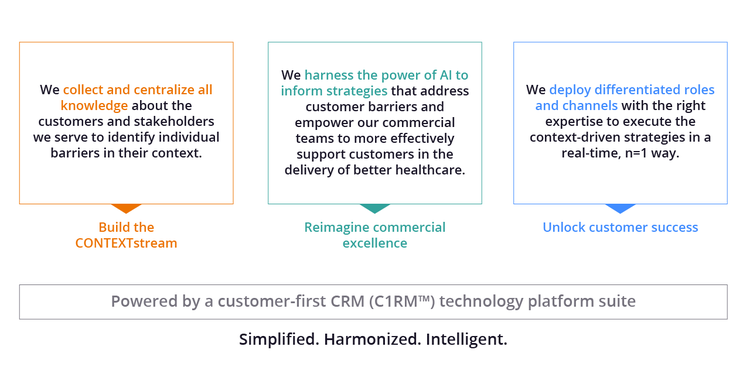
C1RM is built around three mutually reinforcing capabilities: a system of context that captures everything that matters about each customer, an intelligence layer that guides teams on where to focus and what to do next and an activation layer that coordinates the right plays across the right systems and roles.
The organizing logic is the same across all three: the customer’s barriers to adoption are the unit of work. Understand them clearly, coordinate around them effectively, capture what worked—and the learning compounds across the organization.
FIGURE 1: Three pillars, one organizing logic
Pillar one: Build the CONTEXTstream
The foundation of C1RM is a unified, continuously enriched picture of each customer and their context. In practice, this means aggregating everything an organization knows about its customers from multiple data sources and making it accessible to the people and systems that need it.
That data foundation draws from first-party commercial data across various transactional systems (CRM, ERP, CLM), second-party partner data (distributors, GPOs and commercial partnerships) and third-party market intelligence (claims data, physician affiliation networks and syndicated sources). Together, with strong data governance practices and an increasing use of AI, they give the intelligence layer a picture of each customer that goes well beyond what any single system holds.
Understanding where barriers emerge across the medtech patient journey
In medtech, barriers don’t appear randomly. They emerge at predictable points across the patient journey, from the moment a physician first recognizes a clinical need through to post-procedure monitoring and outcomes. Understanding where progress is stalling allows commercial teams to identify the right response and assign the right lead.
Figure 2 illustrates the phases of the patient journey and the stages where barriers most commonly surface.
FIGURE 2: The patient journey
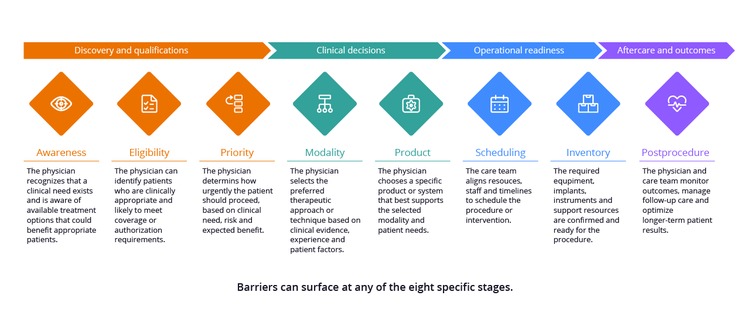
Barriers can be clinical, economic, operational or confidence-related and they can emerge at any point when progress slows, decisions stall or coordination breaks down. Grounding the barriers in this eight-stage framework allows medtech organizations to move from a general sense that “something is blocking this account” to a specific, actionable statement of where in the journey progress has stalled and what type of response is required. ZS has built a robust library of barriers for medtech as an accelerator for companies navigating this journey.
This model is powerful because the intelligence layer above it draws on everything the organization knows, not just what is logged in the CRM. For a cardiovascular team tracking an electrophysiology (EP) physician’s path to first pulsed field ablation (PFA) or an orthopedics team managing tray readiness for a total hip arthroplasty (THA) program, that depth of context makes AI recommendations genuinely useful rather than generic.
Pillar two: Enable intelligence to reimagine medtech commercial effectiveness
With a rich system of context in place, the intelligence layer guides commercial teams on where to focus and what to do across sales, marketing, support and service and across multiple time horizons. This pillar is fundamentally about surfacing insight and supporting smarter decisions.
Core intelligence C1RM capabilities include dynamic targeting and daily account insights; omnichannel journey optimization at n=1; content and engagement intelligence; competitive signal detection; predictive service and maintenance signals; utilization monitoring; and proactive support intelligence for capital-intensive models.
These capabilities matter because of the decisions they influence. A field service team that received a predictive utilization alert 72 hours before a capital equipment failure avoids OR disruption, builds customer loyalty and secures the contract renewal. A rep whose targeting model flagged a competitor’s trial request at a key account before the preference card changed had time to respond before share erosion. In markets with two or three dominant players, the difference between leading and lagging commercial organizations is increasingly whether intelligence reaches the field at decision speed.
Pillar three: Unlock customer success by activating channels and roles
The third pillar is where insight becomes action. C1RM doesn’t just surface recommendations, it gives commercial teams the infrastructure to act on them across every system and role that needs to be involved through well-defined plays.
Activation happens across a connected set of platforms. The CRM is the primary workspace for the field: where plays are assigned, barriers are tracked, cases are supported and interactions are logged. But the activation layer extends well beyond the field CRM to marketing automation, customer support and call center system and field service management platforms that together constitute the full commercial operating environment.
Agentic AI in the field
Agentic AI finds its most visible expression in the activation layer, though it also operates across the context and intelligence layers, automating data enrichment, surfacing signals and running background workflows throughout. Where the intelligence layer surfaces recommendations for human decision-making, agentic AI handles the coordination and routine execution tasks that currently consume significant commercial time. The goal is to remove the friction that limits CRM adoption and free field teams for the relationship-building and clinical work that create the most value.
Where agentic AI can be most impactful:
How it comes to life: Dr. Carter’s THA program
Dr. Sarah Carter is an orthopedic surgeon at a regional health system. She performs roughly 120 THAs per year and has expressed interest in adopting a new anterior approach with a new implant system. Three months after initial conversations, her first case still hasn’t happened.
In a traditional commercial model, this situation is partially visible. The rep knows the relationship is warm. The clinical specialist has done a few educational sessions. But no one has a complete picture of what’s actually blocking progress and responsibility for resolving it is informally distributed.
In the C1RM model, the picture is quite different. The five steps below illustrate how the model operates in practice—a repeatable framework that applies across any business model or therapeutic area.
Step 1: Targeting alert
Situation: The AI model flags Dr. Carter’s THA program for early support—case volume patterns and interaction history suggest the first case is at risk of slipping.
- The adoption co-pilot surfaces the alert with supporting data, recommends a readiness play, schedules a cross-functional huddle and flags the same risk pattern across other business models (a credentialed robotic surgeon without OR block time, a wound closure account plateaus at 40% utilization).
Step 2: Precall prep
Situation: The rep has five minutes before meeting with the OR manager and Dr. Carter.
- The co-pilot assembles the latest case status, surfaces relevant approved content and queues tasks for the clinical specialist, ops and KAM all before the rep walks in the door.
Step 3: Find the barrier
Situation: The team needs to understand where, specifically, progress has stalled.
- The patient journey view pinpoints the stalled stages: eligibility (authorization gaps) and product access (device not on preference card, tray not confirmed) with evidence from claims data and preference card records. This triggers a checklist with owner assignment for each item.
Step 4: Run the play
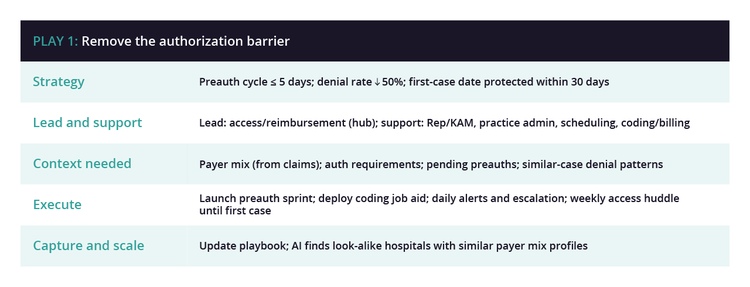
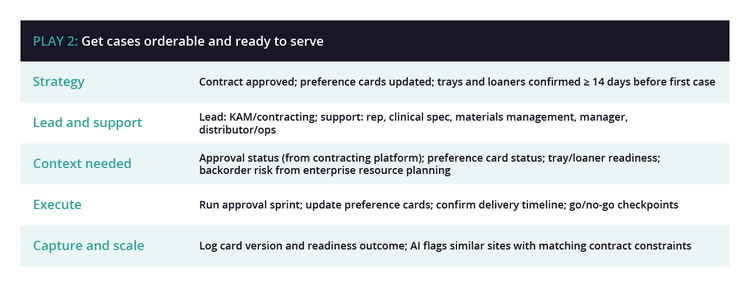
Situation: Two plays run in parallel, each with a defined lead and sequenced steps (Figure 3)
FIGURE 3: Running the plays
Step 5: Close the loop
Situation: Dr. Carter’s first case goes well. The team needs to capture what happened and make it reusable.
- Voice-to-text debrief is captured and autostructured by agentic AI—linked to the account, the play and the specific barriers that were resolved, with no manual CRM entry required.
- The AI extracts learnings (what the payer required, how the OR team was trained, which tray configuration worked) and tags them as reusable patterns in the play library.
- The system identifies hospitals in the region with similar payer mix, similar VA processes and surgeons at a comparable adoption stage and surfaces them for proactive outreach.
The value compounds. Dr. Carter’s win becomes a reference. The play that worked becomes a starting point. What might have stayed inside one rep’s head becomes institutional knowledge that accelerates the next account—and the one after that.
The same cycle, a different segment
The C1RM commercial cycle applies equally outside orthopedics. Consider a cardiovascular team managing an EP physician’s path to a PFA procedure. The physician has completed training and expressed strong clinical interest. Six weeks later, no case has been scheduled.
The intelligence layer flags the account. The barrier view surfaces two stalled stages: scheduling (no OR block time secured for PFA cases) and eligibility (the hospital’s prior authorization process for the new modality hasn’t been established). The system triggers a readiness play with three parallel workstreams: OR block time negotiation with the cath lab coordinator, preauth protocol setup with the payer team and a peer case study sent to the physician from a comparable center that completed its first PFA case two weeks earlier.
When the first case closes, the debrief is captured, the play is updated and the system identifies five other EP physicians at comparable adoption stages across the region—each inheriting the institutional knowledge that closed Dr. Carter’s THA case and the EP physician’s first PFA. Different therapy area, same cycle, compounding returns.
Best practices for CRM integration in medtech sales enablement
We’ve worked with medtech and life sciences organizations through many commercial technology transformations. The difference between the ones that deliver and the ones that disappoint usually comes down to the same handful of factors.
- Business ownership, not IT sponsorship. The most effective C1RM™ programs are owned by commercial leaders with the authority to redesign processes, change ways of working and hold functions accountable for outcomes. Technology is the enabler, not the driver.
- Designed for the field, not for management. Field adoption follows field value. Every design decision should be filtered through the question: does this help the rep, the clinical specialist or the KAM do their job better? Higher adoption generates better context and better context makes the intelligence layer meaningfully more valuable.
- A quantified value case with functional accountability. Executive sponsors who sign up for specific, measurable outcomes in their functions—not just program commitment—create the accountability that drives adoption and benefit realization.
- Leading with technology. The platform should follow the business requirements. Organizations that start with technology selection before defining the commercial outcomes they want to achieve tend to end up with an expensive new home for their old problems.
- Excessive customization. Every accumulated CRM customization should be required to justify itself against a new global template, because they add maintenance cost, reduce agility and make AI integration harder.
- Treating data governance as a follow-on activity. Agentic AI capabilities are only as reliable as the data that powers them. Data governance built after go-live consistently underperforms governance built into the design from the start.
We’ve seen a strong business impact through these digital and AI transformations. These are commercial transformations, not a technology implementation. The difference shows up not in the go-live, but in what happens in the year after it.
Where to go from here: Define the medtech CRM operating model
The case is made. Now the work begins.
The three challenges are solvable: improve CRM adoption with field-first design and agentic AI; close context gaps with a connected data model; and scale barrier-based execution with plays and feedback loops that get smarter with every case.
But these aren’t just technology problems—they’re operating model problems. Progress depends as much on behavior change, governance and cross-functional alignment as on the platform itself.
The best next step is to define the operating model: for which customers, with what data and with what roles accountable for removing barriers. A practical starting point is a C1RM readiness assessment with your commercial leadership team to clarify where you stand across the three pillars, prioritize the gaps and map a realistic first move. This is a conversation about establishing an integrated C1RM operating system. Reach out to start that conversation.