A practical GEO strategy framework to keep your brand in the conversation
Prajwal Shetty, Vivek Bhardwaj and Gaurav Singh coauthored this article
Key takeaways
- Generative AI has become a primary discovery channel, shifting influence upstream of the click.
- Generative engine optimization (GEO) is not SEO applied to AI. It optimizes for how AI systems surface, compare and cite brands in generated answers.
- Inaccurate AI citations can be more damaging than absence, especially in regulated industries where outdated sources can scale errors fast.
- Winning requires a continuous GEO capability—measure, govern and iterate—using frameworks like CRAFT to make progress repeatable.
A CMO at a midsize enterprise software company recently shared a telling moment. Her team had spent three years building top-of-page-one SEO dominance. Then someone ran a simple test: They typed the company’s core use case into ChatGPT and asked for vendor recommendations. The company didn’t appear. Not once. Competitors were cited by name. “We thought we had search figured out,” she said. “Turns out we optimized for the wrong engine.”
That scenario is playing out across industries. Most organizations haven’t caught up.
AI search is now the discovery layer
Generative AI has moved from novelty to primary research channel faster than almost any technology before it. Forrester’s 2025 Buyers’ Journey Survey found that generative AI is now the single most cited interaction type for purchase research—ahead of vendor websites, peer recommendations and analyst reports. ChatGPT alone has over 900 million weekly active users, and Google AI Overviews now appear in more than 25% of all searches, up from 13% just a year ago.
Buyers use these tools the way they once used Google, except instead of scanning a list of links, they receive a single synthesized answer that names brands, makes comparisons, and frames tradeoffs before any vendor site visit.
The commercial consequence is already visible. Traffic isn’t falling because research is declining, instead it’s resolving inside AI interfaces instead of on websites. Driving outcomes now means accounting for AI-mediated discovery—not just optimizing for clicks.
GEO changes the levers and metrics in AI search
GEO is not just SEO applied to AI. Traditional SEO optimizes for ranking position in a list of links. GEO optimizes for how generative AI systems decide which brands to surface, compare and trust. It requires new levers and success metrics.
Three realities catch most brands off guard:
Influence is happening outside your visibility. A buyer can encounter your brand, absorb your key claims, and form a purchase preference entirely within an AI interface—without ever visiting your site. AI-driven searches show extreme zero-click behavior with ~93% compared to ~34% in traditional search and AI platforms crawl your content to generate answers without sending traffic back.
Your own website is not your best asset. In GEO, owned content is not the primary citation driver. AI systems favor third-party, independent sources like trade publications, community platforms and expert-led content, over vendor-controlled websites. Large-scale analyses show platforms like LinkedIn, Reddit and Wikipedia dominate AI citations, reinforcing the importance of external validation and partnerships.
Being cited inaccurately is worse than not being cited at all. Outdated partner pages, archived press releases and inconsistent product descriptions can produce confident-sounding AI errors at scale. In Forrester’s 2025 survey, 19% of B2B buyers said they felt less confident in a purchase decision because of inaccurate AI-generated information. Forrester also predicts a loss of $10B in enterprise value from declining stock prices, legal settlements and fines.
The stakes are amplified in regulated industries. For organizations in life sciences, or other compliance-intensive sectors, AI systems synthesize product information dynamically, often drawing on third-party sources that may be outdated, incomplete or inconsistent with approved claims even before any internal team is aware of it. Organizations in these sectors should be asking:
- Has the legal or compliance team ever reviewed what AI systems are currently saying about our brand?
- Who is accountable for correcting those representations when they shape buyer decisions in real time?
Where GEO efforts go wrong for brands
Despite the urgency, most organizations are either inactive or repeating the same early mistakes.
Treating GEO as a content refresh project. Updating blogs and adding FAQ pages is one input into one layer of a much larger system. AI systems do most of their sourcing from third-party properties—the ecosystem most organizations have never managed with GEO in mind.
Measuring with the wrong tools. Rankings, impressions and session data reveal nothing about AI citation frequency, share of voice in generated answers or whether AI is representing a brand accurately. Most marketing dashboards are built entirely around click-based attribution—making them structurally blind to AI-mediated influence happening before any click occurs.
Moving without governance. Publishing rapidly to capture AI citations, without accuracy review processes, risks amplifying inaccuracies through AI systems faster than corrections can follow. The financial and reputational exposure is real and growing.
Applying SEO logic to GEO is ineffective. Generative search relies on semantic retrieval and synthesis rather than keyword ranking. Models prioritize contextual clarity, factual grounding and cross-source validation.
Not modeling real user prompts. Most organizations optimize for keywords, not how users query AI. Studies show generative systems respond better to natural language, multistep and intent-rich prompts.
What strong GEO looks like in practice
Organizations making genuine progress share a consistent approach—and they are not always the largest. Midmarket brands with clear positioning and active third-party presence often outperform bigger players because AI systems reward clarity and authority over content volume.
Here are four things the best-in-class organizations are getting right:
They start with measurement. Before changing anything, establish a baseline. Which queries matter? How often do they appear in AI-generated answers? How are competitors positioned? Which third-party sources are driving citations in their category? Answering these questions routinely surfaces a counterintuitive finding where companies that rank highly in traditional search can be nearly invisible in AI answers for the same queries, while lesser-known brands gain traction through strong Wikipedia entries or favorable trade media coverage.
They invest in the third-party ecosystem. Wikipedia presence, trade press syndication, review platform engagement and partner content coordination are the channels AI systems trust most, and yet most organizations treat them as afterthoughts. Those that manage them deliberately build advantages that are slow and difficult for competitors to replicate. In the case of a fashion retail brand, thoughtful updates to their Google Business Profiles translated to an immediate lift in high-intent traffic.
They build content for synthesis, not search. High-performing GEO content leads with direct answers, uses structured comparisons and makes specific, data-backed claims. It is organized the way a buyer asks questions in a conversational interface. Princeton and Georgia Tech research found that adding data and statistics to content improved AI visibility by up to 40%.
They treat GEO as a continuous capability. AI citation patterns are volatile—AI Overview content changes 70% of the time for the same query, with nearly half of citations replaced on each regeneration. A competitor’s new white paper or a critical review thread can shift how AI frames your brand within weeks. Organizations running continuous monitoring stay ahead of these shifts. Those running periodic sprints are always catching up because AI-mediated discovery now influences a recurring sequence of buyer decisions long before any sales interaction begins. We have partnered with life sciences organizations to not only establish a baseline with an audit but also translate GEO strategy into a roadmap and an enterprise capability.
The CRAFT framework for GEO
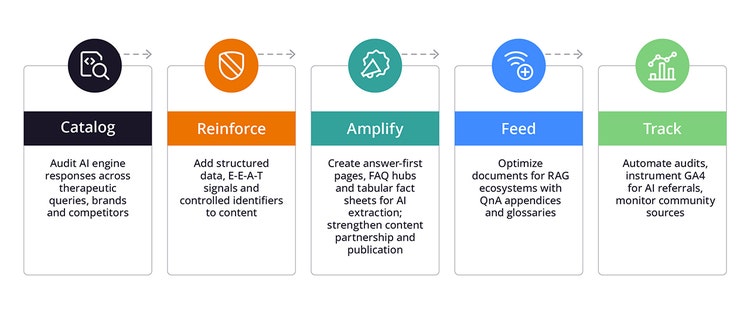
Think of CRAFT as a playbook for getting your brand into the AI conversation—not just once, but consistently, accurately and at every stage of the buyer’s journey. It is built around five practical steps that any organization can act on, regardless of where they start from.
Catalog: Know where you stand before you act. The first step is a structured audit to reveal just gaps in visibility and inaccuracies that could be shaping perception right now.
Reinforce: Update your content to be credible to machines, not just humans. AI systems are designed to favor content that signals authority with clear sourcing, structured formatting and consistent factual claims across the web.
Amplify: Win where AI actually looks. Your own website is rarely where AI goes first. It draws heavily from independent sources like trade publications, professional communities and peer platforms where your presence increases the probability for AI to surface your brand or product in responses.
Feed: Speak the language of AI retrieval. Enhance your content for this reality by testing and structuring it in formats AI systems actively refer to live Q&A sections, glossaries, embedded documents and modular fact-based content that AI can extract cleanly and confidently cite.
Track: Treat GEO as a living capability, not a project. Automated tracking puts in place the monitoring, measurement and feedback loops needed to stay ahead of these shifts so that progress compounds rather than erodes.
FIGURE 1: The CRAFT framework for GEO
How inaction in AI search costs brands
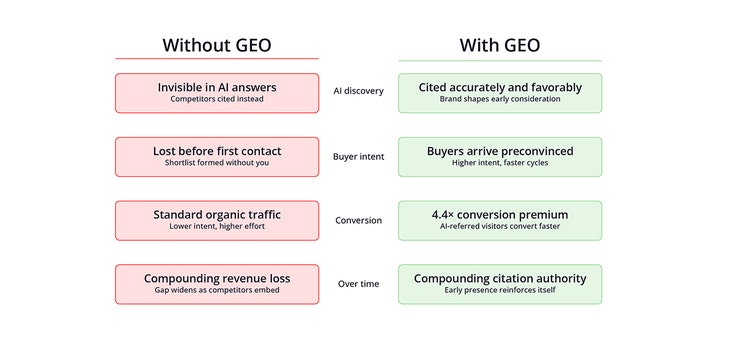
Brands that establish an accurate, consistent AI presence early are building credibility that compounds over time. Early citation history becomes increasingly valuable as AI models improve at assessing source authority, which is the same compounding dynamic that rewarded early movers in SEO and social media.
The corollary is also true, as AI is already capturing high-intent queries. When your brand is absent, competitors shape the narrative and win early consideration. Absence at the AI discovery stage means ceding influence at the moment of consideration, before any sales conversation begins.
The revenue mechanics are straightforward; AI-referred visitors convert at 4.4 times the rate of traditional organic visitors. As AI visibility drops, so does conversion efficiency—creating a compounding effect on revenue that disproportionately benefits whoever is present.
In high-consideration purchase environments, where buyers research extensively before engaging any vendor, GEO’s impact can be especially pronounced. Organizations that have modeled the relationship between AI citation share and downstream pipeline are already seeing the impact. Even small gains in AI visibility translate into real movement in brand consideration and inquiry volume.
Investing in GEO is not the risk, designing it as a one-off initiative is. The organizations seeing impact treat GEO as a governed system, one that shapes how AI senses, decides and acts on their behalf across the buyer journey.
The early-mover window in GEO is closing
From our work with clients, we have seen that the inflection point comes when GEO is owned as a cross-functional decision capability, not a marketing tactic, connecting AI visibility directly to commercial outcomes. Generative AI has already shifted consideration and demand. Those who act decisively will capture it.
FIGURE 2: GEO adoption curve
The window for early-mover advantage in GEO is open, but not for long. The brands investing now in systematic AI visibility are building advantages that will be difficult to replicate when the rest of the market catches up. Organizations need inputs to identify where they stand, what it will take to close the gap, and how to build a GEO capability that connects AI visibility to commercial outcomes.
Related insights
zs:topic/ai-and-analytics,zs:topic/marketing