GLP-1s give us a path to beating obesity, but making it a reality won’t be easy
“It looks,” writes The New York Times, “like we’re living in a golden age for medicine.” They have a point. Our investments in screening for, treating and targeting drivers of cancer have reduced mortality rates to the point where we can credibly imagine a world in which some cancers are largely preventable. mRNA vaccines, meanwhile, promise protection against a long list of awful maladies, including HIV, tuberculosis, malaria, Zika and even cancer. Gene-editing and cell technologies now offer hope for millions suffering from inherited diseases, such as cystic fibrosis, sickle cell disease and others.
And then there’s obesity.
Decades of efforts to control obesity through exercise, dieting, surgery and drugs have proven an unmitigated failure. While these options may work for some patients, none of these interventions—either alone or in combination—have produced sustained, population-level results. This is why no country has experienced a decline in obesity since the 1970s.
But now, for the first time in history, we have highly effective and safe pharmacological tools to deploy against obesity: glucagon-like peptide-1 receptor agonists (GLP-1s), which include Wegovy and Mounjaro, have been shown to help patients shed between 15% and 20% of their body weight. The recent announcement that Wegovy can reduce the risk of major cardiovascular events by 20% is strong evidence that these drugs offer both short- and long-term benefits. Meanwhile, the next generation of drugs, already in late-stage clinical trials, promises to push that figure up to—and possibly beyond—25% weight loss. While these drugs offer hope to millions of consumers struggling to maintain a healthy weight, the traditional healthcare infrastructure and obesity treatment paradigm are ill-equipped to supply the hundreds of millions who could benefit from a better model.
With obesity, we stand at a crossroads: Either we rely on traditional structures to deliver these drugs to the slice of the population that can access and afford them, or we do what is right and make population health our priority. This means acting quickly to figure out how to deploy today’s obesity solutions at scale.
A public health challenge like no other, obesity demands a solution like no other
When a doctor sees a patient with high cholesterol, a condition driven by a mix of biological, environmental and behavioral factors, she likely will prescribe diet and lifestyle changes alongside one of the many drugs approved for its treatment. A patient presenting with obesity, on the other hand, a condition with even more complex drivers and a much larger societal footprint, will likely receive a decidedly less robust prescription: to eat better and exercise more.
It’s easy to see why doctors resort to this outdated, one-size-fits-all approach to patients who are overweight or obese: It’s a numbers game. Nearly 70% of U.S. adults are either overweight or obese, meaning most doctors won’t have time to create individualized treatment plans that go beyond suggesting routine lifestyle changes. If the doctor is familiar with GLP-1s, he may write a prescription—but just as likely, the patient will find either that it’s out of stock at the pharmacy or not covered by their insurance. If they’re significantly overweight, surgery may be recommended.
But here’s the problem with this status quo: These existing weight-management tools have failed to achieve the scale required to reverse obesity. Even as they help some patients achieve their weight-management goals, success is often temporary; many patients who lose significant weight will regain most, if not all, of it.
Any serious effort to reduce obesity at the population level must start by acknowledging that it’s a chronic disease and that we must use all tools at our disposal—including coaching, technology, lifestyle changes and safe, efficacious drugs—to treat it. While most doctors may recognize obesity as a chronic disease in the abstract, when it comes to creating scientifically rigorous weight-management journeys for real-life patients, too many clinicians prefer to fall back on outdated beliefs about the causes of (and solutions to) obesity. They point to a patient’s behavior and seek to address this chronic condition with just one tool in the toolbox. It’s like combating rising sea levels only by building higher sea walls; it will work in some cases, but it’s difficult, it’s unsustainable and it’s a point solution to a multifaceted problem.
Reversing the tide against obesity will require all hands on deck
Consider cancer. Like obesity, many types of cancers are caused by a complex mix of genetic, behavioral and environmental factors. When the U.S. declared its war on cancer in 1971, it didn’t just go after the disease’s pathology. It also opened fronts against individual behaviors and environmental drivers of disease—by regulating the tobacco industry, for example, to reduce the prevalence of lung cancer.
The result was a large-scale shift in social attitudes toward smoking cigarettes. While smoking used to be ubiquitous in both popular culture and real life, every pack of cigarettes now carries an often-gruesome warning about the risks of smoking. Meanwhile, we also invested—and continue to invest—billions of dollars in new techniques for screening, diagnosing and treating cancers. We make these investments because we’ve collectively agreed that cancer’s financial, health and social costs are too high to ignore. These investments are ongoing: The Biden administration’s Cancer Moonshot requested $3 billion in its 2023 budget alone, and that’s in addition to all the other money the U.S. government spends to fight cancer. In contrast, when the White House launched its Steps to a Healthier US initiative in 2003, it allocated just $15 million to combat obesity in its first year. While the White House Conference on Hunger, Nutrition, and Health in 2022 announced $8 billion in new private and public funding to combat hunger and diet-related disease, its fact sheet on the initiative mentions obesity only three times and in narrow terms.
Arresting and reversing the rise of global obesity will take a similar, arguably much more intensive effort. Because unlike for certain types of cancer, whose social and environmental drivers can be traced to just a couple of industries, obesity’s social and environmental drivers are much more varied. As long as food subsidies underwrite a steady supply of cheap, unhealthy food and historical inequities drive disparities in access to quality healthcare (to give just two drivers among many), obesity will persist.
Pharma must pursue “mass market” obesity solutions now to buy us time to create systemic change
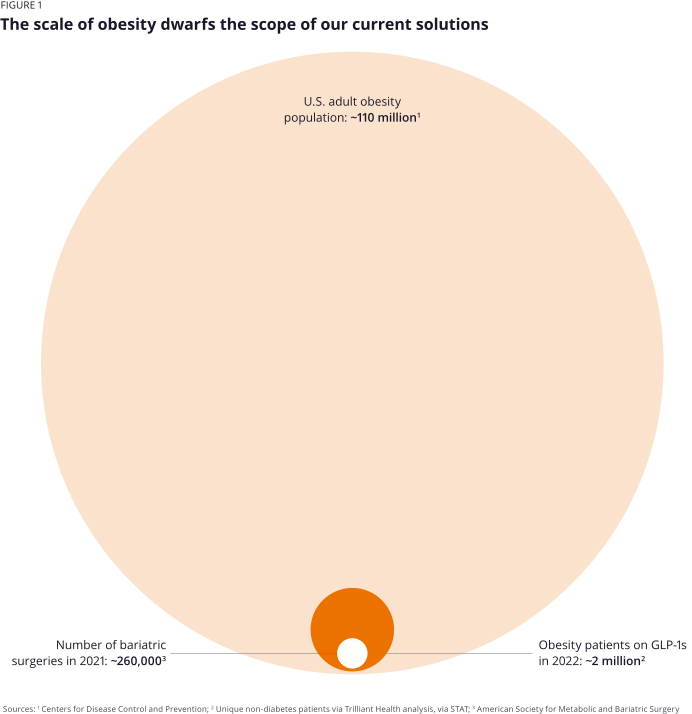
We finally have tools to tackle obesity through a variety of effective interventions, including medication. While patient demand for GLP-1s runs extremely high, Figure 1 illustrates the degree to which their current use falls short of the scale required to bend the obesity curve. Multiple clinical and social factors drive this, but the two most pressing are the cost and supply of these drugs. The traditional pharmaceutical commercial and manufacturing models are partly to blame. To make the economics work, they will need to evolve.
Today’s GLP-1s cost about $15,000 per year in the U.S., and only a quarter of employers—and just 10 state Medicaid plans—cover them. Medicare is prohibited by law from covering these drugs. This means they currently are a niche treatment available mainly to those who can afford to pay for them out of pocket. (This status already has been cemented outside the U.S.; in Germany, Novo Nordisk launched Wegovy without payer coverage, while, in the U.K., the National Health Service has said it will cover injections for only about 35,000 people per year—a tiny fraction of the 13 million Britons who live with obesity.)
If this dynamic continues, here’s what’s likely to happen: Millions of people will lose weight, but far fewer than the hundreds of millions who suffer from obesity. Many of those who do lose weight will regain much if not all of it when they taper down or discontinue use of the drugs, as ample evidence suggests they will. And the global prevalence of obesity—along with its associated economic, social and health consequences—will continue to rise. Pharma will still profit, but much less handsomely than it otherwise could have. And it will fail to achieve its lofty mission of helping patients become and remain healthier
Let’s briefly consider an alternative, though no more desirable, path: Healthcare stakeholders decide that the patient benefit and risk reduction of cardiovascular disease, Type 2 diabetes and other complications of obesity are too compelling to deny coverage. Great! But more than 130 million adults in the U.S. could be eligible to take Wegovy or Mounjaro (the latter of which the FDA is expected to approve for weight loss this year), either because they suffer from obesity or are overweight with at least one comorbidity. Paying for even a fraction of these healthcare consumers to take these drugs, or doing so at a fraction of current prices, would cripple the U.S. healthcare system—to say nothing of what it would mean for global health systems.
To break this impasse, drug manufacturers and others must commit to a strategy of securing access to GLP-1s for every healthcare consumer who wants them and is eligible under clinical guidelines. Theoretically, manufacturers could achieve near-universal coverage for, and mass adoption of, these drugs if they lower prices far enough. We don’t see this as particularly likely or advisable. Instead, we believe pharma should cut prices while simultaneously pursuing a menu of options to help them unlock a larger population at a more affordable price—a course of action that, provided they can solve today’s supply chain issues, would make the economics viable while solving today’s most pressing public health crisis.
Operationalizing a new business model for weight-management drugs
- Redefine the journey from weight loss to weight management. Not every healthcare consumer struggling to manage his or her weight should be prescribed medication before exploring other interventions, and not every patient with obesity needs to be on the drug that yields the largest potential weight loss (and therefore commands the highest premium). Pharma, payers and health systems must collaborate to develop guidelines and lines of therapy based on clinical evidence, population health goals and financial constraints. Importantly, these guidelines and lines of therapy should consider “drug plus” solutions that integrate beyond-the-pill weight-management innovations across the patient journey. There will be millions of individual patient journeys and therefore no single “solution.” However, many of these solutions don’t exist today, so it’s imperative that policymakers and regulators incentivize innovation.
- Pursue innovative population health-based models. Lowering the list price of GLP-1s likely won’t be enough by itself to make mass adoption financially sustainable. Pharma also must pursue other ways to lower the per-patient cost of these drugs by using mechanisms such as fixed-cost models, whereby manufacturers supply payers with as much GLP-1s as they need for a set cost, or capitated models, whereby manufacturers charge payers a per-patient cost for GLP-1s, regardless of volume—provided that cost is significantly lower than it is today.
Pharma also could look to partner directly with employers in the U.S. to offer GLP-1 coverage as a competitive advantage. Regardless of how they choose to do this, pharma must invest in proactively generating both clinical and economic evidence to get these drugs on formularies or devising mechanisms to offer drugs directly to consumers (as Novo Nordisk is doing in Germany). Going direct-to-consumer risks leaving out the most vulnerable patients, especially since obesity strongly correlates with socioeconomic status; therefore, pharma should launch medicines with robust patient support systems. - Improve manufacturing capacity and supply chain. After affordability, the second highest barrier to mass market uptake for GLP-1s is manufacturing capacity. Like the manufacturing model widely employed by technology companies such as Apple, pharma should look to boost manufacturing capacity by licensing its technology to contract manufacturers to produce these drugs. Doing so will require significant standup time and investment in digital capabilities to enhance technology transfer. But manufacturing capacity only solves part of the problem; scaling supply by 10x or 20x will require manufacturers to take a holistic look at the end-to-end supply chain to ensure robust product flow. Ideally, policymakers would see the public health potential of partnering with drug companies to co-invest in strengthening the supply chain. However manufacturers choose to boost capacity, the goal should be to supply everyone who needs these drugs—not only those who have access given today’s constraints.
Tackling obesity is a marathon, not a sprint. But we must start now.
Aligning stakeholders from across healthcare around the goal of combating obesity using medication will be challenging enough. But it will only get us so far. Long-term success will depend on aligning a much wider swath of society—everyone from academics and technology companies to national governments and NGOs—to build on this short-term foundation to develop scalable, affordable and, most importantly, sustainable weight-management tools.
Of course, this opportunity wouldn’t exist without the new generation of weight-loss drugs, which make victory against obesity finally seem possible.
Let’s not squander the opportunity.
Related insights
zs:topic/supply-chain-and-manufacturing,zs:topic/value-and-access,zs:topic/research-and-development