How TrumpRx and PBM reform will redefine global drug pricing
Pharma: Prepare now to thrive in a transparent pricing world
Two recent announcements are likely to shape the already-disrupted biopharma transaction model in the U.S. The rollout of TrumpRx offers a clearinghouse for discounted cash prices for assorted medicines. Meanwhile, the Federal Trade Commission (FTC) settlement with Express Scripts, one of the “Big Three” pharmacy benefit managers (PBMs), potentially upends much of the logic underpinning drug pricing and discounting by shifting away from rebate maximization and toward reducing net prices.
While the future path remains unclear, we believe the time is now for biopharma to imagine a future with transparent U.S. pricing and discounting and to prepare to thrive in this environment.
We’ll cover:
- The current state of play in the biopharma ecosystem
- What may follow as a result of the latest disruptions to the pharma pricing model
- Drug pricing model implications for key stakeholders in the ecosystem
- Recommendations for U.S. biopharma business leaders
Current state of play: The end of the pharma-PBM blame game?
A debate has raged for years about who is most responsible for high drug prices in the U.S. and, especially, for the high out-of-pocket costs many patients face. Biopharma has argued that the PBM industry’s opaque pricing model pushes list prices up to provide room for the rebates that drive drug coverage decisions. Patients are harmed by this distortion because their copays are often set as a percentage of a drug’s list price, or even the full price of the medicine during a deductible phase. The PBMs have countered that they are not the ones who make list price decisions, so responsibility for those high prices lies squarely with the biopharma leaders who do.
Regardless of where the fault lies, it is clear that the incentives in the current ecosystem push many drug list prices up rather than down, even in highly competitive categories. Drugmakers compete for coverage through opaque rebate offers that create profit opportunities for intermediaries rather than helping patients save money. Political leaders in both parties have identified these incentives as problems and are taking action to address them. The recent rollout of TrumpRx and the settlement between the FTC and Express Scripts are evidence of that action.
The role of TrumpRx in the pricing game
In the case of TrumpRx, drugmakers can offer transparent cash prices that are often significantly discounted from the list prices. The initial set of brands is modest, with many having lower-cost generic versions already available. This channel could eventually evolve to encompass a broader set of brands and to potentially provide a transparent price reference for traditional PBM-mediated acquisition channels. Meanwhile, the FTC lawsuit initiated under the Biden administration and settled by the Trump administration demands that Express Scripts’ “standard offering” now:
- Prioritizes low net prices over maximizing rebates
- Sets administrative fees that are not dependent on drug list prices
- Guarantees that patients share in any negotiated discounts
Such an arrangement would, if scaled, put an end to the incentives promoting high list prices coupled with high rebates.
Uncertainties and what could follow from the latest disruptions to the pharma pricing model
While the FTC Express Scripts settlement provides a roadmap for transparent and less distorted U.S. drug pricing, we are far from the end of this road. First, many medicines still are not part of this arrangement, particularly those that tend to be covered outside of a patient’s pharmacy benefit (typically medicines that are injected or infused in a clinic or hospital setting). Second, the settlement itself is potentially quite narrow. The other PBMs in the “Big Three,” CVS Caremark and Optum, have not yet settled with the government. Third, most of the Express Scripts settlement terms focus on the PBM’s “standard offering,” but don’t require health plans who contract with Express Scripts to select that arrangement. In other words, if a health plan prefers today’s high price plus high rebate model, they appear to still have access to it.
It’s critical for biopharma leaders to plan for a future where the U.S. drug pricing system looks broadly like the “standard offering” in the FTC Express Scripts settlement. That’s because the remaining PBMs will likely agree to reasonably similar terms with the U.S. federal government. Meanwhile, health plans that have preferred high rebates in the past could come under pressure to adopt low net price designs, especially as patients gain greater visibility to lower drug prices available outside their health benefits.
Drug pricing model implications for key stakeholders
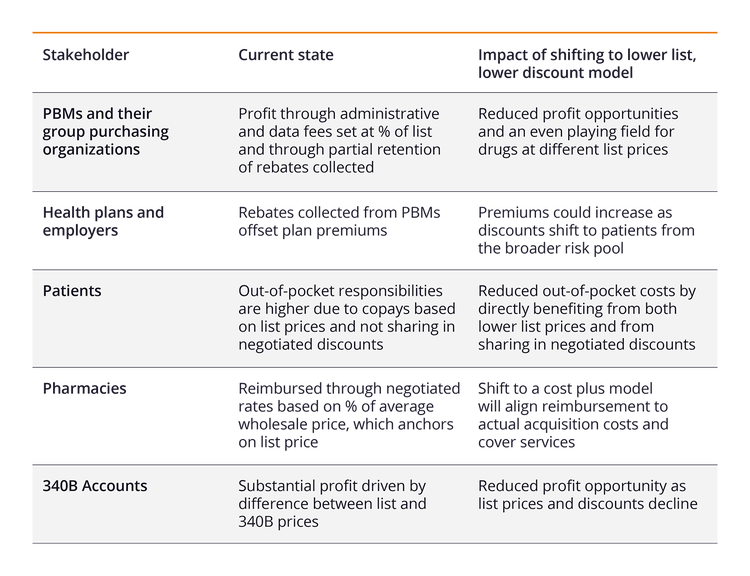
A drug pricing system geared toward lower net prices could bring a combination of lower list prices and greater transparency around discounts. This change would be profoundly disruptive to many stakeholders in the U.S. drug transaction ecosystem because of the reliance that many players have on today’s pricing model. Here are the impacts we’ve outlined for key stakeholders across the ecosystem:
Recommendations for U.S. biopharma business leaders
We have three immediate recommendations for U.S. biopharma business leaders. First, leaders should map out the strategic responses of all affected stakeholders to make sure their organizations have a clear understanding of the new game. Second, leaders should design a new business process for U.S. pricing and discounting in this environment. And third, leaders should adjust global pricing practices for a world where U.S. net prices are transparent and linked to global prices through “most favored nation” (MFN) policy.
1: Map out the strategic responses of key stakeholders to these drug pricing changes
We anticipate that each stakeholder group will take different strategic responses. For example, health plans may increase copay and coinsurance levels to offset premium growth. Or the leading PBMs may lean more into other value-added services such as real-world evidence assessments as a means of maintaining the advantage their scale provides.
U.S. biopharma leaders should map out the first-order impacts of a lower list, lower discount model extensively and then play out the most likely strategic responses for each stakeholder. Leaders should then assess how commercial activities should evolve to address these new behaviors. If copay and coinsurance levels go up, for example, how might that affect commercial copay program design? Playing out these responses and impact on commercial activities will help prepare the industry these types of shifts in the U.S.
2: Design the new U.S. drug pricing business process
Today’s rebate and fee arrangements between biopharma and PBMs are opaque with no visibility for patients, drug competitors or other PBMs on terms. If, however, patients directly benefit from contract discounts at point-of-sale, they will be able to discover these. For example, if a drug with a $1,000 list price offered a 50% discount to the PBM, a patient with 25% coinsurance would pay $125 at the pharmacy. Anyone with visibility to that patient claim—which would include both drugmakers and other PBMs—would be able to calculate the implied discount.
This type of change would affect the existing business process around pricing profoundly. Today, list price decisions tend to consider future discounts only lightly. And each contracting decision is treated independently (typically with some general guidelines) because the rates offered to one counterpart don’t affect the rates offered elsewhere, nor do competitors gain visibility into the details of winning bids.
Most organizations have designed business processes around this environment with contract-specific analyses, negotiations and authorizations. Those processes will not be fit for purpose in a transparent world where discounts with one entity are discoverable by other entities and by competitors. Instead, biopharma will require more centralized and internally consistent pricing tactics that treat all discounts as discoverable and interconnected. This will also require new types of analysis. For example, how might incumbents or new entrants respond to a biopharma company’s pricing terms? And what is the right discounting strategy for a PBM’s “standard offering?”
3: Adjust global drug pricing practices
MFN policies, to date, have yielded lower prices for Medicaid and cash-pay patients for a limited number of therapies from 17 large biopharma manufacturers. The Global Benchmark for Efficient Drug Pricing (GLOBE) model pilot and the proposed Guarding U.S. Medicare Against Rising Drug Costs (GUARD) model expand MFN pricing to a subset of the Medicare population as well. And the Express Scripts deal with the FTC has the potential to link the net price that U.S. private insurers pay to a global reference price that is visible on TrumpRx and must be part of Express Scripts’ “standard offering.”
This change would further constrain manufacturers in how they price globally, which would affect launch timing, sequencing and availability throughout the world. Today, manufacturers’ prices ex-U.S. are primarily driven by health technology assessments and governmental willingness-to-pay, which often yield prices that are well below those paid in the U.S.
Managing the effects of transparent drug pricing outside the U.S.
A transparent list price offered by PBMs competing with an MFN-linked TrumpRx price would effectively eliminate manufacturers’ ability to offer lower prices ex-U.S., as manufacturers would be forced to preserve margin in the U.S. to fund future innovation. Countries outside of the U.S. would then be faced with challenging decisions about whether to pay more, or more likely make difficult trade-offs to not cover certain therapies at all when they cannot afford to do so. This would likely result in a tiered system, where major breakthrough therapies are prioritized for reimbursement at the U.S.-linked price, while incremental innovation is likely to not be covered in many countries.
Biopharma manufacturers whose pricing and commercial strategy decisions today are made largely at a country level will need to adapt rapidly. They will need to establish global pricing models and run scenario analyses to determine the optimal price of each therapy in an MFN-linked global market. Go-to-market strategy and investment decisions, which are directly tied to country-level forecasts will also need to change, as more products become inaccessible through government payers at MFN prices. And in the longer term, questions about the sustainability of the current model and the need to source innovation at a lower cost, whether from China, Europe or elsewhere, will force challenging decisions for health authorities ex-U.S.
Where does the drug pricing road take us from here?
While much remains murky about the future of U.S. drug pricing, the general direction of travel toward lower list prices linked to what other countries pay and transparent discounts that benefit patients is clear. Organizations that begin planning for that future now will have the edge over those who react in real time. Articulating that future environment in detail and assessing how pricing business processes and global launch strategy must evolve are three essential places to begin to prepare now.
Related insights
zs:topic/customer-experience,zs:topic/strategy-and-transformation