From curiosity to capability: Shivam’s journey in agentic AI
AI-led decision-making isn’t just about building smarter, faster or more autonomous agents. It’s about redesigning how decisions are governed and trusted to drive positive outcomes . To see what that looks like in practice, we spoke with Shivam Shivam, a leader of ZS’s Tech Innovation Lab in India, our firm’s engine for turning emerging AI into real client impact.
Shivam joined ZS in 2018 as a business technology analyst, bringing his curiosity to how data can solve real-world problems. Over the years, his career has evolved alongside the technology itself—from data warehousing and digital marketing automation to natural language processing (NLP), knowledge graphs and, ultimately, agentic AI systems.
Now, Shivam leads a team of more than 70 engineers, specialists and architects who rapidly prototype emerging technologies, build reusable assets and incubate client solutions. His focus on turning advanced AI concepts into scalable, real-world impact reflects not just his personal growth, but how ZS approaches innovation.
His latest research on multiagent governance has been accepted through the Institute of Electrical and Electronics Engineers’ (IEEE) peer‑review process, a global benchmark for technical credibility.

Shivam Shivam presenting at an IEEE conference in Japan
AI-native transformation starts with decision design
AI is creating value across organizations, but how teams work hasn’t always kept pace.
“Today, we talk a lot about creating agents,” Shivam explains. “But controlling agents is far more important than just creating them.”
In early experiments, Shivam observed that agents with different objectives could enter feedback loops, essentially working against each other. This led to slower decisions, increased cost and unnecessary complexity.
“If you don’t align agents around a shared goal, they can easily go in different directions,” he says.
That realization shaped his focus: designing systems where AI decisions are not only powerful, but also aligned, transparent and trustworthy.
The A2 Layer Control Framework: balancing structure and autonomy
As his work in agentic systems evolved, Shivam developed the A2 Layer Control Framework—a structured approach to governing multiagent behavior while preserving flexibility. Just as children begin life under strong parental guidance before learning to navigate the world independently, Shivam designed a system where:
- Parental rules define nonnegotiable global objectives (shared values, core constraints)
- Environmental rules allow agents to learn and adapt through interaction, without violating those core principles
“At ZS, we often say: do the right thing, treat people right, get it right,” Shivam notes. “Those values resolve conflicts across the organization. Agents need the same kind of global objective function.”
This structure creates stability without stifling learning, an essential balance for real-world AI systems.
From theory to impact: testing in regulated pharma
To validate the framework, Shivam applied it in one of the most demanding environments possible: regulated pharma content generation.
In these scenarios, errors aren’t just inconvenient. They can be dangerous. A single incorrect dosage unit in a clinical document can have serious real-world consequences.
With governance built into the system, the team was able to:
- Accelerate content movement through review cycles
- Reduce unnecessary computing cost
- Improve consistency and reliability
- Increase predictability in system behavior
Using regulated pharma content as the test case proves that governance doesn’t slow agentic AI down—it makes it accurate, affordable and safe enough to use.
Scaling impact across ZS
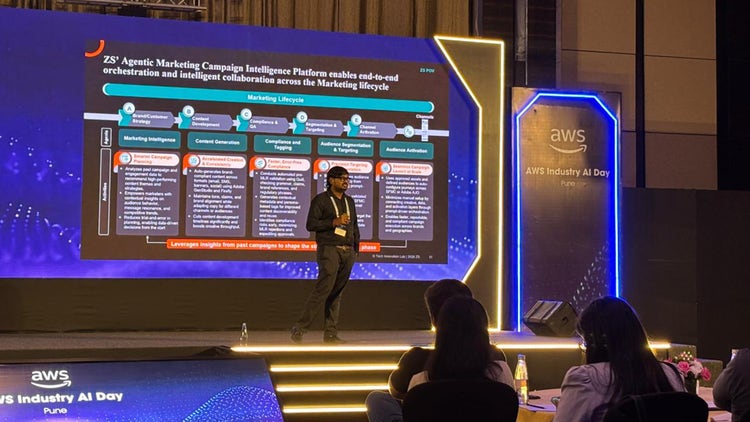
Though initially tested in pharma, this framework is designed to scale across industries and use cases. Through the Tech Innovation Lab, this capability is already being embedded across the firm. The Lab supports active business development and delivery across multiple pharmaceutical clients and domains, including commercial, research and development, and supply chain management.
The lab’s growing footprint includes:
- 50+ reusable accelerators enabling rapid AI deployment
- 75+ technologies actively used across client implementations
- 20+ research publications, including international IEEE presentations
By centralizing foundational AI capabilities, from agentic architecture to responsible AI guardrails, the Tech Innovation Lab ensures teams aren’t rebuilding from scratch, and clients can realize value faster.
Turning innovation into real-world outcomes
For Shivam, the most rewarding part of the journey is advancing the technology and the teams behind it.
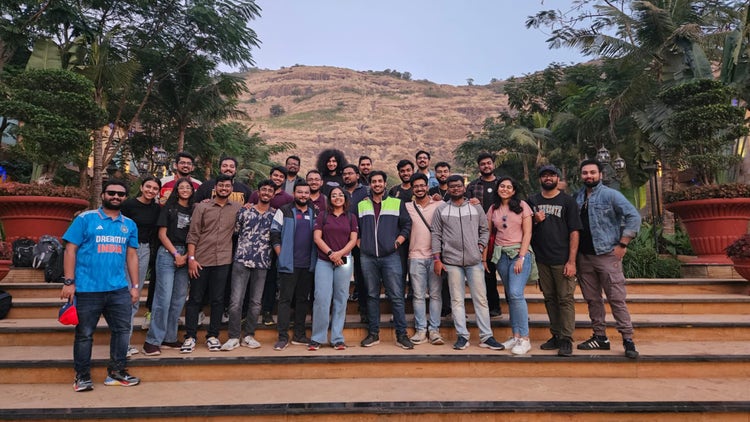
Shivam Shivam and team
“What I’ve enjoyed most is the combination of building technology and building people,” he reflects. “Seeing a team I helped shape become leaders in this space is deeply fulfilling.”
Seven years into his journey at ZS, his impact continues to grow.
“There’s a lot of hype right now,” he says. “But what matters is applied research—work that moves quickly toward real business outcomes.”
At ZS, that mindset connects innovation to execution, ensuring AI doesn’t remain theoretical, but becomes something organizations can trust, scale and rely on.