How should health plans respond to the One Big Beautiful Bill Act?
Ellen Sexton, Executive Vice President and Chief Growth Officer, Blue Shield of California, co-authored this article.
Katie Kong, Cheri Rice and Chris Dallas-Feeney contributed to this article.
How should health plans respond to the One Big Beautiful Bill Act?
The One Big Beautiful Bill Act (OBBBA) is changing the economics of health plans. By increasing pressure on coverage, servicing, affordability and provider stability across Medicaid, the Children’s Health Insurance Program (CHIP), the individual market and dual-eligible populations, it reshapes the operating and financial environment for health plans.
For health plans specifically, prior policy changes largely required organizations to adapt how they deliver care. OBBBA pushes plans to take on a much more active role in keeping members enrolled as eligibility requirements tighten, documentation burdens rise and pathways to coverage narrow. Potential enrollment loss is one part of a wider operating and financial exposure. This could result in higher churn, more servicing burden, greater affordability pressure and deeper provider strain, with impacts that will vary meaningfully by state and market position.
Plans need to understand how the policy changes are likely to play out in practice and what response they require. The management questions are immediate. What does a plan protect first and where does the operating model need to change? Blue Shield of California illustrates how one plan is responding to coverage instability, servicing pressure and provider strain, while using advocacy to address conditions outside its direct control. More broadly, plans will need to decide what to stabilize now, what to optimize within the current model and what to reshape over time. Those choices begin with understanding how the pressures compound.
4 ways OBBBA creates compounding pressure for health plans
The real challenge of OBBBA is the way multiple forms of pressure can build at once across the business and become harder to manage in combination. Taken together, the law concentrates risk in four areas that matter most for plan performance.
1. Coverage instability becomes persistent
In Medicaid expansion populations, work requirements, six-month redeterminations, immigrant eligibility restrictions and new cost-sharing provisions create multiple pathways to disenrollment. In the Affordable Care Act (ACA) market, stricter income verification, reduced automatic reenrollment, narrower special enrollment pathways and the loss of enhanced subsidy support (the expiration of the American Rescue Plan/Inflation Reduction Act enhanced premium tax credits at the end of 2025, not enacted by OBBBA) increase friction while net premiums rise. Enrollment loss from subsidy expiration will continue to materialize through 2026 and beyond, on top of the direct disenrollment OBBBA drives. For plans, this could lead to membership becoming less predictable, care continuity harder to protect and risk pools more vulnerable to adverse selection as healthier members exit first. Members who retain coverage may face higher paperwork burdens, rising out-of-pocket costs and growing financial strain.
FIGURE: How OBBBA could drive Medicaid and ACA enrollment losses
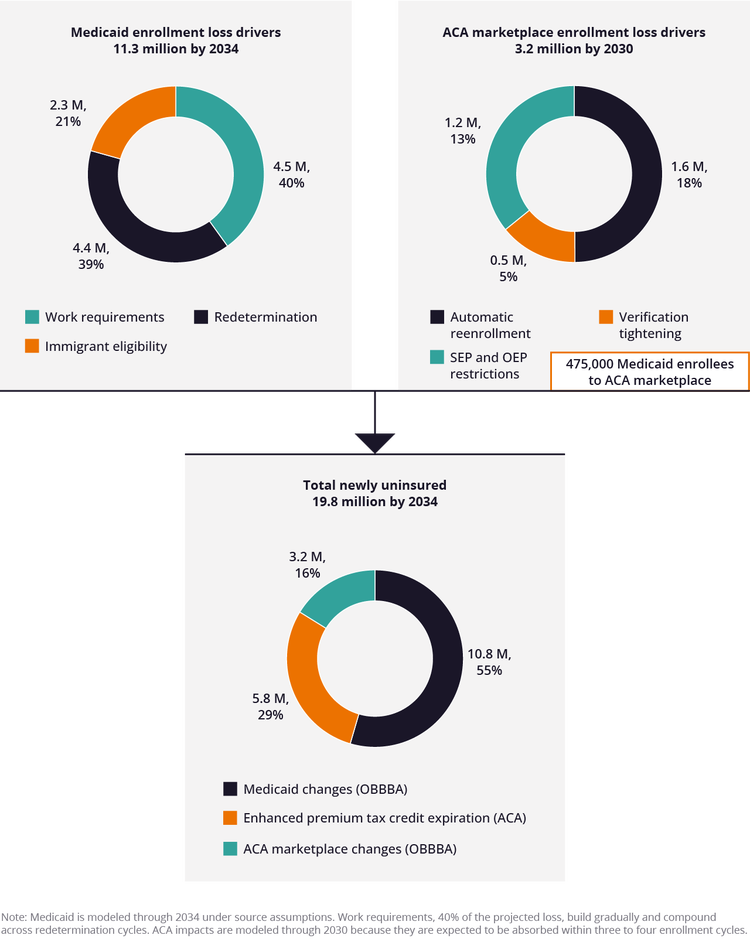
Note: Estimates are cumulative through 2034 and may change with future policy. Analysis was performed in March 2026 and is based on ZS modeling.
2. Administrative burden rises across programs
OBBBA raises the ongoing effort required to keep coverage intact and reinforces the need for efficient member engagement channels. More frequent eligibility checks, work or exemption verification and added documentation extend administrative burden well beyond the annual renewal cycle. When verification breaks down, often outside plan control, coverage shifts into stop-start patterns that drive churn, reinstatement loops and repeated rework. The burden shows up across process, staffing and data. Call centers, eligibility teams, care managers and provider administrative staff all absorb more “fix-it” work, while harder-to-verify cases increase manual outreach and reconciliation. The result is higher service cost, more provider abrasion and a greater risk of avoidable coverage loss. Blue Shield of California projects its Medi-Cal administrative loss ratio will rise from 7% to 9% between 2025 and 2027 as a result of OBBBA, even with ongoing optimization efforts.
3. Affordability pressure changes behavior before it shows up in claims
As premium support falls away and cost sharing rises, members may make different choices about both coverage and care. Some move into thinner bronze plans for individuals and families or leave coverage altogether. Others delay refills, skip follow-up or disengage from treatment. These shifts can begin well before they appear in claims data. When those changes finally appear in utilization, continuity of care may already be disrupted and acuity may already be higher. For plans, affordability pressure can weaken retention, worsen risk mix and raise cost over time.
4. Provider strain becomes plan strain
For health plans, provider financial strain is a core payer risk channel. Medicaid-exposed providers, especially rural hospitals and safety-net systems, entered this period with thin operating margins. Medicare and Medicaid generally reimburse below the cost of care, and hospitals serving a larger share of these patients tend to report lower margins than those with more commercially insured patients; many rural hospitals rely on supplemental payment programs to remain financially viable. Physician practices, including primary care, have increasingly consolidated into hospital systems and other larger organizations — a trend underway well before OBBBA. Facility fees may mitigate some near-term pressure in hospital-owned settings, but consolidation can also shift more Medicaid rate risk to those systems.
The strain extends beyond finances. Research on Medicaid coverage churn finds that gaps in coverage are associated with reduced continuity of care, fewer office visits and greater reliance on emergency care. When a member loses coverage, contracted medical groups and independent physician associations may lose roster visibility and associated value-based payments, and the care-management, referral-coordination and documentation support the health plan financed is generally tied to active enrollment.
Why will OBBBA affect states differently?
The same federal policy will produce different financial realities depending on the state in which a plan operates. Four factors shape where pressure lands first and how much of it reaches the plan.
State fiscal and financing capacity. States with greater fiscal capacity can absorb more of the federal reduction through general fund appropriations or supplemental payments. Others may compress provider rates, cut optional benefits or narrow eligibility. According to the Kaiser Family Foundation’s (KFF) state-by-state allocation of Congressional Budget Office estimates, federal Medicaid spending reductions average 14% nationally over the decade, with Louisiana, Illinois, Nevada and Oregon facing cuts of 19% or more. The losses are concentrated in states that have relied heavily on provider taxes and state-directed payments to finance their Medicaid state cost share. State legislative sessions through 2026 will show how much of the reduction each state absorbs or passes through.
Exposure also depends on financing structure. For example, California uses managed care organization taxes and state-directed payments as part of Medi-Cal financing. Federal changes under H.R. 1 impose new limits on those mechanisms, and DHCS is evaluating the implications for the MCO tax, Proposition 35 funding and existing state-directed payments. The resulting pressure could affect capitation, optional benefits and rate adjustments over time.
Expansion and eligibility exposure. Expansion states face the largest direct enrollment effects because work requirements and six-month redeterminations apply to expansion adults. They must manage procedural disenrollment at scale among a working-age population. Nonexpansion states face less enrollment disruption but greater risk of optional benefit erosion and network instability among a smaller, more medically vulnerable population.
Population and program mix. Employment patterns, immigration exposure, coverage fragility and the concentration of dual-eligible members shape both enrollment and margin pressure. States with larger low-income working-age or immigrant populations may see sharper disruption as eligibility tightens. States with more dual-eligible members may also face reduced Medicaid wraparound value and Medicare Advantage payment pressure at the same time. For dual-eligible members, the pressure can compound across both programs. Restrictions on home- and community-based services may shift more demand toward institutional settings as Medicare Advantage payment tightens. The CMS-HCC V28 risk model compressed average Medicare Advantage risk scores as it phased in from 2024 through 2026, with no change in actual member complexity.
Compounding household and provider pressure. OBBBA cuts nearly $200 billion in federal funding from the Supplemental Nutrition Assistance Program (SNAP) over the next decade. Beginning in FY2028, states may be required to fund up to 15% of SNAP benefit costs based on their payment error rates, limiting resources that might otherwise buffer Medicaid reductions. Because SNAP and Medicaid serve overlapping populations, worsening food insecurity can undermine chronic disease management and increase unplanned utilization, leaving plans with a sicker, more costly population than current pricing reflects.
How do OBBBA pressures converge in California?
In California, coverage, servicing, affordability and provider pressures do not arrive separately. More frequent redeterminations increase servicing demand at the same time coverage instability threatens continuity of care and local provider capacity. Blue Shield of California’s response shows how those pressures can become one operating problem rather than a series of isolated policy changes. For plans with a long-term stake in the market, protecting member relationships, local access and provider stability carries strategic weight alongside footprint economics.
Coverage instability can become a break in care
DHCS says H.R. 1 eligibility and enrollment changes are expected to affect millions of Medi-Cal members statewide. Covered California has separately reported affordability and enrollment pressure after enhanced premium tax credits expired at the end of 2025. As individuals lose eligibility or face more frequent redeterminations, coverage churn can interrupt relationships with primary care, specialty, behavioral health and pharmacy providers. Members may delay or skip visits, medications, diagnostics and preventive services, shifting care toward episodic emergency department use as safety-net systems and providers lose funding and capacity. High-need populations—including people with chronic conditions, pregnant members and infants, and people with serious mental illness or substance use disorders—may face greatest loss of access to medications, prenatal and postpartum care, behavioral health services, preventive care and childhood vaccines.
As of July 2026, Blue Shield Promise Health Plan, Blue Shield’s Medicaid subsidiary, serves more than 500,000 Medi-Cal members, while Blue Shield serves more than 625,000 individual and family plan members. At that scale, coverage instability affects both government-program and individual-market coverage, making coverage support a significant operating priority.
Because OBBBA shortens retroactive Medicaid coverage, plans have less time to repair coverage gaps after termination. Early identification and outreach therefore become more important.
Blue Shield Promise jointly operates Community Resource Centers across Los Angeles County, in partnership with L.A. Care Health Plan, where members can get Medi-Cal enrollment and renewal support. Blue Shield Promise also offers renewal assistance through its Medi-Cal Retention Department and in-person resources in Los Angeles and San Diego counties.
Redetermination volume raises the cost of continuity
As redeterminations resume, healthier members may be more likely to lose or leave coverage, increasing the risk of a sicker remaining population. Plans face that shift while administrative overhead rises, tying servicing efficiency more closely to affordability and population management.
Blue Shield Promise currently supports more than 41,000 members through redetermination each month. Beginning in 2027, it expects 185,000 members to undergo redetermination twice annually, or about 370,000 redetermination actions. A self-guided digital process is intended to absorb routine volume while preserving human support for complex cases. At this scale, servicing efficiency and coverage continuity become the same operating problem.
Claims, payment integrity and site-of-care work can offset only part of that pressure. Simpler eligibility and renewal processes remain essential.
Provider access depends on more than network adequacy
The provider response extends beyond contracts and unit cost. In addition to bidirectional data and networks that include essential community providers, doulas and community health workers to support continuity across settings, Blue Shield Promise anticipates expanding upon its value-based payment arrangements to allow increased reimbursement to primary care while reducing readmissions, ED utilization and unnecessary hospital stays. It is also redirecting lower-acuity commercially insured patients from large systems to disproportionate-share and community hospitals, with the aim of supporting service-line viability. Provider strategy then becomes a question of local capacity as well as price.
Some pressures remain outside plan control
Coverage losses would likely shift demand and uncompensated care to community organizations and emergency departments. Operational changes cannot preserve affordable coverage, safety-net financing or simpler eligibility rules on their own. Blue Shield’s advocacy has therefore focused on efforts like extending enhanced ACA premium tax credits, protecting Medicaid financing mechanisms and working with California policymakers to streamline renewals and reduce procedural disenrollment. In this context, advocacy addresses the conditions the operating model cannot change by itself.
The pressures cannot be managed separately. In California, coverage support, servicing changes, provider strategy and advocacy each address a different part of the same operating problem. Health plans therefore face three kinds of decisions. Immediate risks need stabilization. Parts of the current model may be optimized. Products, networks, partnerships or market participation may need to be reshaped when the economics no longer hold.
Misjudging the response creates its own risk. Plans can spend scarce capacity optimizing a market whose economics no longer hold or reshape a model when targeted stabilization would be sufficient.
What should health plans stabilize, optimize and reshape?
The choice depends on the severity of the pressure across coverage, servicing, affordability and provider stability and whether the current operating model can absorb it. Stabilization addresses immediate continuity and performance risks. Optimization improves a model whose economics still hold. Reshaping is necessary when a product, network, partnership or market can no longer perform sustainably.
Stabilize
Membership retention and coverage transition
- Targeted churn prevention programs to reduce procedural disenrollment
- Medicaid-to-ACA transition playbooks with affordability counseling and plan selection logic
- Predictive analytics to identify members at risk of disenrollment and manage adverse selection
Near-term affordability controls
- Segment-specific affordability thresholds and intervention triggers across premiums, cost-sharing and site-of-care
Operational churn and servicing stabilization
- Eligibility, servicing and appeals workflow automation to reduce rework and compliance risk
- Proactive care management redesign to mitigate utilization spikes during coverage transitions
Optimize
Product and benefit redesign
- Benefit and network redesign, including tiered and narrow configurations
- Plan design scenario modeling tools to evaluate affordability and financial trade-offs across states
- Clinically informed affordability levers using integrated medical and pharmacy analytics
Cost-of-care and utilization intelligence modernization
- AI-enabled near-real-time monitoring of utilization and emerging cost trends
- Revenue and claims integrity modernization to ensure payment accuracy without increasing provider abrasion
Reshape
Provider partnership and payment model strategy
- Data-sharing workflows that preserve roster visibility, care coordination and documentation support as members move through coverage changes
- Joint high-risk population programs with shared accountability for avoidable ED and inpatient utilization
- Value-based and alternative payment models that stabilize cost trends and support provider solvency
Portfolio, network and market repositioning
- Defend, reshape or exit decisions across markets and lines of business
- Rural delivery model redesign to preserve access while reducing inpatient dependency
- Care and workforce redesign in markets where provider capacity can no longer support the current network model
- Behavioral health continuity strategies for members at greatest risk of coverage loss and avoidable acute care
The choice health plans face
OBBBA may be more than another policy headwind for government-program plans. Risks could be concentrated across four key dimensions simultaneously, including coverage instability, administrative burden, affordability pressure and provider strain. Those pressures are likely to compound one another and vary meaningfully by state. In California, coverage support, servicing, provider strategy and advocacy are becoming connected responses rather than separate initiatives. Health plans now need clearer choices about what to stabilize, what to optimize and where the operating model itself needs to change as churn, service cost and provider instability are expected to rise.
The analysis in this whitepaper is informational. Estimates and projections may change as implementation develops. References to Blue Shield of California, Blue Shield of California Promise Health Plan and other organizations are illustrative and do not imply endorsement or affiliation.