Step into the performance biosphere: The power of cross-functional collaboration
Steve Phillips and Kory Eylmann coauthored this article.
Organizations today face a troubling paradox. They’re richer in talent and technology than at any point in history, yet poorer in performance. Billions are invested in hiring, platforms and tools, but productivity growth is stagnating, attrition is rising and engagement is slipping. Leaders are left asking a simple question: why isn’t all this investment translating into results?
The answer is uncomfortable but increasingly clear. Talent and technology are essential inputs, but they no longer determine outcomes on their own. What converts those inputs into sustained performance is collaboration. Not the teamwork of offsites and slogans, but structural collaboration: the conditions that make people reliably smarter together than apart.
In modern organizations, collaboration isn’t culturally “nice to have.” It’s the force that determines whether talent and technology compound or cancel out.
When optimization creates organizational fragility
History repeatedly shows what happens when systems optimize individual components while neglecting how those components interact.
In the 19th century, German foresters replaced complex, diverse woodlands with orderly monocultures of Norway spruce. Early yields were impressive. But the forests lost their resilience. When disease and pests arrived, the plantations collapsed rapidly because the system had been optimized for efficiency rather than designed for resilience.
The global financial crisis offers a similar lesson. Banks optimized for short-term returns, risk models and product innovation without accounting for the dense interdependencies of the financial system. When stress appeared, failure cascaded faster than anyone expected.
More recently, many technology startups pursued rapid growth by hiring aggressively and deploying sophisticated tools, while neglecting cross-functional discipline, decision clarity and shared accountability. When scale arrived, the organizations fractured under their own complexity.
No analogy is perfect, but the pattern is consistent. When organizations overoptimize for inputs and efficiency while underinvesting in connective capacity, they create the appearance of strength while quietly building fragility.
Cross-functional collaboration as a performance multiplier
Apple recognized this dynamic earlier than most. In the early 2000s, the company deliberately designed its operating model to force collaboration across disciplines. Product development was structured so that design, engineering and marketing couldn’t progress independently. Physical space, leadership routines and decision rights were intentionally shaped to increase interaction and shared problem-solving.
The result wasn’t simply better teamwork. It was a system in which insight compounded. Ideas improved faster, trade-offs surfaced earlier and products emerged that no single function could have designed in isolation. Apple’s success was not driven by talent or technology alone, but by the way they were connected.
When collaboration is effective, teams learn faster, generate more novel solutions and adapt more reliably under pressure. Psychological safety reduces defensive behavior and increases information sharing. Collective problem-solving activates learning and creativity. The implication isn’t that collaboration feels good, but that it measurably changes how work gets done.
The organizations that win apply the same principle externally. A customer relationship management solution becomes the connective system that aligns technology, analytics and human judgment to guide customers through connected journeys, remove friction and meet them where they are.
Collaboration isn’t a soft skill. It’s a hard performance multiplier.
Strengthening the biosphere for better organizational performance
If collaboration is so critical, why is it so inconsistent?
Because collaboration doesn’t emerge reliably from goodwill or culture alone. It emerges from systems intentionally designed to support it.
We call this system the performance biosphere. Like a biological ecosystem, it depends on diversity, interdependence and continual renewal. Individual species don’t make an ecosystem thrive; the relationships between them do. The same is true in organizations. Individual talent and technology don’t create sustained performance; the connections between them do.
A healthy biosphere is self-reinforcing. Strength in one area feeds strength in others. But the reverse is also true: weakness in one area degrades the whole, often in ways that remain invisible until stress reveals them.
The performance biosphere rests on five interlocking enablers:
- Cross-functional expectations and enablement: Collaboration fails most often not because people resist it, but because expectations are unclear and the cost of crossing boundaries is high. High-performing organizations establish explicit norms for how work moves across functions and equip teams with shared language, processes and tools that make collaboration practical rather than heroic.
- Accountable leadership: Collaboration doesn’t sustain itself. It requires leaders who design the conditions for it and are held accountable for doing so: setting clear decision rights, resolving conflicts quickly, modeling cross-boundary behavior and rewarding outcomes that require collective success rather than individual optimization.
- Strategic talent selection: Hiring for credentials and technical excellence alone reinforces silos. Organizations that outperform select and advance people based on how they contribute to collective intelligence: curiosity, adaptability, willingness to share credit and the ability to integrate perspectives. Over time, talent decisions shape the collaborative capacity of the entire system.
- Social learning embedded in work: Knowledge compounds only when it moves. High-performing organizations design work so that learning happens through interaction, not just through formal training. Peer feedback, shared problem-solving and rapid reflection loops ensure that insights spread and improve with use, like nutrients cycling through an ecosystem.
- Retention through shared identity: Sustained performance depends on whether people choose to stay and invest discretionary effort. Shared purpose, belonging and identity reduce friction, accelerate coordination and increase contribution. Retention isn’t just about compensation. It is about whether people feel part of something worth building together.
FIGURE: Five enablers of the performance biosphere
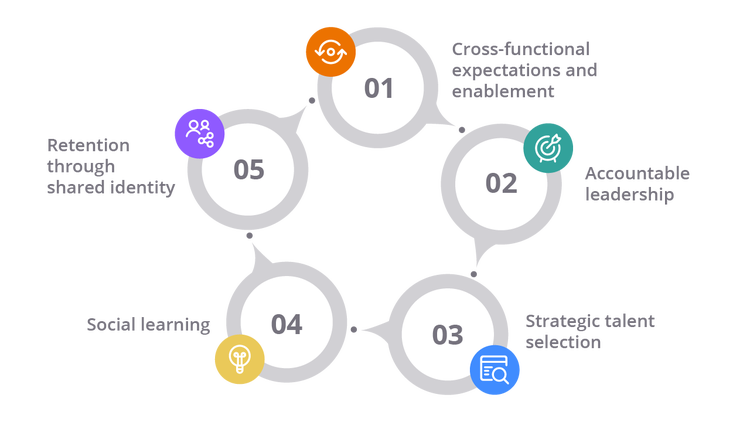
These enablers aren’t initiatives to be pursued independently. They function as a system. Like any ecosystem, the biosphere is only as healthy as its weakest connection.
Move from inputs to advantage to boost organizational performance
The warning signs are already visible across industries. Attrition is rising. Engagement is falling. Growth is slowing. Many organizations respond by investing in more talent and more technology, hoping scale will solve structural problems.
It won’t.
Talent and technology without collaboration produce diminishing returns. Collaboration transforms those inputs into advantage by increasing learning speed, decision quality and adaptive capacity. This is the difference between an organization that accumulates resources and one that compounds capability.
Why it’s time to design a performance biosphere
Every organization now faces a choice. It can continue to optimize the old system, extracting marginal gains while fragility grows. Or it can design a performance biosphere: a system intentionally built to make collaboration scalable, durable and generative.
Fragile systems rarely fail gradually. They appear stable until a threshold is crossed, then decline rapidly. Resilient systems adapt quietly and compound over time.
The future won’t belong to the organizations with the most talent or the most technology. It’ll belong to those that design the conditions under which talent and technology make each other better.
That’s the work. The only question is whether your organization builds it by choice or confronts its absence later.