Precision marketing for health systems: Engage patients, improve care and save resources
This article is co-authored by Maria Gil and Ana Ni
Timely experiences.
Relevant marketing outreach.
Platforms that are easy to navigate.
This is what patients are accustomed to in their everyday lives. But hospitals and health systems often struggle to deliver the clarity and convenience that companies such as United Airlines or Starbucks provide. As consumer expectations rise, patients increasingly expect care interactions that feel coordinated, responsive and tailored to their needs. Generic reminders or one-size-fits-all campaigns are quickly becoming antiquated.
Turning patient insights into outreach that drives action
In other industries, precision marketing has emerged as a way to meet high consumer expectations. Precision marketing combines data, behavioral insights and AI to guide people toward specific actions at the right moment.
But can precision marketing work in healthcare? Absolutely.
While many healthcare providers have become more sophisticated in targeting patients and optimizing marketing spend, targeting alone does not drive action. The next step is translating insights into outreach that patients can understand and act on.
Precision marketing shifts focus from campaigns to patient receptivity, helping health systems influence behavior earlier, improve outcomes and create experiences that build trust and loyalty.
Why healthcare patient engagement often leaves patients underengaged
Health system marketing and patient engagement typically takes one of two approaches. While both add value, they can lead to many patients being underengaged.
Approach No. 1: Focused engagement for high-need patients
Population health programs concentrate intensive outreach on a small group of patients with multiple chronic conditions or recent acute events. These efforts reduce readmissions, prevent complications and support value-based care. However, they usually reach only about 20% of the population, leaving the majority of people without proactive support.
Approach No. 2: Broad, passive marketing to the public
At the other end of the spectrum, health systems run wide-reaching demand campaigns focused on reach and conversion, often promoting ED wait times or high-margin services. Local priorities should shape these messages, rather than systemwide goals like quality, continuity of care and population health. Unfortunately broad, passive marketing often leaves communications disconnected from individual needs.
The opportunity hidden in underengaged healthcare patient populations
With nearly 80% of the U.S. population underengaged, healthcare systems are missing an opportunity to improve outcomes and manage costs earlier. Many of the patients who appear low-cost today are at risk of becoming tomorrow’s high-need population. The underengaged population includes:
- People who are generally healthy but skip preventive care
- Individuals with mild or early-stage chronic conditions, who are increasingly at risk
- Patients with stable chronic needs who rely on episodic or ED-based care instead of ongoing primary care
When health systems fail to engage this population, preventable gaps in care persist and manageable conditions progress. This, of course, forces health systems to intervene later in a patient’s journey—as care becomes more complex, expensive and fragmented.
By engaging these patients more effectively, health systems can drive earlier interventions, improved compliance, fewer appointment no-shows and stronger patient relationships.
Precision marketing creates a path to shift care patterns before they escalate, strengthening quality performance, patient loyalty and financial sustainability by connecting data, technology and human insight to deliver impact at scale.
How are health systems using healthcare patient engagement today?
The National Committee for Quality Assurance (NCQA) emphasizes that systematic, data-driven outreach is essential for improving population health and achieving quality improvement goals such as:
- Closing care gaps
- Managing chronic diseases
- Increasing preventive screenings
Leading health systems are already using precision marketing to improve preventive screening uptake, reduce avoidable utilization and enhance the patient experience through AI and data-driven strategies. What sets these high performers apart is not just how precisely they identify patients, but how effectively they translate that insight into action through well-designed, timely and accessible outreach—at scale.
Precision marketing: Turning engagement into action
As healthcare providers become more advanced in optimizing marketing spend and targeting populations, a new challenge comes into focus—because knowing who to engage is no longer sufficient. Whether engagement leads to action increasingly depends on the quality of outreach itself, including how messages are designed, timed and delivered in ways patients can understand and act on.
Leading organizations know precision marketing is a capability that drives outcomes, and not simply a communication tactic. Here’s how they’re achieving four key goals.
Examples of successful health system marketing campaigns to patients
Example: Even as it became more data driven, Novant Health needed more insight into how marketing drove patient volume and ROI. Marketing mix modeling (MMM) proved that marketing drove 15% of clinical encounters and 8.5% of hospital cases. MMM also assessed performance by channel and by message, identifying opportunities to optimize marketing spend.
Impact: Thanks to marketing-attributed cases and encounters, Novant Health saw an increase of more than $23 million in operating revenue—a 16% uplift in ROI.
Example: Cleveland Clinic piloted an AI-enabled health coaching program for patients with Type 2 diabetes. Using predictive analytics, the program identified patients at highest risk of poor HbA1c control and offered personalized monitoring.
Impact: Within one year, more than 70% of the identified patients achieved HbA1c control, compared to only 2.4% under standard care.
This same approach of AI-driven risk identification paired with tailored engagement can be applied to other conditions such as hypertension, heart failure or preventive screenings.
Example: Facing escalating costs from avoidable ED visits under value-based contracts, Southwestern Health Resources applied AI and machine learning models to flag members likely to use the ED unnecessarily. Through proactive outreach, these individuals were redirected to lower-cost care options such as primary care.
Impact: Within just six months, this approach reduced unnecessary ED utilization by 2% and generated $2.5 million in savings. Beyond the immediate financial impact, the program demonstrated how precision marketing can effectively change patient behavior, aligning care utilization with both cost efficiency and improved patient experience.
Example: Patients at OSF HealthCare faced long hold times and friction scheduling appointments, straining call center capacity. To address this, OSF HealthCare implemented Clare, a virtual engagement assistant to facilitate scheduling, answer questions and help patients navigate care.
Impact: In the first year, the program generated $2.4 million in savings and improved patient experience through easier scheduling and self-service enablement.
The best digital marketing strategies for healthcare providers targeting patients
Precision marketing builds on the same financial discipline that underpins modern marketing. Marketing mix modeling (MMM) is often the first step, as it helps organizations understand which channels and messages drive incremental value, which in turn frees up budget by reducing low-yield spend.
Determining MMM’s ROI is relatively straightforward: Calculate the incremental revenue generated by each channel per dollar spent. Teams can then optimize MMMs by reallocating investment toward higher-performing channels and messages.
What’s the ROI of precision marketing for health systems?
Precision marketing extends beyond efficiency to focus on real-world impact. The ROI of precision patient engagement comes from optimizing marketing spend and reinvesting that capacity into precision-informed outreach that influences patient behavior. By reaching out to underengaged populations in ways they are prepared to act on, healthcare providers can shift care-seeking patterns, improve adherence and increase preventive care uptake.
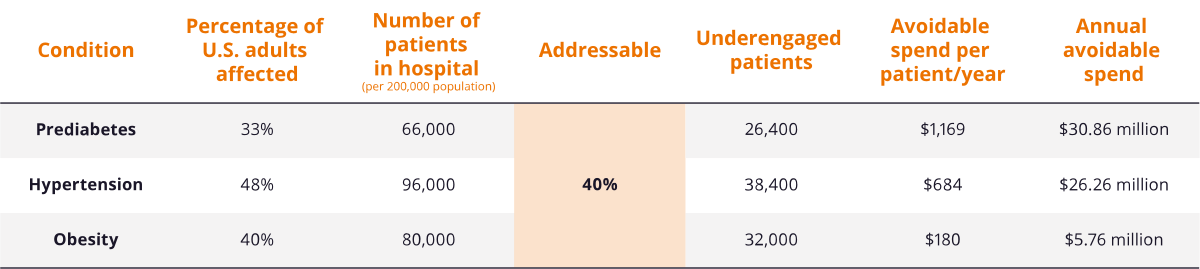
For precision marketing, ROI must be linked to specific populations and targeted behaviors. Consider the example of a typical midsize regional medical center that provides primary and specialty care across a defined community. The medical center has about 250 beds and serves a population of 200,000 people. For this example, let’s focus on three common, mildly chronic conditions.
- Prediabetes: Affects about 33% of U.S. adults
- Hypertension: Affects about 48% of U.S. adults
- Obesity: Affects about 40% of U.S. adults
Approximately 80% of people with these conditions are deemed underengaged, so we modeled a 40% addressable segment as a conservative starting point. Our proposed interventions focus on timely outreach that delivers personalized messages. These messages would guide patients to choose a primary care physician and schedule an appointment through the most appropriate channel.
Based on these numbers, we’re able to estimate the annual avoidable spend per engaged patient. We’ve calculated this savings based on the impact of comparable digital engagement efforts.
- Prediabetes: $1,169 annual savings per patient
- Hypertension: $684 annual saving per patient
- Obesity: $180 annual savings per patient
Figure 1: An example of how precision marketing helps healthcare providers avoid unnecessary spending
How precision marketing powers real-world outreach
Precision marketing is compelling because it’s not a single tool or campaign. Rather, it’s a repeatable process that embeds data, AI and behavioral insights into daily operations. When built as a core capability, precision marketing allows healthcare providers to scale outreach across patient populations while delivering measurable clinical and financial impact.
Optimizing marketing investment is a necessary foundation for this approach. Using MMMs in a disciplined way can:
- Clarify which marketing activities drive value
- Eliminate low-yield spend
- Free up capacity to invest in more advanced engagement capabilities
Meeting patients where they are with precision marketing for healthcare
Precision marketing becomes operational when outreach is designed around patient receptivity instead of an organization’s campaigns or channels. Ultimately, the goal is to consider the patient’s readiness to engage in outreach efforts. This includes thoughtfully considering:
- What information is communicated
- How the information is delivered
- When the information is delivered
Without this alignment, even well-targeted and analytically optimized marketing efforts often struggle to turn engagement into action.
What is patient receptivity?
Patient receptivity is central to effective outreach, and three factors shape it: literacy, language and agency. Outreach should be designed not only around who to engage, but also around whether individuals can understand the message, receive it in an accessible way and act on it within their current circumstances. This approach is what separates true precision patient engagement from personalization that doesn’t move beyond targeting.
In practice, precision marketing determines:
- What and how much can be asked of the patient
- Which channel is appropriate for reaching the patient
- Whether the objective of an interaction should be action, education or building trust
These considerations help teams design effective outreach. The previous examples illustrate what this shift looks like in practice, allowing us to see where precision marketing evolves into readiness-informed outreach that drives measurable clinical, operational and financial impact.
A path to move from traditional outreach to precision marketing for health systems
Precision marketing offers a path forward by turning marketing into a capability that can close care gaps, sustain chronic condition management and strengthen patient loyalty. But how can you move from concept to execution?
A marketing maturity model for precision marketing
Health systems are at different points in their precision marketing journey. This marketing maturity model defines four stages of evolution, with each stage building on the last as organizations advance from optimizing marketing efforts to executing readiness-informed outreach.
- Focuses on driving awareness and patient traffic
- Highlights preferred service lines through demand generation efforts
- Relies on broad campaigns and outreach, such as billboards and radio advertisements
- Runs targeted campaigns using available data
- Segments audiences using EHR, claims or demographic data
- Applies early automation, such as no-show reminders and preventive screening reminders
- Uses advanced analytics to optimize spend, channels and targeting
- Applies predictive models to identify who to engage and when
- Personalizes content and offers based on data signals
- Measures success by marketing efficiency, attribution and ROI
- Designs outreach around patient readiness rather than campaign logic
- Adapts message complexity, channel, timing and calls to action to individual receptivity
- Works in lockstep with clinical, access and population health teams
- Measures success by patient actions, clinical outcomes and operational impact
Precision marketing matters: How you can shift from ideation to action
Hospitals and health systems seeking to elevate their marketing maturity and drive growth with precision marketing can follow this three-step plan to get started:
- Assess your maturity: Identify your current stage in the maturity model. Evaluate data quality, governance, technology and alignment between marketing and clinical priorities.
- Pursue data modernization: Invest in high-quality, integrated data, robust governance and technology infrastructure. Pilot AI-enabled interventions such as no-show reduction or preventive screenings to build evidence and momentum.
- Align the enterprise: Reposition marketing as a driver of systemwide outcomes by applying precision outreach practices that tie engagement to cost reduction, quality performance and patient loyalty—rather than awareness or volume alone.
As organizations pursue precision marketing, they must also address common barriers to adoption. These include ethics and compliance concerns around AI-driven outreach, fragmented data, limited AI readiness, capacity constraints and inaccurate perceptions of marketing.
Leading health systems overcome these challenges through clear governance and human oversight, investments in integrated data platforms, low-risk pilots with clear paths to scale and tighter alignment between marketing, clinical and operational teams.
Precision marketing in healthcare: The future of reaching patients
By progressing through this three-step plan, health systems can close the gap between traditional marketing and enterprise outcomes, capturing incremental value at each stage. This shift reframes marketing as a core capability that drives clinical, financial and patient experience performance.
When health systems adopt precision marketing, everyone benefits. Patients receive timelier and more personalized outreach. Providers reduce avoidable utilization and improve care continuity. And organizations realize measurable gains in efficiency, quality and loyalty.
Precision marketing builds a capability that is essential today and foundational for the healthcare delivery model of tomorrow.