“Premiumization” strategy in travel requires a system, not more products
Key takeaways:
- Premiumization in travel succeeds when companies focus on the moments that genuinely drive travelers to spend more for higher-value options.
- Sustained premiumization requires running a coordinated system across various functions, such as product, pricing, loyalty, data and customer service.
- The risk is adding premium features that raise costs, without giving customers a clear reason to choose them, or competitors can easily copy.
Premiumization is an increasing priority for suppliers as travelers direct increasingly more discretionary spending toward comfort, convenience and flexibility across their journeys. A K-shaped economy has expanded the number of households with the ability to spend more, and income data confirms that trend is holding. This is visible in more seat upgrades, more suite bookings and greater use of premium ground transport. It also shows up in smaller, repeatable trade-ups. Premium economy, rows with extra legroom, late checkout times, welcome amenities and comfort tiers below traditional luxury are becoming more routine picks rather than occasional splurges.
Premiumization is not limited to premium brands or large players. All travel companies can capture more value when “premium” is treated as a deliberate operating choice across the business rather than a collection of upgrades.
These “moments of choice” increasingly determine how value is created and captured. Suppliers across the spectrum—from Frontier to Four Seasons—are competing to win a disproportionate share of that spend. Doing so requires a premiumization business strategy, and many players have already moved in this direction. Early-mover advantage, however, won’t last indefinitely. As investment accelerates across the industry, competition for incremental spend will intensify. The open question is whether those investments build durable advantage or simply raise costs without changing customer choice.
FIGURE: Premium captures the peak. Premiumization captures value at key upgrade moments.
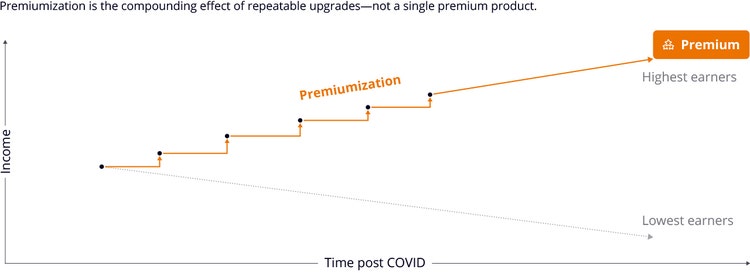
As premiumization rises across cabins, room types and tiers, differentiation fades fast
Many travel suppliers are already turning their premiumization investments into stronger financial results. Delta Air Lines and United Airlines are reporting stronger earnings driven by premium cabin demand and are committing capital to reconfigured seat mixes that increase revenue per seat. In lodging, luxury and upper-upscale hotel segments are outpacing midscale growth, reinforcing why premium portfolios are increasingly central to revenue performance. In ride-share platforms, Uber and Lyft are seeing sustained share gains from premium and comfort tiers, signaling that consumers will trade up when travelers feel they’re getting what they pay for.
The challenge is that these moves will quickly no longer be unique. As more brands figure out how to effectively commercialize better seats, upgraded rooms and curated experiences, those features stop being differentiated and start resetting expectations. The space gets crowded quickly, and competition for that extra spending will intensify.
Where premiumization adds legroom, upgrades and bundles without impacting traveler choice
In most organizations, premiumization sits in silos or is absorbed into brand, pricing or customer experience, diluting focus and accountability. The bigger risk is not underinvestment but misdirected investment that raises cost without changing traveler choice. Feature creep is quickly matched by competitors, resetting expectations and eroding differentiation. As “better” escalates, these enhanced offerings become table stakes, driving higher cost, tighter margins and diminishing returns.
Why premiumization falls short without coordination across the traveler journey
The right premium product or offering remains table stakes. Suppliers need to get this right, though product alone no longer creates sustained differentiation.
A premiumization strategy only delivers durable value when it’s treated as a system rather than as a collection of upgrades. Just as coordination among frontline teams is essential to delivering a consistent, elevated traveler experience, coordination across internal systems and functions enables suppliers to capture incremental value at scale.
From search to booking, check-in and the experience itself, product, pricing, loyalty and servicing shape whether a traveler spends more. When those elements work together, premiumization shows up in higher-value trips and upgrades. When they don’t, offers feel disconnected and are easy to ignore. In the near term, this is where premiumization is won or lost.
What it takes to scale premiumization across pricing, loyalty and servicing
1. Define premiumization. The definition of premium is evolving, and every supplier needs to be explicit about what its premiumization strategy means in its context. For large airlines, premiumization may include elements such as new economy fares that combine boarding priority, seat selection and lounge access. For large multibrand hotel groups, it involves moving loyal midscale guests into upper midscale properties through targeted promotions and loyalty incentives. And for a large ultra-luxury hotel brand, like Aman or Four Seasons, it may mean expanding on-property experiences through curated partnerships.
In value and midscale portfolios such as Choice Hotels, premiumization is less about room upgrades and more about how brands, bundles and loyalty work together to make higher‑value options easy to choose. When that definition is explicit, pricing, loyalty and service reinforce the same decision instead of competing for it.
Once “premium” is defined, the subsequent strategy must then be intentional, clear and easy to commercialize. Any friction that stands between a traveler and a higher‑value experience weakens credibility and limits incremental revenue.
2. Pull the right levers. A successful premiumization strategy depends on prioritizing the right commercial actions. That requires cross-functional systems thinking across media, content and commercial and other teams, with each group clear on its role and the specific outcomes it owns. Senior leadership plays a critical role here: setting direction, communicating priorities and ensuring pull‑through with disciplined follow‑ups.
Beyond alignment, the clearest competitive edge now lies in data. Leading hotel companies are using AI to mine social listening, search behavior and customer history to identify the specific moments when individual travelers are more likely to upgrade. Hyatt and Accor use conversational search and natural language processing to interpret traveler intent during discovery and in‑stay, while Marriott uses its loyalty program’s scale to build a detailed view of each customer—what they spend, when they book, and which offers move them. The result is upgrade and ancillary revenue that is consistent enough to plan around, not just an occasional win.
3. Make it personal. In an ideal world, every commercial function would operate in sync, adjusting as strategy shifts. However, all travel organizations operate with uneven commercial capabilities. Sales teams may have strong segmentation and account coverage while B2B marketing struggles to produce tailored content at scale. Direct booking platforms may perform well for some segments while B2B enablement lags.
A premiumization strategy will expose gaps quickly. To generate meaningful return, every part of the commercial operation needs to keep pace, with personalization at its core. We see this across the industry, from large airlines adapting personalization within existing platforms to luxury hotel brands building personalization capabilities from scratch. Where you start matters less than how consistently you execute. Promoting upgrades broadly to customers who cannot or will not buy drives low conversion, weakens brand affinity and risks creating perceptions of elitism.
4. Commit. Volatility has defined the travel industry since early 2025, with geopolitics, tariffs, immigration policy, operational disruptions and sustained cost pressures making instability the only constant. However, volatility is not a reason to hedge a premiumization strategy; sustained commitment and consistency is critical.
United Airlines, for example, treats premiumization as a multiyear structural bet as it rebuilds aircraft layouts, lounges and networks around sustained premium demand, despite macro uncertainty. At Alaska Airlines, the carrier aligned loyalty, premium cabin strategy, onboard experience and main‑cabin upgrades instead of matching competitors feature for feature. That consistency has shifted revenue mix over time, reflecting coordinated choices sustained across cycles rather than a single product decision.
Nonetheless, course corrections will be required, hopefully guided by real‑time signals from AI‑led social listening, review analysis and structured feedback loops that surface insights from field‑level interactions.
How AI enables a premiumization strategy
AI is now embedded in how most travel organizations operate. For a premiumization strategy applied well, it can help identify when a traveler is most likely to trade up—before booking, at check‑in or during the stay—by turning fragmented customer signals into decision‑ready insights. Before booking, AI can surface which travelers are receptive to higher‑value bundles or fare classes. At check‑in, it can prioritize upgrade offers based on real‑time context and willingness to pay. In‑stay, it can trigger targeted offers tied to usage patterns and service interactions. The question is no longer whether AI belongs in a premiumization strategy but whether organizations can translate those indicators into coordinated action.
Turning premiumization into higher-yield bookings, upgrades and increased loyalty
Premiumization works best when it’s measured by financial outcomes. With 70% of U.S. travelers expecting to increase their total travel spending across the balance of 2026, even as prices rise, the upside of getting this right is real. Sustaining that growth depends not only on adding premium features but increasingly on coordinating how offers are presented—when and at what price—so each successful upgrade makes the next one more likely.