The missing measure in market access in healthcare: Quality of access
Kapil Jain coauthored this article.
Key takeaways:
- Market access in healthcare must measure more than on-paper coverage; it must revolve around whether patients actually start therapy. Now we have the tools to bridge the gap between the two.
- Quality of access captures the real-world barriers that derail therapy initiation, from prior authorization and pharmacy routing to cost surprises and poor communication.
- For pharma, improving quality of access is both a patient care imperative and a commercial growth opportunity.
- AI advances in market access analytics now make it possible to identify access frictions at scale and act on it before patients fail to receive proper treatment.
Let’s imagine a typical scenario: A physician writes a prescription. The patient wants therapy. The payer covers it. On paper, everything is aligned. And yet, the patient may never start treatment.
This scenario isn’t hypothetical; it happens routinely.
Patient access to therapy challenges: Why “covered” doesn’t mean “started”
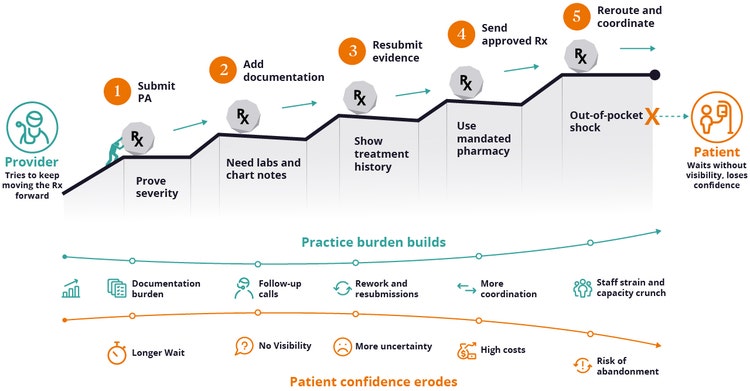
The prior authorization (PA) that technically should be approved but practically fails. A drug is covered. The PA requires documentation on disease severity. One payer accepts a physician’s statement. Another demands lab values, chart notes, treatment history or proof of progression. The prescriber submits what seems reasonable. It’s not enough. The case enters a cycle of requests, resubmissions and follow-up. Meanwhile, the patient waits and the practice spends time on back and forth with the payer. A single missing element, sometimes a checkbox versus a lab value, stalls the entire process.
The pharmacy routing surprise. The PA approval comes through. Only now does the practice learn that the prescription must go to a mandated specialty pharmacy. The prescription must be rerouted. New outreach begins. The need for more coordination leads to more delays. For the patient, this is the moment confidence breaks. They have already waited through one administrative hurdle and are now told there is another. Some patients abandon the script. Not because access was denied, but because the path forward looks too uncertain and too slow.
The cost shock that arrives too late. Even when the process works, patients can be blindsided by out-of-pocket costs through co-pay maximizers or accumulator designs. They often have no visibility into what was coming. By the time they find out, frustration has already set in.
The patient left in the dark. Throughout all of this, patients often have no idea where they are in the process, what step comes next or when they might hear back. They don’t know if the PA was submitted, whether it was approved, when the pharmacy will reach out or what they’re supposed to do in the meantime. They’re waiting, with no information and no control. For many, that uncertainty alone is enough to disengage.
The slow bleed of operational drag. Practice staff learn quickly which products are easy to start and which create disproportionate work. More PA steps results in more follow-ups. This isn’t a minor inconvenience since provider practices face real staffing constraints. They don’t have the bandwidth to absorb the significant PA burden and the back-and-forth with payers and patients that comes with it. When a product consistently creates more administrative work than alternatives, staff deprioritize it—not out of clinical judgment, but out of operational necessity. Products that are harder to get through the system get less enthusiasm, less persistence and sometimes less prescribing momentum. Access friction does not just delay therapy after the prescription is written. It begins influencing treatment decisions before the prescription is written at all.
These aren’t edge cases. They’re the everyday reality of post-prescription access in the U.S.
FIGURE 1: Practices keep pushing, patients keep waiting
What these stories reveal about market access in healthcare and quality of access
First, this happens a lot. These aren’t rare exceptions. They’re systematic. Several brands report 90% access on paper and still see only about 70% of patients start therapy. That 20-point gap is not noise. Across plans with similar on-paper access, we see fill rate variation of up to 20 absolute percentage points. This is a persistent, measurable gap between access as reported and access as experienced by patients and providers.
Second, pharma isn’t measuring what matters. The industry focuses overwhelmingly on coverage status, formulary position, contracted lives and utilization management flags. Those metrics matter, but they capture only part of the story. The failure modes described above (PA documentation burdens, pharmacy routing errors, operational drag, cost surprises, patient confusion) live almost entirely in dimensions the industry largely ignores.
The problems are downstream. The measurement is upstream. And that mismatch is why so many organizations are surprised when strong access numbers don’t translate into strong therapy starts.
Traditional access metrics tell you whether a patient can get a drug. They do not tell you whether a patient will.
Quality of access is the real-world likelihood that a patient actually receives the prescribed medicine—and the burden patients and providers must overcome to make that happen.
At a glance: Quality of access defined
- What it is:
Quality of access is the real-world ability of a patient to move from prescription to therapy initiation successfully and without avoidable friction.
- What it includes:
It includes the operational and administrative factors that shape access in practice beyond on-paper formulary coverage, such as PA requirement details, pharmacy routing, cycle times, patient communication and out-of-pocket cost surprises.
- Why it matters:
Traditional market access metrics show whether coverage exists. Quality of access shows whether that coverage actually translates into therapy initiation and what specifically might get in the way.
Why so many patients fail to get the access pharma thinks we’ve invested in
The root cause of the disparity between the good coverage we think we have and the access struggles patients experience is a lack of shared understanding across every party in the chain:
- Providers don’t know exactly what documentation a specific payer requires to fast-track a decision, or whether there is a mandated pharmacy or site-of-care restriction.
- Patients don’t know what to expect next or when to expect it.
- Patient support hubs don’t know what a patient’s specific plan covers or doesn’t cover.
- Payers have their own processes, but those processes are opaque to everyone else.
Everyone is acting in good faith. But everyone is discovering critical information in real time, through trial and error, after the script is already written. If a plan has a demanding policy, burdensome procedural practices or site-of-care restrictions, on-paper access won’t translate into a smooth experience or timely therapy initiation.
The result is a system where everyone is hoping instead of knowing. And hope isn’t a reliable operating model.
This problem has a consequence that goes beyond any single patient case. When providers face capacity constraints (and most practices today do) they can’t afford to fight through a low-quality access process for every prescription. They don’t have the staff. They don’t have the time. The administrative burden of PAs, appeals, resubmissions and status checks is real, and it competes directly with patient care.
So what happens? Providers start factoring in operational difficulty alongside clinical merit when choosing therapies. Not because they want to; because they must. The product that’s clinically optimal but operationally painful loses ground to the product that is clinically comparable and operationally simple. That’s not a market access problem in the traditional sense. It’s a distortion of clinical decision-making driven by procedural friction. And it’s happening today, at scale, largely unmeasured.
What would it look like if the system worked the way it should?
What ‘good’ looks like: Reducing disparities between on-paper coverage and real-world results
Before we talk about solutions, we need to define the target. The clearest way to do that is to go back to the same kinds of situations we described earlier and ask: what changes if the right intelligence is in the right hands at the right moment?
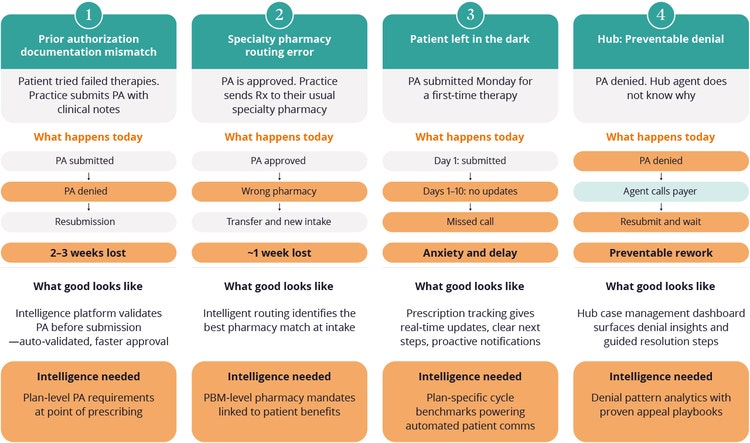
Consider a biologic for moderate-to-severe plaque psoriasis. On paper, access looks strong. In practice, the journey from prescription to first dose is full of preventable breakdowns. The table below walks through four common examples, what happens today, what should happen instead and what it takes to get there.
FIGURE 2: From today’s problems to a better path
PA impact on patient access: The hidden delays after the prescription
A 42-year-old woman failed the first-line psoriasis therapy. Practice switches her to a new therapy and submits PA, noting “BSA 15%, failed first-line therapy.”
What happens today: PA is denied. This plan requires a Psoriasis Area and Severity Index (PASI) score ≥ 25, specific prior therapy trial dates, minimum 12-week duration and documented reason for discontinuation. The practice didn’t know these requirements. Two to three weeks are lost in resubmission cycles or medical appeals.
What good looks like: The prescriber’s office gets information about the exact documentation requirements for this plan before submission through the patient hub portals. The practice includes everything required by the payer in the first attempt. The plan approves the script in days, not weeks.
Intelligence need: Plan-level intelligence on specific PA evidentiary requirements, surfaced at the point of prescribing or PA submission.
Specialty pharmacy routing: A common patient access to therapy challenge
A 38-year-old man’s PA is approved. Practice sends Rx to their usual specialty pharmacy.
What happens today: Three days later, they learn the pharmacy benefit manager (PBM) mandates a different specialty pharmacy. Transfer, new intake, new outreach. Another week lost. The patient was expecting a call that never came.
What good looks like: The hub knows the mandated pharmacy before the PA is even submitted. The prescription is routed correctly on day one. The patient gets a message confirming which pharmacy will contact him and when.
Intelligence need: PBM-level pharmacy network and site-of-care mandate data, linked to patient benefit design at intake.
Patient left in the dark: Communication breakdowns that worsen patient access to therapy challenges
A 29-year-old woman, first biologic. PA submitted on Monday.
What happens today: The patient hears nothing for 10 days. The patient calls the practice twice. The answer they get is “still processing.” By day 14, the patient is anxious and skeptical. The patient misses a specialty pharmacy call (from an unrecognized number). Four more days are lost in this process.
What good looks like: The patient gets frequent alerts on where they are and what to expect next. As an example, on day one they see: “Approval typically takes five to seven business days for your plan.” On day five they see: “Approved. Pharmacy will call within 48 hours. Here is their number.” This helps patients be informed, prepared and engaged.
Intelligence need: Plan-specific cycle time benchmarks derived from historical case data, powering automated patient communications.
Operational drag in practices: How PA impact on patient access shapes prescribing
What happens today: PA is denied. The hub agent doesn’t know why. The hub agent calls the payer, waits on hold and learns it was missing PASI documentation. The agent calls the practice. The practice takes three days to respond and resubmit PA. This triggers another five-day review, resulting in two-plus weeks lost on a preventable issue.
What good looks like: The hub’s system flags at intake that this plan has a high first-submission denial rate for IL-23 inhibitors, nearly always for missing PASI documentation. The hub proactively requests the right documentation before submission. If denied, the system autopopulates an appeal with clinical language that has historically worked.
Intelligence need: Denial pattern analytics by plan, condition and drug class, with prebuilt appeal playbooks and proactive documentation checklists.
The common thread is simple and hard to miss. Good doesn’t mean perfect. It means every actor in the process knows what’s expected of them, when and why. Actionable intelligence is available at the point of consumption and at the moment of action.
Quality of access isn’t another key performance indicator (KPI) to track and report. It isn’t a new scorecard, but a way to make access actionable: not just whether access exists, but how it works in practice, where it breaks down and why and what it takes to keep therapy initiations on track. The next evolution of market access will come not from measuring access more precisely, but from making it more actionable.
The value of quality of access in a pharmaceutical market access strategy
The value of quality of access intelligence isn’t abstract. Its most important impact is on patients who are appropriate for therapy but never make it on to treatment because the process breaks down after the prescription is written. When benefit investigation, PA, pharmacy routing or onboarding are delayed or mishandled, the result is missed therapy initiation and often worse downstream outcomes.
In our experience, avoidable access friction materially reduces therapy starts and can shorten time on therapy for those who end up starting treatment as well. A meaningful share of fill rate slippage appears to come not from coverage itself, but from the absence of actionable intelligence about how access actually works on the ground. That creates a compelling business case. But the bigger point is that these are patients who should be getting treated and aren’t. Fixing that is first a care imperative, but also a significant commercial opportunity.
There are other benefits, too.
When the process works well, providers spend less time on administrative burden and more time on patient care. Hub staff spend less time chasing and more time helping. Patients feel informed and supported rather than confused and abandoned. And critically, providers regain the ability to make treatment decisions based on clinical value rather than operational convenience. When a practice has confidence that a prescription will get filled without disproportionate effort, that confidence changes behavior. In competitive categories where clinical differentiation is narrowing, this kind of operational simplicity increasingly drives prescribing decisions. It’s not a soft benefit. It’s a commercially significant one.
This is a rare outcome in healthcare. Not a tradeoff. A genuine win for patients, providers, hubs and manufacturers simultaneously. Building this capability is more than access optimization. It is a competitive advantage, one that strengthens provider trust and improves long-term manufacturer brand equity.
Why now: AI in market access pharma and the future of prior authorization
Quality of access isn’t a new problem. It’s widely known and relatively well understood. Pharma companies have had access to most of the data needed to address it for years. So what has changed?
Advancements in agentic AI have made it practical to process all structured and unstructured data reliably at scale across thousands of health plans. We can now build a 360-degree view of the utilization management tactics an individual plan uses. AI can collect field intelligence in a frictionless manner to fill gaps in understanding. AI can mine denial letters and other documentation to compare what plans say they will do versus what they actually do.
That distinction matters. A plan’s published policy is one thing; its actual adjudication behavior is often another. Capturing that gap would have been a painstaking manual effort across thousands of plans in the past. Now it can be done reliably by machines. What was once anecdotal is now capturable, measurable and addressable.
Quality of access capabilities are operationally grounded intelligence: the ability to detect patterns, predict failure modes and route the right guidance to the right person at the right time.
There’s another reason why right now is a great time to build this capability. Health plans are actively looking to employ AI and digital technologies to reduce PA costs and drive internal efficiencies. A proposed Centers for Medicare and Medicaid Services rule intended to streamline PA processes aims to further accelerate improvement. Once PAs become cheaper to implement and operationalize, they’ll become even more pervasive. Meanwhile, provider practices are increasingly capacity-strained and have limited bandwidth to address cumbersome authorization processes. Pharma needs to be ready for that future, not reacting to it.
How pharma can operationalize quality of access
Quality of access isn’t a side project, but it also doesn’t require blowing up the organization. Most pharma companies already have the right roles in place across field reimbursement, patient support, trade, payer contracting, sales and patient communications. The opportunity is to make those teams more effective by giving them a shared, real-time view of where access breaks down and what to do about it.
Because those breakdowns span prescribers, hubs, pharmacies, payers and patients, no single function can solve them alone. But this doesn’t require a wholesale reorganization. It requires a coordinated, cross-functional capability that equips stakeholders with better information and enables better action. We see this capability organized around three strategic pillars, pursued in parallel.
A three-part operating model to improve quality of access
Improving quality of access requires more than better reporting—it requires a new operating model for market access. Pharma companies already have many of the right roles in place across field reimbursement, patient support, trade, contracting and patient communications. The opportunity is to connect those functions through shared intelligence and coordinated action. Three shifts matter most:
- Build the intelligence foundation to understand how access works in practice, plan by plan.
- Equip each function to act on that intelligence at the moment decisions are made.
- Align metrics and incentives with quality of access so the organization improves what truly affects therapy initiation.
Pillar 1: Build an intelligence platform for quality of access and market access in healthcare
Everything depends on the intelligence platform. The goal is a shared quality-of-access intelligence platform: a single source of truth on how access works on the ground, plan by plan, tactic by tactic, that every function draws from and contributes to.
This means going well beyond published formulary data. It means capturing real adjudication behavior: denial patterns, documentation requirements, step therapy enforcement, pharmacy mandates, cycle times and the gap between what plans say they will do and what they actually do. The raw material exists across claims data, hub case records, specialty pharmacy fulfillment logs, field intelligence and unstructured sources like denial letters. AI makes it possible to synthesize all of this at scale across thousands of plans. What was once anecdotal now becomes structured, “queryable” and actionable.
This platform answers the question that matters: for this patient on this plan who is prescribed this drug, what are the specific hurdles and what has historically worked to overcome them?
Pillar 2: Rewire every function to improve patient access to therapy
Intelligence without activation is a dashboard nobody uses. Each function needs to be retooled to consume and act on quality of access intelligence within its own workflow.
In launch and early contracting, quality of access intelligence should help define what the access pathway ought to look like, not just help teams manage the hurdles after the contract is written. Account and market access teams can use payer policy intelligence and payer behavior-based benchmarking to negotiate simpler prior authorization policy and forms that improve first-pass approval and reduce downstream practice and patient burden.
Field reimbursement managers need plan-specific reimbursement guidance before they walk into a practice, not generic education materials. Hub agents need to see, at case intake, the likely friction points for this patient’s plan and the documentation package that maximizes first-pass approval, not discover the problem after a denial. Trade teams need friction-point data to negotiate targeted services with specialty pharmacy partners. Patients need timely, personalized communications telling them what to expect and when, based on the real experiences of thousands of similar cases on their specific plan.
Instead of adding new channels, the goal is to make existing channels, CRM platforms, hub case management systems and patient communication tools materially smarter. Every function does the same job it does today, but with intelligence it has never had before.
Pillar 3: Realign measurement and goals around quality of access
If the organization continues to measure access by coverage status and formulary position alone, nothing changes. Quality of access metrics need to sit alongside traditional access KPIs in leadership dashboards: fill rate by plan, time to therapy initiation, first-pass PA approval rate, denial-to-appeal conversion.
More consequentially, these metrics need to inform commercial decisions. Payer contracting teams should factor quality of access into rebate negotiations, paying more for plans that deliver smooth, high-quality access and recalibrating where they do not. Trade teams should use fulfillment and denial data to hold specialty pharmacy partners accountable and design targeted services where friction concentrates. Until measurements and goals change, behavior will not change either. The right measurement and goals will help the transformation sustain itself.
Where to start: Solving patient access to therapy challenges with a quality-of-access pilot
The transformation is broadly applicable to most specialty therapeutics and medical benefits. However, it makes sense for leaders to start with one priority brand. Build the intelligence platform for that brand’s top friction points. Rewire the highest-impact activation channels. Prove the model and measure the impact. Then scale across the portfolio.
The investment is real. But so is the cost of inaction: $150M in recoverable annual revenue for a billion-dollar brand, a widening competitive gap and a future where PAs become even more pervasive as payers use AI to make them cheaper to deploy.
The organizations that build this capability now will set the standard. The ones that wait will find the gap harder to close every year.
The future of pharmaceutical market access strategy starts with quality of access
Quality of access isn’t another KPI. It’s a mindset shift. The gap between access on paper and access in practice is real, measurable and costly. The friction is systematic, distorting clinical decisions and frustrating providers and patients alike. And for too long, the industry has measured coverage and ignored everything that happens after.
The value of addressing it is substantial and shared across every stakeholder. And now, for the first time, we have the technology to make it actionable at scale.