Rare, but ready: Why the future of pharma runs through rare disease
For years, many in the pharmaceutical industry have viewed rare diseases largely as a niche pursuit with limited commercial appeal—one driven more by the noble pursuit of patient benefit than by commercial potential. Small patient populations equal small returns, the thinking goes. Safer, they think, to pursue high-prevalence disease areas, such as immunology, neurodegenerative disorders, cardiometabolic conditions or obesity.
This view is becoming obsolete. Of the estimated 10,000 rare diseases, roughly 95% have no known treatment. But rare disease is more than just an area of high unmet need. Core clinical and commercial fundamentals make it one of the most strategically sound bets in pharma today, especially as growing numbers of biopharma companies crowd into more conventionally attractive therapy areas (TAs).
For portfolio leaders weighing where to place their next bets, rare disease offers both unmet need and a structurally advantaged development model that derisks investment and accelerates the path to market.
Why clinical development for rare diseases offers unique structural advantages
Clinical development targeting rare diseases isn’t just scientifically rewarding. It’s often more efficient. This is because rare disease development frequently benefits from an attractive two-for-one: smaller trials paired with a higher probability of success.
Rare diseases offer lower development costs compared with nonrare diseases
While finding and enrolling patients for rare disease trials typically take longer than for other trials, given the smaller patient pool, trials require significantly fewer patients overall. In fact, phase 3 trials for nononcology rare disease involve roughly half as many patients and unfold across fewer trial sites, potentially reducing development costs.
Rare diseases also benefit from two additional development advantages that lower trial costs and speed time-to-market:
- Given ethical considerations and lack of existing standard of care, regulators allow a much higher share of rare disease trials (37%) to dispense with controls arm, compared with nonrare diseases (17%).
- Given high unmet need, many trials in rare disease win regulatory approval to launch products after showing clear benefit during phase 2 trials.
Given these factors, rare diseases offer drug manufacturers lower investment costs and more rapid launch timelines.
Investigational therapies in rare disease offer a greater likelihood of regulatory success
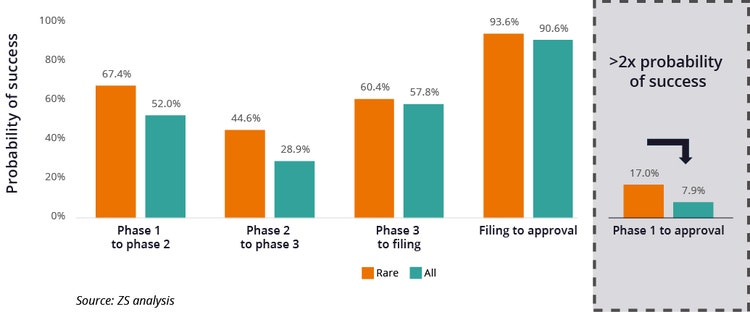
Compared with nonrare diseases, the modality and preselection of biomarkers correlates heavily with the probability of technical and regulatory success. In fact, regulators are more than twice as likely to approve investigational therapies in rare disease as they are for nononcology mass-market therapies.
FIGURE 1: PTRS for drugs for rare disease vs. everything else
Why the economics of rare disease are better than many realize
Despite smaller patient populations, rare disease therapies often punch above their weight commercially. Four structural advantages make the economics work, sometimes better than in nonrare disease areas.
1. Lower promotional spend. Rare disease therapies benefit from lower total promotional costs, thanks to their highly targeted markets. With smaller patient populations and fewer prescribing physicians, companies can focus their efforts on high-touch, concentrated engagement rather than broad-scale campaigns. These therapies also leverage centralized provider channels, making it easier to shape the market efficiently and drive adoption through focused influence.
2. Faster uptake thanks to lower competition. Rare disease markets often see lower competitive pressure, allowing new therapies to gain traction more quickly and sustain longer exclusivity. In fact, the average time to peak share for nononcology rare therapies is just four years, per 2024 ZS analysis—compared with 10 years for nonrare ones. With fewer direct competitors, companies can carve out a defensible foothold that deters new entrants, especially in markets too small to justify broad investment. Add to that lower risk of generic incursion and reduced postlaunch promotional demands, and the long-term commercial runway becomes even more compelling.
3. Price premiums at launch. Premium pricing in rare disease has been sustained by a compelling mix of urgency, unmet need and limited treatment options for small patient populations. ZS analysis shows a strong correlation between disease prevalence and drug price at launch, with drugs targeting lower-incidence diseases commanding a substantial premium. Payers have willingly absorbed the premium because the overall budget impact for these drugs has historically been small, despite high individual drug prices.
In addition, while drugs for rare disease and oncology are priced at similar levels, both command a substantial price premium overall—especially compared with immunology therapies. Across the U.S., Germany, Spain and the U.K., the average annual price of orphan drugs is approximately $400K, compared to $300K for nonrare oncology treatments and just $50K for nonrare immunology drugs. What’s more, the implied ex-U.S. discount is far smaller for rare diseases—24%, compared with 40% for oncology and 68% for immunology.
4. Inflation Reduction Act (IRA) shield. Under current rules, single-indication orphan drugs are exempt from Medicare price negotiations. And given the latest guidance on IRA implementation, this exemption now extends to drugs with multiple rare disease indications. It’s important to note, however, that this protection is lifted if a product also secures an approval for a non-rare indication. What it means: Companies should be thoughtful about label expansion strategies and lifecycle planning.
Bottom line: Fewer patients doesn’t necessarily mean lower commercial potential.
Novelty and unmet need continue to differentiate rare disease launches
Rare disease therapies are consistently entering less saturated markets, with 38% of launches between 2022 and 2024 being first-in-disease, far more than in cancer, chronic or acute settings (Figure 2). This underscores the high unmet need and innovation potential still present in the rare space. By contrast, only 29% of rare launches were “next in class,” suggesting that companies are not merely crowding into existing therapeutic niches but are introducing treatments where none existed before.
FIGURE 2: Novel launches by drug and disease type
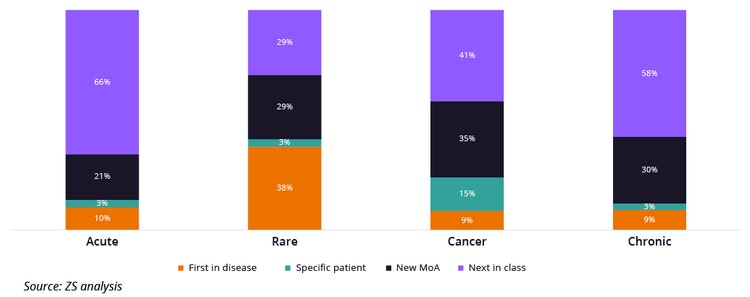
While rare markets are maturing and some are becoming more competitive, the data still show that rare launches outperform in terms of novelty and clinical impact. A ZS analysis found that 67% of rare disease launches met or exceeded analyst expectations in their launch year—outperforming oncology (63%) and chronic disease areas (42%).
Looking ahead: Rare disease presents a significant growth opportunity
Given the vast outstanding unmet need for rare disease therapies, it’s no wonder we see so many large pharma companies turning to nononcology rare diseases in search of more open, less crowded paths to strategic growth—especially through targeted acquisition. For example:
- AstraZeneca is doubling down on rare diseases through strategic acquisitions, starting with its creation of a dedicated rare disease unit following its acquisition of Alexion and its complement-biology platform and rare disease pipeline. More recently, it acquired Amolyt Pharma to expand its endocrinology pipeline and add a phase 3 asset for chronic hypoparathyroidism.
- Gilead strengthened its liver portfolio with its acquisition of CymaBay and its first-in-class investigational therapy, seladelpar, for primary biliary cholangitis therapy including pruritus.
- Biogen bolstered its rare disease portfolio and near-term growth trajectory with its acquisition of Reata and its FDA-approved therapy, Skyclarys, for Friedreich’s Ataxia. The drug strategically complements Biogen’s neuromuscular pipeline in the face of rising competition for legacy multiple sclerosis treatments.
- Kyowa Kirin strengthened its rare disease portfolio through its acquisition of Orchard Therapeutics and its hematopoietic stem cell gene therapy, Libmeldy, for treatment of early-onset metachromatic leukodystrophy (MLD).
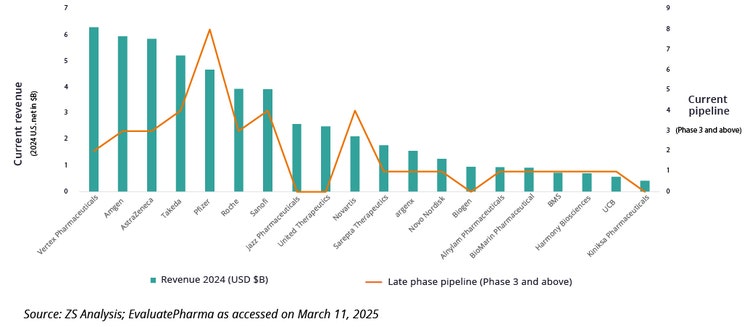
Looking at today’s revenue leaders in nononcology rare diseases challenges the outdated view of this drug class as a commercial backwater. That’s because companies aren’t just investing in their pipelines; they’re realizing significant return from those investments.
FIGURE 3: Top companies in nononcology rare disease, by revenue
And the commercial opportunity in rare diseases is only expected to grow:
- Orphan drugs are projected to account for roughly 20% of prescription drug sales by 2026, per ZS analysis—growing at roughly twice the rate of nonorphan drugs.
- Investigational therapies for rare diseases are projected to make up nearly a third (29%) of total pharma pipelines over the same timeframe, suggesting even greater revenue share ahead.
While rare disease is gaining traction, sustained momentum will depend on how companies respond to a set of fast-evolving policy, funding and reimbursement risks.
Reality check: Risks to monitor for rare disease
From funding freezes and policy shifts to impending expirations of key incentives, the rare disease space—like every disease space—faces potential headwinds in the years ahead. They fall into three categories:
- Policy uncertainty. Rare disease research is highly dependent on funding for basic research, making it acutely vulnerable to threats to federal grant funding. While a temporary grant funding freeze appears to have eased, uncertainty remains around potential policy shifts, including to cell and gene therapy reimbursement models. While there’s been speculation that leadership changes at the FDA’s Center for Biologics Evaluation and Research could hinder regulatory pathways, delays have not been an issue. New leadership is unlikely to alter existing rare disease programs.
- End of priority review program for rare pediatric disease. The rare pediatric disease priority review voucher program—which heavily incentivized R&D for rare pediatric diseases—expired at the end of 2024 and was not reauthorized in the federal funding bill signed into law March 15, 2025. Without these incentives, the business case for funding research into rare disease could become murkier.
- Termination of a key federal committee. The March 2025 termination of the Advisory Committee on Heritable Disorders in Newborns and Children (ACHDNC)—a key voice in expanding the national newborn screening panel—has raised concern across the newborn screening and rare disease communities.
- Payer fatigue. Payer enthusiasm for orphan drugs, while historically strong, may be softening as more therapies enter the market and their cumulative budget impact grows.
Rare disease’s oncology moment: The window is open, but not for long
To discerning observers, the rare disease market today resembles the oncology market of 15 years ago: Poised for a surge of innovation and patient impact. And just like during those heady days, we’re seeing a crush of companies moving into the space. Despite funding and regulatory risks on the horizon, the strategic and commercial opportunity in rare diseases remains strong. Companies that invest early in core capabilities will be best positioned to seize first-mover advantage.
For companies not yet in rare disease, now’s the time to enter the space. For those already there, it’s time to deepen your commitment. ZS helps companies assess where their existing capabilities align with high-potential opportunities, whether through development, acquisition or strategic entry. Your next step matters.