Scaling AI in pharma and biotech: 2026 outlook from ZS’s CDIO research
Pharma leaders aren’t just asking where AI can work, they’re deciding where it must drive growth, and what it will take to make that real.
We’ve spent the past three years tracking how organizations are approaching AI—from experimentation to enterprise integration and early questions about value. And this year, something changed. Leaders are no longer asking, “Where can AI work?” They’re asking, “Where will AI drive the growth that matters—to our business and to the people we serve?”
That shift signals maturity and urgency. To understand what this looks like today, we surveyed 115 U.S.-based tech executives from multinational pharma and biotechnology firms. These are the people setting their organizations’ data, digital and AI agendas and pushing innovation forward. Here’s what to know:
Growth is on the line and leaders want value from AI
Industry leaders are facing a mix of pressures: higher expectations for healthcare, competitors’ scientific advancements, AI disruption and regulatory friction. Nine in 10 tech leaders see these pressures as active threats to business growth.
Top priorities to sustain growth include accelerated discovery (52%), patient engagement (43%), portfolio diversification (36%), new revenue streams (33%) and ecosystem partnerships to strengthen their capabilities (31%).
One pharma CIO shared that his organization has “learned enough with AI to move past experimentation,” and is now concentrating on five to 10 high-impact use cases, each with the potential to deliver 20%-30% ROI. Another shared, “How we think of what it takes to succeed has changed, the function isn’t hardcore IT technologists anymore. People must be focused on business value transformation.”
The takeaway: CIOs can’t just set the tech agenda. They need to drive clarity on the data, digital and AI bets that can drive growth priorities. And clarity isn’t just about direction, it’s about accountability. Digital and tech leaders are no longer enablers operating on the sidelines; they’re co-owners of outcomes, sharing accountability with business leaders to deliver measurable business impact. Without this alignment, organizations risk making disconnected technology investments that stall adoption and fail to support critical goals.
Figure 1: Value expectations for investment by function
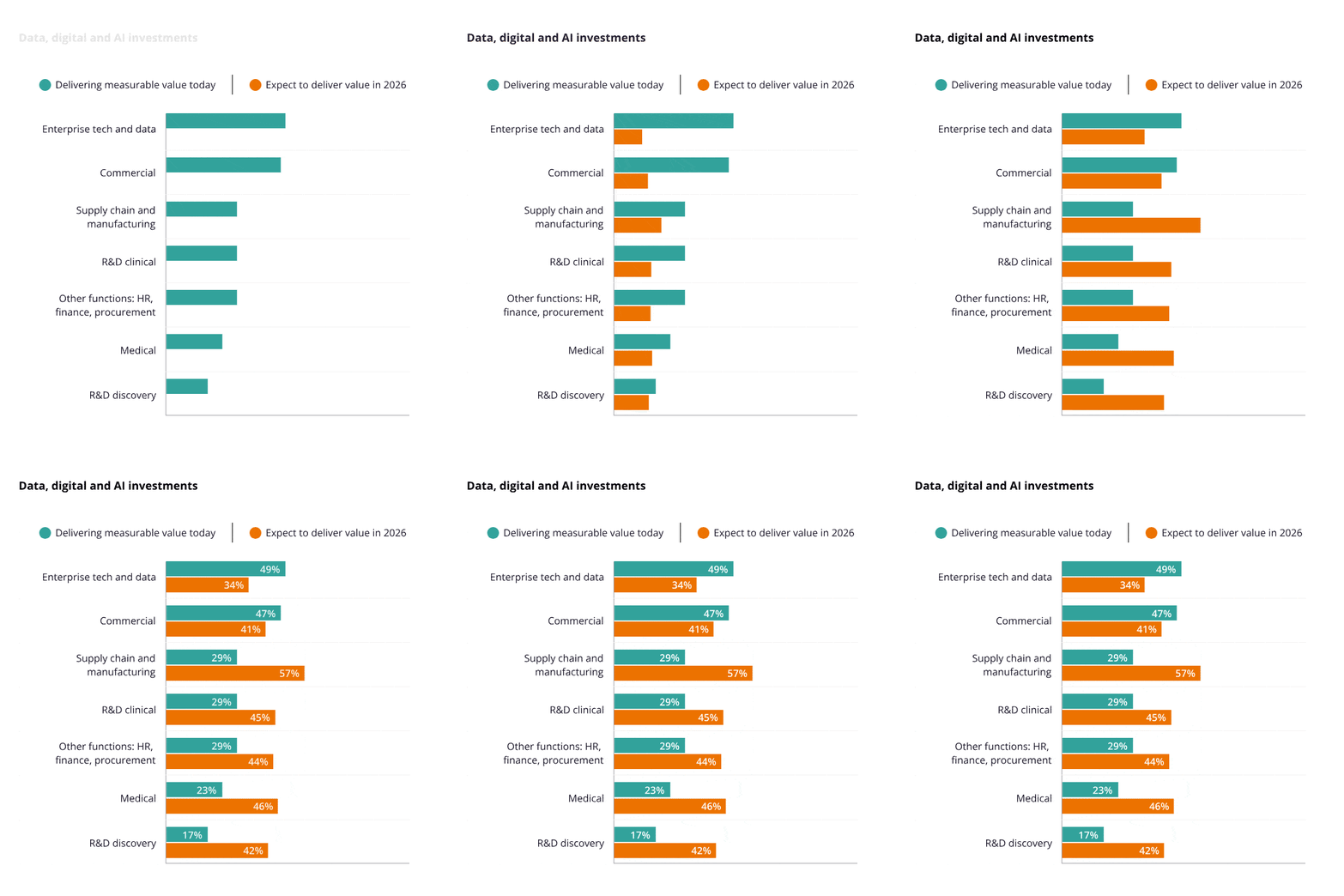
Q: When do you expect your company’s investments in data, digital and AI to deliver measurable value (financial or otherwise)?
Source: ZS’s CDIO outlook survey, October 2025. Base of 115.
Two budget paths for pharma and biotech’s AI investments: Quick wins and long-cycle bets
Budgets for data, digital and AI investments are increasing but on two different paths.
Path one is the fast track where value is easier to prove on shorter cycles. Nearly half of respondents say they’re already consistently demonstrating measurable value through enterprise tech and data operations (49%) and commercial sales and marketing efforts like healthcare provider engagement and personalization (47%).
In supply chain and manufacturing, the current impact is lower—only 29% say they’re seeing results today—but optimism is high. Another 57% expect to see results within the next year, particularly from AI and analytics tools that help reduce stockouts and better predict demand (see Figure 1).
Path two, a long game. More plan higher budget increases for R&D discovery and clinical, even though the payoff isn’t as certain (see Figures 1 and 2). In discovery, only 17% say they can prove measurable value today with data, digital and AI investments, but 42% expect value within the next year. Clinical shows a similar pattern: about 30% can demonstrate value now. Another 45% anticipate progress toward real value in the year ahead, especially in areas such as study planning, patient recruiting and the use of real-world data.
Takeaway: For digital and tech leaders, the priority is clear: define the business outcomes and expected results first. Nearly seven in 10 (67%) warn that launching an AI initiative without clear goals and success metrics is a mistake. Leaders must hardwire objectives and measurable results into every initiative. That means looking at near-term automation and cost reduction while setting targets like faster delivery, higher sales or lower operating costs for longer-term gains.
Figure 2: Discovery and clinical budgets are expected to rise on the belief of payoff
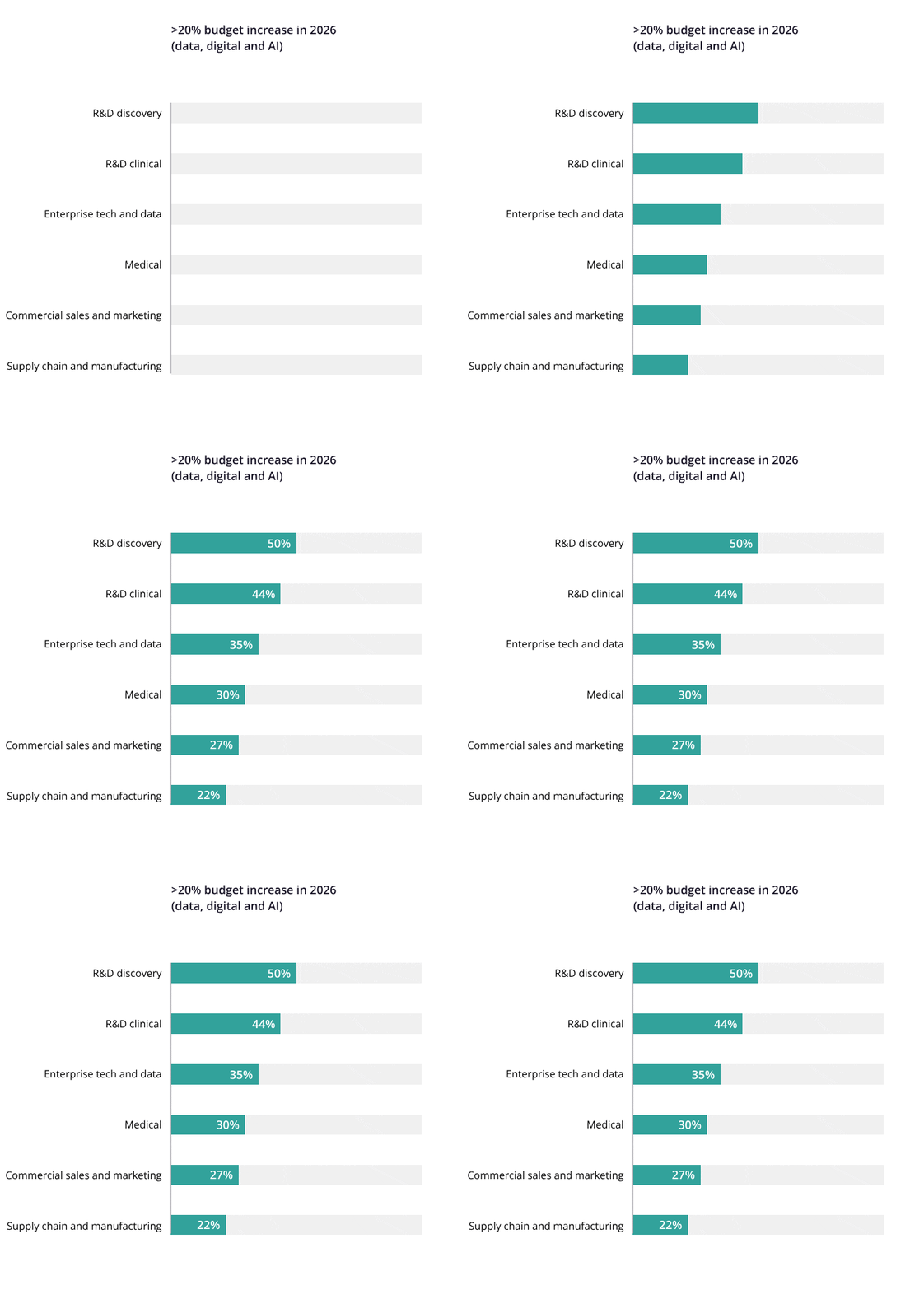
Q: Over the next 12 months, how much do you expect your company’s data, digital and AI investments to change in these areas?
Source: ZS’s CDIO outlook survey, October 2025. Base of 115.
Agents are the goal, but domain context and trust-building are areas to master
Agentic automation is moving from concept to practice, especially in IT operations, where 45% plan to create agentic workflows and R&D discovery, where 41% have similar plans. In these areas, leaders are beginning to test how agents can reason, act and adapt in real workflows. But in customer- and patient-facing functions, most executives show caution, favoring smaller-scale use cases that focus either on task automation with human-in-the-loop checks or augmenting people’s work with assistants and copilots.
In every type of effort, building in context for the domain and the company make the difference. Domain experts know the processes, regulations and data realities that determine success. Their role is to ensure data quality, validate AI recommendations and step in when guidance is needed.
One CIO explained that the strongest teams balance skills evenly—half focused on technology execution, half on business process expertise. Another CIO put it bluntly: “The true value of agentic AI comes into process reengineering. We don’t have enough people to understand the end-to-end process.” Without this balance, AI falters on specialized data, compliance and complex workflows.
Trust-building is a critical, ongoing requirement, too. Responsibly scaling AI solutions depends on embedding trust practices throughout the AI life cycle. Yet building the capabilities to get and stay on top of responsible development is a constant challenge when data and technology can evolve faster than governance models, regulatory guidance or workforce readiness.
Takeaway: Make domain expertise the driver, including where agents add value over other machine learning and AI options. Getting agents up and running takes more than just technology—it requires high-quality domain-specific data, changes to workflows and alignment across business stakeholders. Just as importantly, these agents need to be treated like part of the workforce, with clear roles, accountability and ways to improve over time.
When it comes to responsible development practices, not all use cases are created equal.
Take adverse event detection in clinical trials as an example. Because it’s a GxP-regulated process, it calls for strict validation and oversight—any error could jeopardize patient safety or derail a study. On the other hand, using AI to forecast demand comes with fewer risk and regulatory requirements. The risks in those cases are business-related, not life-critical.
Depending on the use cases, a one-size-fits-all approach to building trust can bog down innovation where speed could be a stronger lever. Leaders are learning where to dial up the rigor and where it’s safe enough to move faster.
Figure 3: Leaders’ priorities for improving operations through AI agents
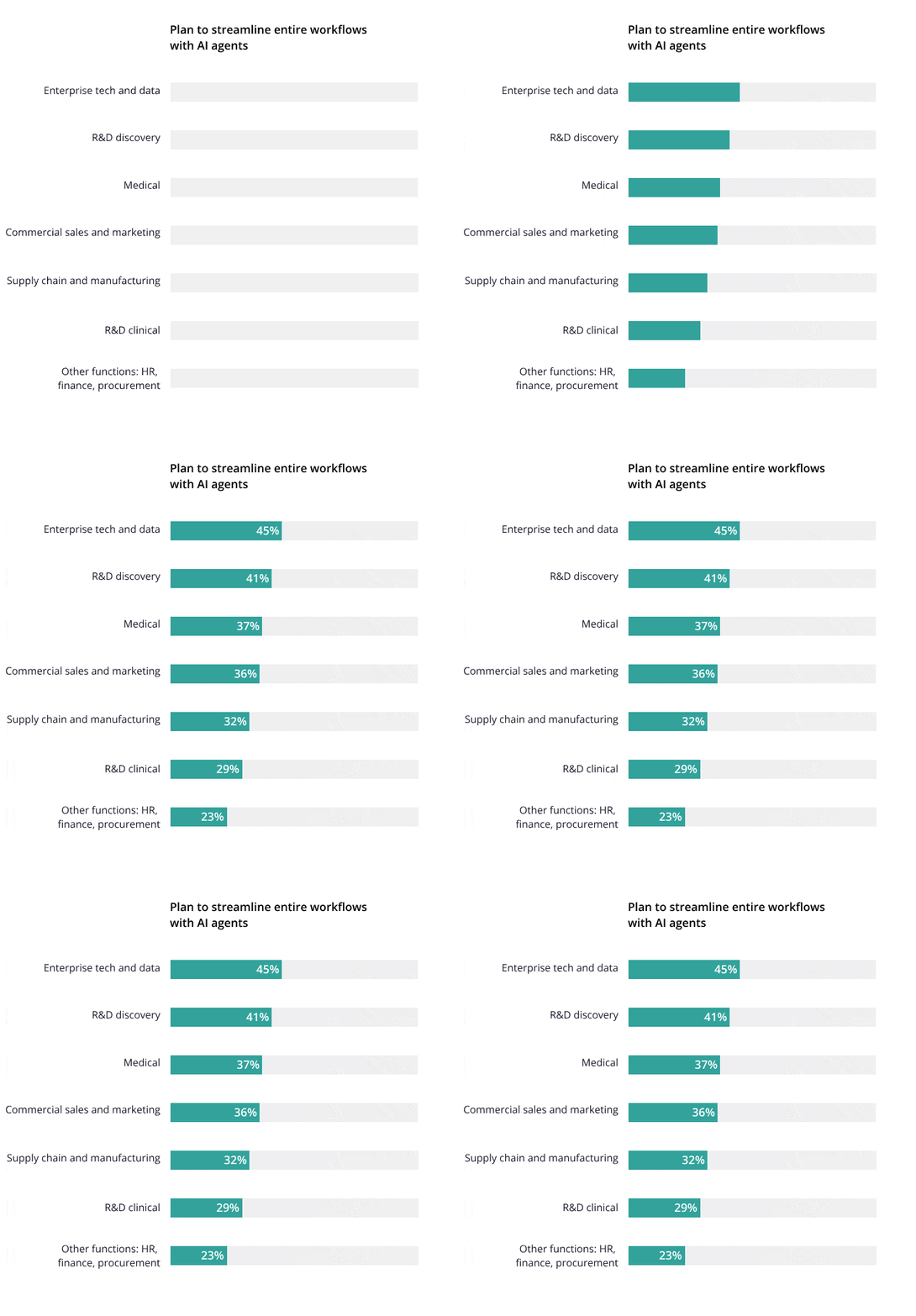
Q: What is your company’s primary goal for using gen AI or AI agents in the following areas over the next 12 months?
Source: ZS’s CDIO outlook survey, October 2025. Base of 115.
AI demands stronger data and a more resilient tech infrastructure
Progress with scaling AI often hits the same wall: most enterprise tech stacks and data ecosystems weren’t built for it. Persistent gaps in data quality, access and ownership continue to slow momentum. Most pharma and biotech leaders agree that a strong data foundation is non-negotiable for success—68% say to neglect data quality and governance early is the main reason AI initiatives fail.
In our survey, it came through clearly: data foundations aren’t optimized for AI consumption or agentic processes, and most systems still lack the practices, architecture and infrastructure needed to support intelligent workflows. That includes gaps in AI platforms, real-time data pipelines and GPU and cloud capacity. CIOs are calling out the role of platforms to govern agents. As one explained, “It’s important to adopt a platform-based solution where you can keep an inventory of all the agents that are being built, and enforce development standards and paradigms.”
Takeaway: Strong data for AI consumption demands a resilient core infrastructure and tech stack. CIOs are backing this by increasing investments in cloud and infrastructure (88%), data products and platforms (86%), AI platforms (84%) and IT/DevOps tools (79%) over the next 12 months. This is more than cleanup. It’s building new capabilities to ensure context-rich data is structured, governed and delivered in ways that AI can use it securely, consistently and at scale.
Figure 4: Steps pharma and biotech are taking with data foundations
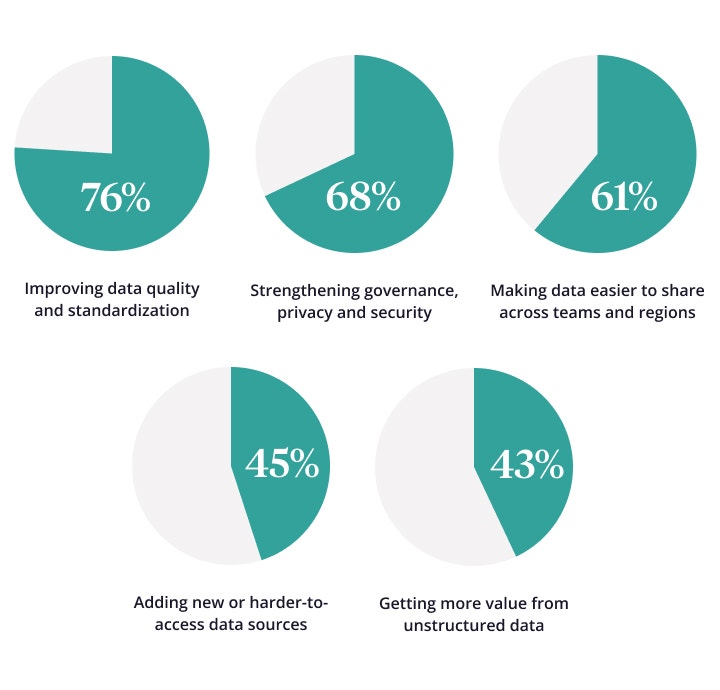
Q: What steps is your company taking to strengthen data foundations for AI in the next 12 months?
Source: ZS’s CDIO outlook survey, October 2025. Base of 115.
The gap between AI experimentation and results points to the operating model
CIOs know the promise of AI, but many remain cautious. Nearly six in 10 say they only pursue innovation when the value story is clear, and just 40% of those pilots make it to scaled deployment. The result is a persistent experimentation-to-impact gap that technology alone can’t solve.
Real strain is showing up in the pressure to change operating models. Technology and data capabilities (61%), talent and skills (58%), and business engagement and decision-making (56%) are under the most pressure to change. These aren’t side issues—they are the foundations for whether AI can move beyond experiments to consistently drive business value.
Some companies are taking bold steps toward the workforce of the future, like Moderna merging IT and HR into a single function. Most aren’t moving that far, but shifts are underway. As one CIO shared: “We decided to have more internal engineers at scale. We’re building an entire organization around AI, and we hired an SVP there.”
Takeaway: Digital and tech teams must shift from enablers of AI to drivers of innovation. CIOs are already moving in this direction: 55% have the authority to reshape their enterprise operating model now. Most are reshaping a new order by looking at team structures and with this comes decisions around decision-making, behaviors and culture. And 86% are testing or making changes to roles and teams to ensure resources are deployed more effectively in service of the value agenda.
Figure 5: Tech and data operating model: Top pressures to change
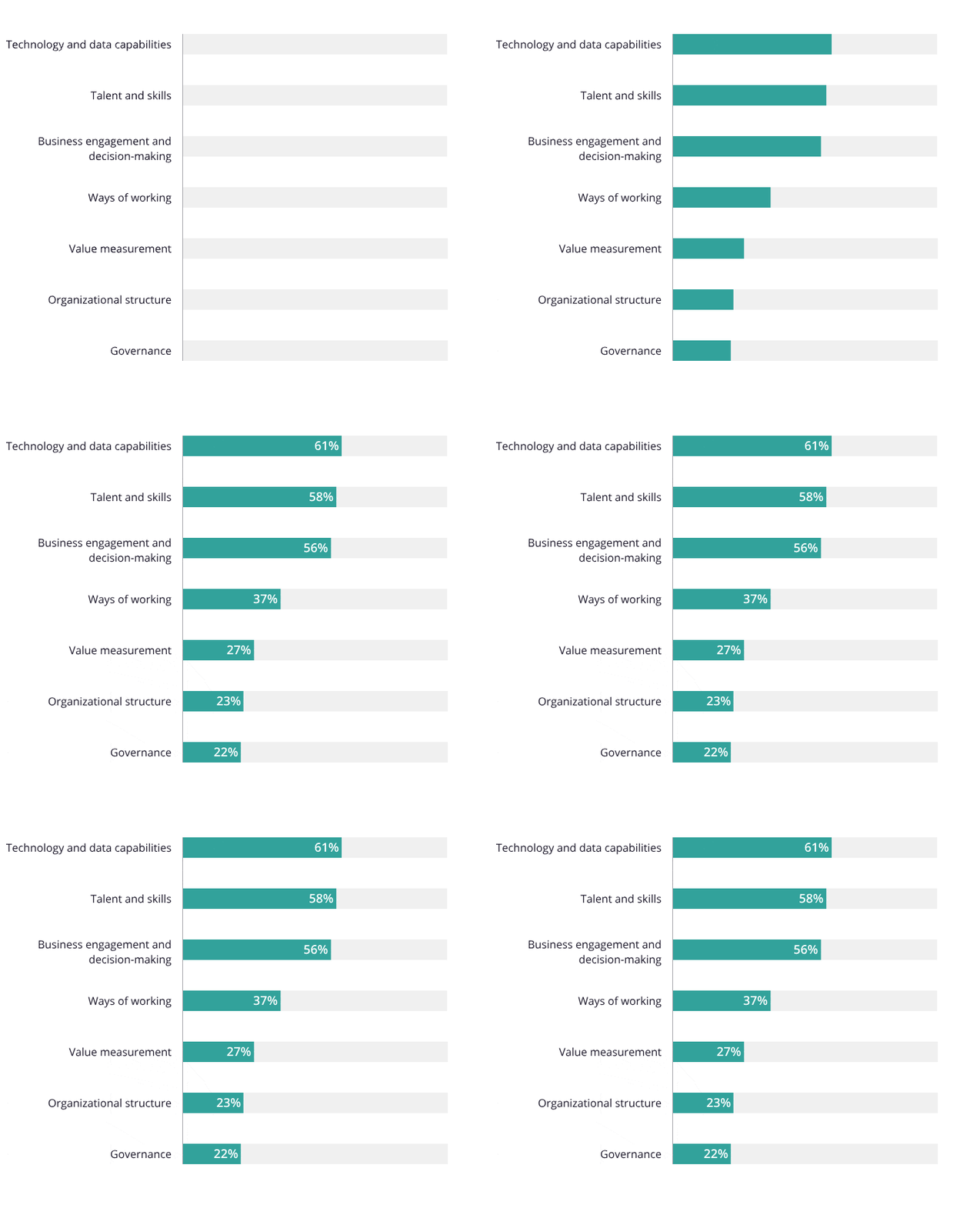
Q: Which elements of your IT operating model are under the most pressure to change?
Source: ZS’s CDIO outlook survey, October 2025. Base of 115.
What to do now: The next move for pharma and biotech AI leaders
Strategy, data and tech are already moving. Whether you get impact—or stall—will come down to the operating model choices you make next.
Start to re-examine it through the lens of where you need to be with outcomes in the next three years. Carefully consider what’s working and should stay, what needs to adapt and what can be let go.
Teams that make these calls now, with a clear view of their company’s business priorities and technical realities, will be in a stronger position to deliver scale innovation where it matters most.
About ZS’s CDIO outlook survey
The Harris Poll conducted an online survey on behalf of ZS during July 2025. The survey received responses from 115 technology executives at pharmaceutical and biotechnology companies who are decision-makers for their companies’ technology infrastructure, analytics and technology strategy. Two-thirds (62%) of respondents are executive-level titles (CDIO, CIO, CTO) and the rest are senior level decision-makers. More than one third of respondents (36%) represent companies with U.S. $30B in annual revenues. Twelve CIOs from large, multinational companies also provided additional insight through interviews with ZS. Percentages may not add up to 100% due to rounding or the acceptance of multiple responses.
Related insights
zs:topic/marketing,zs:topic/supply-chain-and-manufacturing,zs:topic/data-digital-and-technology,zs:topic/ai-and-analytics,zs:topic/research-and-development