Accelerating global clinical supply operations through smarter, faster labeling
Turning clinical labeling into a competitive advantage
This article was authored by Prashant Khare and Aditya Gupta.
Clinical supply organizations have spent a decade investing in forecasting, inventory planning and distribution. Most have made real progress. Yet for many, a pattern keeps repeating: supply is technically ready, but country activation stalls while teams wait on label text.
This is not a minor, uncommon headache. Across multicountry programs, labeling-related delays are a recurring source of avoidable lag. They often add weeks to each activation wave, with their cumulative impact compounding across amendments.
For large multicountry studies, this can translate into months of lost enrollment time—not because the product wasn’t available, but because the words on the box weren’t ready.
The root cause doesn’t have anything to do with the team’s performance. It’s architectural. Labeling workflows were designed for an era of fewer countries, fewer amendments and more stable regulatory environments. That era is over. At a time when clinical organizations are under pressure to move faster, reduce costs and improve execution predictability, controlling critical elements like labeling is essential.
Five shifts turning labeling into a bottleneck in clinical supply operations
Five structural shifts have converged to slow labeling in global clinical supply:
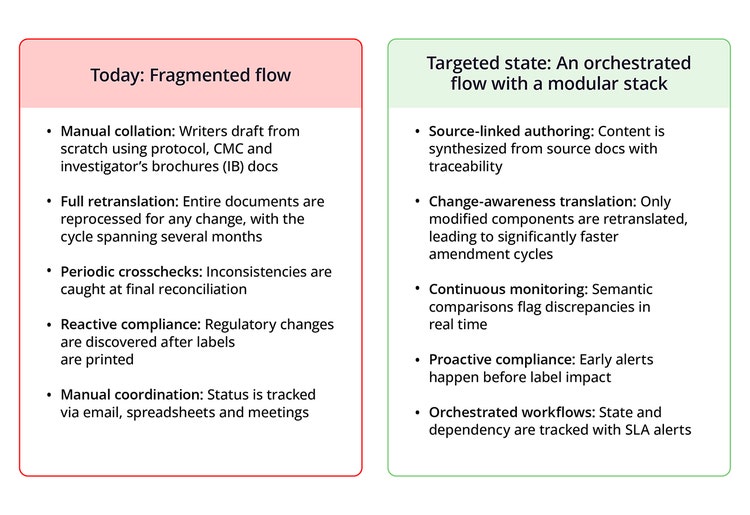
Translation is now the activation gate. In multiwave studies, localized label text now determines when later-wave countries can open. When a protocol amendment triggers retranslation across dozens of languages, downstream delays can last months, not weeks.
Version drift compounds silently. Protocols, investigator brochures, investigational medicinal product dossier (IMPD) sections and global label text evolve on independent timelines. Discrepancies are often caught late during final reconciliation when they are most expensive and disruptive to fix. For example, a single inconsistency between chemistry, manufacturing and controls (CMC) documentation and label storage text can trigger a packaging recall affecting multiple markets.
Global templates buckle under local exceptions. In theory, standardized templates improve efficiency. But country-specific phrasing, formatting rules and language constraints frequently force manual overrides, reintroducing the very variability that templates were meant to eliminate.
Stability windows have collapsed. Amendments now frequently overlap with active review and approval cycles. Teams have less time to “lock” content before the next change arrives, creating a near-continuous state of label instability.
Risk accumulates at handoffs. The chain from regulatory approval to formatted text to vendor execution to printed packaging spans multiple systems, teams and organizations. Each of these only have partial visibility.
Labeling challenges can have an outsized impact
These five challenges don’t stay confined to labeling. They can lead to delayed site activations, duplicated translation spend and the quiet erosion of team credibility when timelines slip for reasons difficult to explain to program leadership. Over time, they directly affect enrollment velocity and confidence in delivery timelines.
Why incremental supply chain fixes aren’t solving labeling delays
Most organizations have already tried the obvious improvements: Faster translation vendors, tighter review service level agreements (SLAs) and better templates. These help at the margins, but they often optimize individual steps without addressing the structural fragmentation underneath.
The core issue is that labeling work remains scattered across documents, with vendors and systems failing to share a common understanding of three critical elements:
- The intended content
- What has changed since the last stable version
- What state each component is in across markets
Without that shared foundation, improvements remain local. Faster translation doesn’t help if the source text has drifted from the protocol. Better templates don’t help if teams lack clarity on which version is current across markets.
What’s needed is a shift from optimizing steps to orchestrating flow, treating labeling not as a sequence of tasks, but as a connected process spanning authoring, translation, review and execution. More broadly, this means rethinking labeling as part of an end-to-end clinical supply value stream—where decisions and execution are designed to work together so intelligence can scale reliably across the organization.
FIGURE 1: Clinical labeling: What’s happening today vs. what’s possible
A modular capability stack—built for flexible adoption
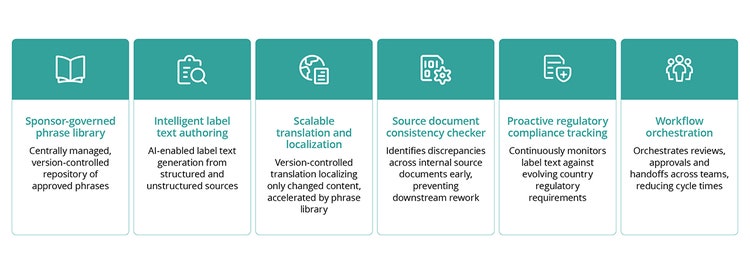
A modular capability stack can address the sources of labeling challenges while enabling a more connected labeling value stream, one designed for scaling decisions, execution and outcomes without added complexity.
These six modular capabilities can be adopted independently, but their value compounds when combined. Here’s how they work, what they change and how sponsors at different maturity levels can determine which capability delivers the most value first.
FIGURE 2: Modular capabilities for managing labeling change
Capability 1: Sponsor-governed clinical label phrase library
The problem it solves: Every sponsor already has a large set of approved label language, but it’s scattered across past studies, old packaging specs and team members’ institutional knowledge. Because it isn’t consolidated and governed in a structured way, teams repeatedly recreate “known-good statements” and introduce unnecessary wording drift and remain dependent on vendor-held translation assets.
How it works: An AI-enabled engine scans historical label text, extracts reusable statements, normalizes variants and organizes them into a governed library by content type, therapeutic area, jurisdiction and language. It continuously proposes new phrases and updates as additional labels and amendments are approved, which keeps the library current while maintaining sponsor ownership and validation controls.
What changes in practice:
- Localization acceleration. When a significant share of label content can be assembled from preapproved and pretranslated phrases, translation cycles compress meaningfully.
- Semantic consistency. Reusing governed phrases reduces variability introduced by independent drafting.
- Vendor independence. Institutional knowledge remains with the sponsor rather than embedded in vendor-specific translation assets.
A sponsor-governed phrase library serves as the foundation for the broader system, enabling reuse, consistency and traceability across downstream processes.
Capability 2: Intelligent label text authoring
The problem it solves: Label development typically starts with manual collation of inputs from protocols, CMC documents, safety reports and regulatory guidance. This is a time-consuming, inconsistent process that’s difficult to audit.
How it works: AI-enabled authoring systems synthesize content from structured and unstructured sources, generating draft label components with clear links back to source documents. Label writers shift from drafting to reviewing and refining.
What changes in practice: First-draft cycle time decreases, review iterations decline and traceability improves. Every statement is linked to its originating source, such as a protocol section or CMC specification, which supports audit readiness and regulatory responses.
Where it fits relative to existing tools: Intelligent label text authoring sits upstream as the label text drafting layer, converting protocol, IB and CMC inputs and approved phrases into traceable, approval ready content published into existing systems.
Capability 3: Scalable translation and localization
The problem it solves: Traditional translation workflows reprocess entire documents even when only a small section has changed. In global studies with many target languages, a single amendment can trigger substantial retranslation work. Without systematic reuse of approved translated phrases—not just translation memory—teams also lose the ability to preserve regulator-familiar wording, which can drive avoidable rework, reconciliation and risk.
How it works: Context and change-aware, AI-enabled localization engines isolate modified content, reuse previously approved translations where intent is unchanged and route only new or genuinely updated content for translation. Phrase-library matches are prioritized to preserve regulator-familiar wording, and complex requirements can be handled without requiring separate workflows.
What changes in practice: Translation cycles compress significantly, particularly during amendments, while consistency improves across markets and languages.
Capability 4: Source document consistency tracking (internal change focused)
The problem it solves: Misalignment between protocol, IMPD, CMC documentation and label text is common and often discovered late in the process.
How it works: For this internal quality control capability, semantic comparisons are continuously scan across regulatory artifacts, flagging discrepancies in critical fields such as dosage, storage conditions and administration instructions. Alerts are prioritized based on potential impact.
What changes in practice: Teams shift from periodic manual reconciliation to continuous monitoring with exception-based review, enabling earlier detection of high-impact issues.
Capability 5: Proactive regulatory compliance tracking (external change focused)
The problem it solves: Regulatory requirements evolve continuously, but most organizations assess impact only after changes have been published—sometimes even after labels have already been produced.
How it works: This external regulatory intelligence capability monitors regulatory updates, maps changes to active label content and generates impact assessments by study, market and component.
What changes in practice: Teams gain earlier visibility into required updates, enabling proactive revisions instead of reactive remediation. This is particularly valuable for studies spanning dozens of countries with heterogeneous regulatory timelines.
Capability 6: Workflow orchestration
The problem it solves: Even with excellent content and translation capabilities, labeling work fails at handoffs. Approvals stall in inboxes, vendor deliverables arrive without context and nobody has a reliable view of overall readiness.
How it works: An orchestration layer tracks state and dependencies across the labeling life cycle, identifying bottlenecks and surfacing risks before they affect critical timelines. SLA-based alerts surface bottlenecks before they become critical-path delays. All actions are logged for audit readiness.
What changes in practice: Teams operate with greater transparency and confidence, reducing delays caused by misalignment and manual status tracking.
The compounding effect of a modular capability stack
Individually, each capability addresses a specific constraint. Together, they form a connected system where outputs reinforce each other and improve over time (see Figure 3).
FIGURE 3: How a modular capability stack leads to compounding benefits
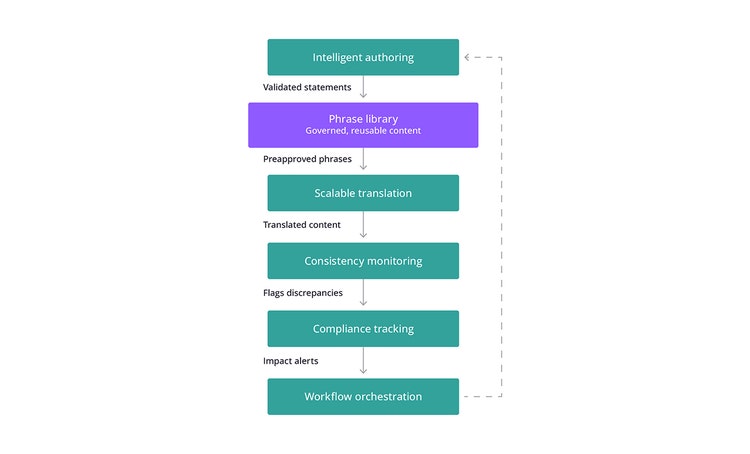
In a truly orchestrated flow, authoring generates structured, source-linked content. That content feeds the phrase library, which increases reuse across studies. Translation builds on this foundation, while consistency monitoring and compliance tracking identify risks earlier in the process. Workflow orchestration ensures the entire system remains coordinated.
The result is a reinforcing cycle: Each study improves the underlying system, making subsequent labeling faster, more consistent and more predictable.
This in turn has direct implications for clinical supply performance. Sponsors are better able to:
- Absorb amendments without resetting activation timelines
- Detect issues before they become costly
- Operate with the predictability required to support enrollment and program commitments
Getting started with a modular capability stack for smarter, faster labeling
Sponsors who want to take advantage of an orchestrated flow can begin with the capability that addresses their most immediate constraint, while working toward a more connected system over time. We generally recommend this phased approach:
- Build the phrase library. Consolidate approved label language across key therapeutic areas and establish governance. This pays immediate dividends.
- Pilot intelligent authoring. Introduce AI-supported drafting to accelerate development and improve traceability.
- Layer in translation and consistency monitoring. Reduce rework and detect issues earlier through change-aware localization and cross-document validation.
- Scale orchestration and compliance tracking. Enable enterprise-level visibility and proactive risk management.
The goal shouldn’t be to overhaul labeling overnight, but to instead build a system that becomes faster, more consistent and more reliable with every study it supports.
As clinical trials become more global and complex, labeling is no longer a back-office step. It’s a critical enabler of activation speed, enrollment momentum and program credibility. Organizations that prioritize it will be better positioned to execute confidently at scale.
Related insights
zs:topic/supply-chain-and-manufacturing,zs:topic/ai-and-analytics,zs:topic/data-digital-and-technology,zs:topic/research-and-development