ZS Synthetic Test and Control: Redefining precision in pharma impact measurement
This article contains significant contributions from Niveditha Mogali, Director of Enterprise Analytics Capabilities for GSK. Disclaimer: ZS is a vendor partner of GSK.
Measuring the real impact of pharma marketing has never been harder. A traditional test and control approach—long trusted as the backbone of success measurement—is increasingly constrained by fragmented customer journeys, complex omnichannel promotional mix and tighter regulatory requirements.
To address the challenges associated with traditional test and control, we’ve pioneered a novel approach: ZS Synthetic Test and Control. This innovation uses marketing mix results to estimate synthetic sales, capturing the impact of omnichannel promotions without the need to match every individual activity. ZS Synthetic Test and Control helps pharma companies deliver more reliable, scalable and faster insights.
GSK was the first pharmaceutical company to adopt and validate this methodology, piloting it across its priority brands. Their early adoption demonstrates how ZS Synthetic Test and Control can help transform campaign measurement.
In our work with GSK, we’ve seen firsthand:
- The structural limitations of traditional test and control frameworks in today’s environment.
- How to successfully pilot ZS Synthetic Test and Control to enhance measurement accuracy, adaptability and operational efficiency.
- How conceptual models and validation insights can power early adopters to achieve tangible business impact.
- The strategic roadmap organizations can follow for upgrading their experimentation and decision-making infrastructures.
- How industrywide modernization of test and control practices can drive greater agility, innovation and sustained growth.
The challenge of traditional test and control methods
Traditional test and control frameworks have long been the gold standard for measuring campaign impact. However, in today’s complex, omnichannel promotional environment, these methods face significant limitations that make them increasingly unreliable and difficult to scale.
ZS’s experience working with global pharma leaders revealed four recurring challenges:
- Low match counts: Traditional methods require strict one-to-one matching of entities on variables like geography, specialty, precampaign sales and omnichannel promotional activity. These constraints often result in very small match groups, limiting statistical power and reducing confidence in the findings.
- Subjective criteria relaxation: To increase match counts, analysts often relax matching criteria. These adjustments are subjective and introduce analyst-driven bias, undermining the reliability of results.
- Inconsistent results: Due to criteria relaxations, results can vary widely when analyses are rerun—even on the same dataset. The results often differ significantly when a more robust regression-based analysis is conducted once or twice a year. Inconsistency erodes trust in the methodology and hampers decision-making.
- High turnaround time: The need for repeated iterations and manual adjustments lengthens the analysis process considerably. Each run requires review and refinement, slowing down decision-making.
These challenges illustrate why legacy approaches are no longer sufficient for modern pharma marketing optimizations. Organizations risk delayed insights, wasted resources and losing their competitive edge as they continue to rely on traditional test and control methods.
Figure 1: Illustration of potential factors for obtaining matches
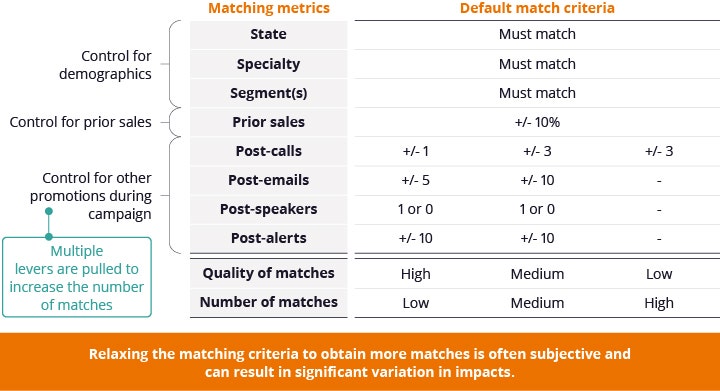
This is an illustration. The numbers shown are illustrative and do not represent actual data from GSK.
ZS Synthetic Test and Control is designed to overcome these shortcomings and deliver scalable, reliable and faster insights. GSK’s early adoption has validated the framework’s ability to address pain points in real-world campaigns.
ZS Synthetic Test and Control
ZS Synthetic Test and Control allows companies to move beyond absolute promotion matching across channels by applying synthetic sales, also known as predicted sales outcomes, that account for the effect of all promotions except the channel under evaluation.
This innovation enables:
- The ability to match against synthetic sales—rather than each channel’s absolute activity—to deliver higher match counts even with tighter thresholds.
- Improved match quality by eliminating subjectivity and ensuring alignment across key drivers. This improvement is due to the ability to control various confounding factors that might otherwise skew results in traditional matching methods. The focus on synthetic sales leads to more consistent and reliable results.
- Consistent and reproducible results stemming from a standardized, model-driven process.
- Campaign or vendor level precision, as teams can isolate the true incremental impact of individual promotional levers.
Figure 2: Comparing traditional test and control with ZS Synthetic Test and Control
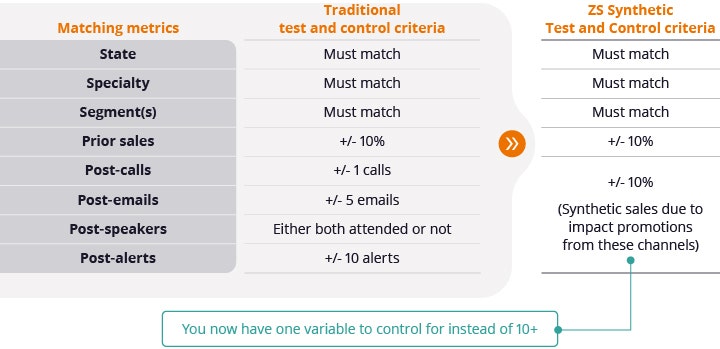
This is an illustration. The numbers shown are illustrative and do not represent actual data from GSK.
GSK as an early adopter of ZS Synthetic Test and Control
GSK was one of the first pharmaceutical companies to pilot ZS Synthetic Test and Control, using it across both its specialty and primary care brands. Their adoption demonstrates how this approach addresses real-world measurement challenges and drives better business decisions.
Case study 1: Specialty brand speaker program
GSK used traditional test and control approaches to measure the impact of a peer-to-peer speaker program for a specialty brand. However, multiple iterations with varying thresholds were required to achieve sufficient match counts, making the analysis time-consuming, highly iterative and of uneven match quality.
When GSK adopted the ZS Synthetic Test and Control approach, however, they achieved better results including:
- Significantly higher match counts: Even with tighter thresholds, match counts increased, providing a more robust dataset for analysis.
- 4-10 times better match quality: The quality of matches improved dramatically, resulting in consistent outcomes across different iterations.
Case study 2: Campaign assessments for a primary care brand
A leading primary care brand within GSK required a scalable approach to evaluate campaign impact across multiple channels. They explored traditional methods—such as test and control and regression-based approaches—along with ZS Synthetic Test and Control. The brand sought to evaluate effectiveness across three key dimensions: result accuracy, speed to insights and operational feasibility.
ZS Synthetic Test and Control emerged as the preferred solution by achieving higher match counts, better match quality and statistically significant results. It has since become the standard approach for campaign impact measurement within the brand, revealing insights previously inaccessible through conventional methods.
The brand’s team identified six key benefits of ZS Synthetic Test and Control:
- Moving beyond surface-level engagement metrics to understand true sales impact
- Aligning performance with campaign spending to identify optimization opportunities
- Accelerating time to insights by eliminating the need for multiple models
- Reducing subjectivity in analysis
- Lower dependency on holdout groups, allowing brand leads to experiment freely
- More consistency across measurements because results are tied to marketing mix
Use cases enabled by ZS Synthetic Test and Control
ZS Synthetic Test and Control provides a new way to measure campaign impact more consistently and accurately. These use cases detail how it supports campaign planning, segment-level insights and cross-campaign comparison, while reducing the need for traditional holdout groups.
Campaign and channel selection: ZS’s Synthetic Test and Control approach enables agile measurement of campaign impact, allowing marketers to evaluate performance with just two to three months of activity and to quickly identify optimization opportunities.
Segment level optimization: Different customer groups often respond differently to promotional activity. ZS Synthetic Test and Control makes it possible to measure this differential impact with precision, uncovering which specialties, geographies or segments are most responsive. This allows for more personalized promotional strategies and ensures resources are targeted to the highest-value segments.
Cross-campaign comparison: Traditional methods often produce results that are difficult to compare across campaigns due to differences in methodology or analyst judgment in criteria. By standardizing the approach, ZS Synthetic Test and Control helps brands evaluate campaign performance on a like-for-like basis, so that leaders can benchmark results consistently across the portfolio.
Reducing reliance on holdout groups: Traditional test and control designs often require preplanned holdout that limit coverage. ZS Synthetic Test and Control eliminates this burden by using naturally unexposed customers—arising from implementation gaps or timing—as proxy control groups.
Implementation considerations for ZS Synthetic Test and Control
Several factors determine the reliability of ZS Synthetic Test and Control. A strong marketing mix foundation, high-quality data, representative control samples and automation all ensure the approach delivers consistent and scalable insights.
Marketing mix foundation: ZS Synthetic Test and Control requires input from marketing mix models, to evaluate synthetic sales baselines by estimating outcomes of omnichannel promotions. This ensures impact measurement aligns with broader marketing analytics while maintaining methodological consistency.
Data quality and coverage: High-quality, comprehensive data is essential. Reliable capture of promotional exposure across all channels and customer segments underpins the accuracy of any analysis irrespective of the approach.
Automation and scalability: When embedded into existing data pipelines, ZS Synthetic Test and Control can be automated end-to-end, allowing for repeatable analyses with rapid turnaround times. This makes it feasible to evaluate multiple campaigns concurrently and provide near real-time insights for decision-making.
Figure 3: An illustration of the impact of ZS Synthetic Test and Control
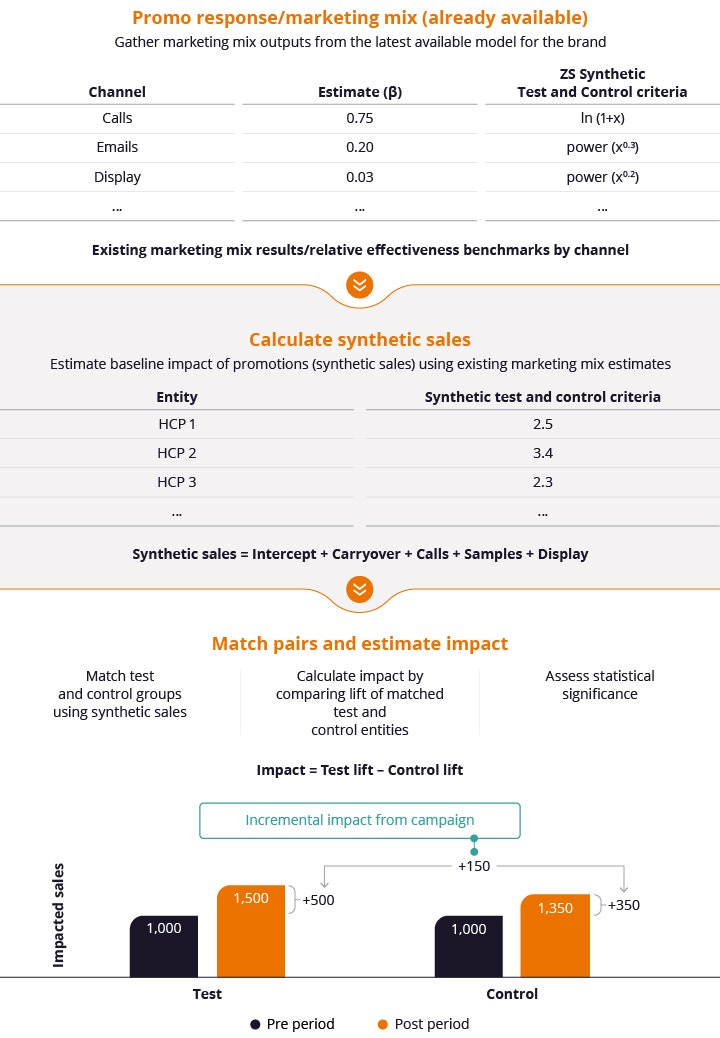
This is an illustration. The numbers shown are illustrative and do not represent actual data from GSK.
A better way forward: Improved pharma impact measurement
As the pharmaceutical industry continues to evolve, the demand for innovative solutions that drive precision and effectiveness in marketing strategies will only grow. ZS Synthetic Test and Control represents a breakthrough innovation to address the limitations of traditional methods while offering a standardized, scalable path forward.
GSK’s early adoption has validated the effectiveness of ZS Synthetic Test and Control in real-world campaigns, demonstrating it can enable:
Comprehensive analysis: By accounting for all promotional activities, ZS Synthetic Test and Control provides a holistic view of their impact, ensuring no aspect is overlooked. This comprehensive analysis is like having a panoramic view of a landscape, where every feature is visible and accounted for. It allows companies to make decisions with more confidence.
Empowering data-driven decisions: The reliability and accuracy of ZS Synthetic Test and Control empowers pharma companies to make strategic decisions based on solid evidence, helping them fine-tune their marketing strategies for optimal results.
Future-proofing marketing efforts: In an industry characterized by rapid change and innovation, the ability to adapt and evolve is crucial. ZS Synthetic Test and Control addresses current challenges and positions organizations to effectively navigate future developments. By providing a scalable and adaptable framework, this approach ensures pharma companies are well equipped to meet the demands of an ever-changing market.