TPPs aren’t working. It’s time for a new approach in pharma R&D
There has been a push across the pharmaceutical industry for a more integrated approach to ensure R&D portfolio investments, clinical development plans and evidence strategy all incorporate input across relevant functions from an asset’s early stages. Yet because of how it’s created and used, the target product profile (TPP)—the tool most central to cross-functional communication—often lacks the nuance required to thrive in an integrated environment.
An integrated approach helps pharma companies invest in high-fidelity trials on promising science. It also helps them avoid expensive surprises such as trials not being designed for approval in key markets, health technology assessments (HTAs) or payers rejecting their value proposition or producing outcomes that fail to resonate with physicians and patients.
There are many forces driving this need for an integrated approach. First, to support growth and shareholder return, large pharma companies are increasingly reliant on blockbuster products with $1 billion in peak global sales. Increasing competition within diseases and mechanisms of action also means earlier thinking is needed on how to differentiate assets. Finally, the cost to bring a new drug to market has also grown, due in part to increasing clinical failure rates. This means companies have to be more judicious with capital allocation and choose the right risk-reward tradeoffs.
Recent years provided plenty of anecdotes on the cost of an integrated approach coming too late:
- Zynteglo, a gene therapy for β-thalassemia, was approved by the European Medicines Agency (EMA) but never received reimbursement from the largest European markets despite offering value-based pricing arrangements.
- Despite comparable efficacy and fewer intravitreal injections, Beovu fell short of expectations in wet macular degeneration as safety concerns related to intraocular inflammation created an unattractive clinical tradeoff.
- Rubraca was expected to perform as a comparable, second product in the closely watched PARPi class, but both the first and third entrants had more competitive development programs to shape differentiated labels and clinical profiles.
Conversely, there are fears that commercial thinking will kill programs prematurely. Every company has examples of major innovations that were nearly terminated because of misperceptions of market value. Merck famously shelved MK-3475 long before it became Keytruda. Warner-Lambert, the company that originated Lipitor, nearly declined to develop it as a fifth-to-market statin with an internal forecast of $300 million at peak.
What should we learn from these stories? The biggest leaps forward in scientific insight require the most faith—though these stories can also be red herrings as they don’t represent most cases in which commercial potential was doubted.
The promise of early, integrative thinking is as powerful as its challenges. Misaligned incentives, cultural siloes, asymmetric expertise and the human biases that manifest in the face of genuine uncertainty all present roadblocks to harmonizing perspectives across functions. Overcoming these hurdles is a difficult but important process companies must pursue.
As with many problems, a resolution begins with communication. Thankfully, this situation can be improved. While other interventions will also be required, companies can make meaningful progress by addressing the problems with predicted TPPs and exploring alternatives.
The problem with predicted TPPs in pharma
Years ago, we had a conversation with a business unit (BU) forecasting lead who was seeking advice. His team consistently produced forecasts with peak sales of $1-$2 billion, while another BU was sharing forecasts that consistently had peak sales of $3-$5 billion. Was there something wrong with his team or with the therapeutic areas his BU covered?
No. His team’s forecasts were based on TPPs that reflected the minimum viable clinical outcomes needed to achieve the commercial opportunity required for R&D funding. The other team’s forecasts were based on TPPs that reflected transformational clinical outcomes. Two BUs, two different interpretations of what a TPP represents. More concerning, it is statistically implausible that either BU’s forecasts were correct. On average, only about 20% of drugs become blockbusters with peak sales above $1 billion.
Most companies treat the TPP as a prediction of an asset’s clinical performance in a given indication. This predicted TPP serves many roles. It’s the:
- Single source of truth for the asset’s profile
- North Star for evidence strategy and clinical development plan design
- Foundation for business case development and investment decisions
Because these clinical outcomes are inherently uncertain, TPP prediction often defaults to expertise or becomes a negotiation between aspirational and pragmatic thinking. As companies have pushed for commercial perspective earlier in development—in some cases beginning as soon as candidate selection—TPP prediction now involves less in-human data.
One challenge this creates: focusing internal dialogue on the asset rather than the disease and unmet needs. While unmet need is sometimes considered in shaping a TPP and understanding the commercial opportunity, the TPP is fundamentally a reflection of the asset and it can become easily disconnected from what the many stakeholders in the market require. This is particularly unhealthy in early development when investment rationale should be about the value of solving the problems a drug is intended to solve.
There is also an inherent flaw in business cases based on predicted TPPs. The two most determinative inputs to a clinical program’s value are the forecast, based on the TPP, and the probability of regulatory approval, often called PTRS or POS. However, the predicted clinical outcomes on which the forecast is based may be significantly better than the threshold for regulatory approval, making the probability of achieving them significantly lower. Yet we often risk-adjust the TPP-based forecast on the probability that clinical outcomes will hit an (often different) approvability threshold.
Predicted TPPs also create decision ambiguity. If the prediction was too optimistic, organizations can struggle with investment decisions on programs comparing newly released clinical data against a TPP. If you missed by a little, is it good enough? How much of a miss is too much? The decision-making process can cause material delays in overall development timelines. This ambiguity can have a snowball effect, leading to lack of transparency around future decisions, which in turn can negatively affect culture.
There has been much talk in the industry about changing risk assessments from probability of approval to probability of reimbursement or even probability of commercial success. This broader aperture should be applied to the TPP.
Moving beyond the TPP in pharma with the ARCH model
We propose a new model to replace the TPP, which we call the ARCH model. It comprises approval, reimbursement, commercial viability and hope—four areas where companies should have visibility and foresight. Rather than a negotiation across functions to align on unknowable future pivotal trial outcomes, the ARCH model transparently captures both aspirational thinking and reality checks.
FIGURE 1: Comparing the ARCH model in pharma with the TPP
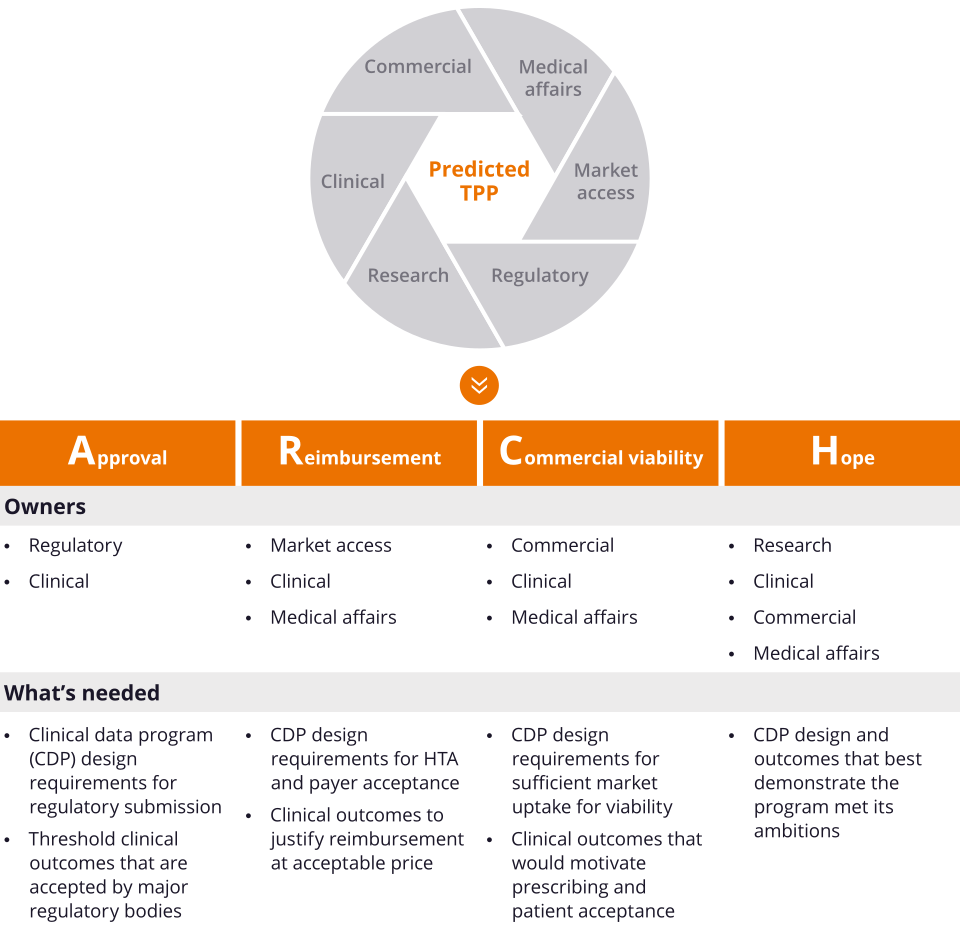
The ARCH model should capture:
- Trial design and outcomes requirements for regulatory approval in key markets
- HTA and payer requirements, which may differ from regulators
- The unmet needs the potential therapy hopes to meet, as well as its competition, along with implications for competitive trial design and the outcomes required for commercial viability. For many companies, this is $1 billion in peak sales
As for the fourth element of ARCH, the hope for an asset should reflect the conviction of scientists who have gotten out of bed for years in its pursuit. It should also make clear why the asset would be life-changing for patients, and commercial potential depends on the value stakeholders see in meeting the targeted unmet need. If the hope for an asset’s clinical outcomes is equivalent to those required for commercial viability, it is likely not a good investment. As we know, pharma R&D involves high levels of risk, and risk requires upside to attract capital.
Operationalizing the ARCH model in pharma
Deploying the ARCH model has implications on three levels: how clinical programs and trials are designed, how business cases are constructed and how pipeline investment decisions are made. The predicted TPP is embedded in the operating model for teams working on pipeline assets across research, clinical, medical affairs, commercial, market access and regulatory.
Transplanting this failed model should be done with care. Here’s what you should consider as you implement ARCH:
Program and trial design.A clinical program—the sequence of trials in pursuit of an indication—and its component trials need to be designed with many stakeholders in mind. These include regulators, HTAs and payers, as well as physicians and patients in markets that constitute the bulk of opportunity. The ARCH model requires teams to articulate these design requirements separately. The minimum viable design needs to be sufficient for approval, reimbursement and commercial viability—the ARC in ARCH.
Asset teams should also explore design elements that would create evidence of the hope for the product. These elements can provide optionality for investment decisions and should be activated if the upside or probability of fulfilling the hope is sufficient. Regulators, HTAs and physicians may be satisfied with a randomized controlled trial against placebo or an older standard of care. But if the hope for an asset is clinically meaningful in-class differentiation, then a head-to-head trial against a novel competitor should be on the table and outlined in the hope scenario.
Business cases.The mechanics of developing business cases also needs to change. The ARCH model inverts the current line of reasoning. Rather than interrogating market intelligence and market research participants to predict how many patients will receive a predicted TPP, asset teams instead ask:
- What would stakeholders need to see in the clinical data package for the product to be used at the frequency required for commercial viability?
- What would be the value to all stakeholders of meeting the unmet need?
- What data would stakeholders need to see to believe the need had been resolved?
This assessment should differ between early and late development decisions. Preclinical assets are inherently risky, but this shouldn’t deter companies from investing in them. In fact, the preclinical assets that bear the most risk—those with relatively less mechanistic validation, more uncharted clinical and regulatory paths or a higher competitive bar to beat—are sometimes those with the greatest commercial potential. The business case for preclinical assets should be about balancing hope against the relative scientific validation and precedent in the path to market.
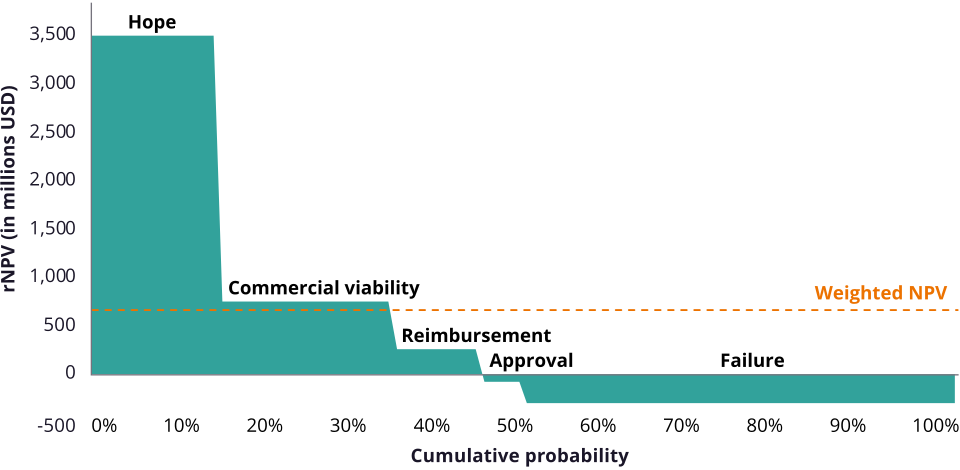
Investment decisions. The ARCH model calls for a fundamental shift in how investment decisions are framed, moving away from relying solely on single-point risk-adjusted net present value (rNPV) as the primary metric for determining a clinical program’s investment worthiness. The rNPV can disguise a great deal of nuance in both a therapy’s financial potential and the risk presented to the organization.
Instead, understanding the net present value (NPV) of each scenario in the ARCH model provides a more robust picture for management. Having this detail across a portfolio of assets also provides opportunities for more nuanced portfolio-level tradeoffs. These scenario-specific NPVs offer management teams visibility into how much upside and risk is built into their pipelines.
FIGURE 2: An illustration of net present value (NPV) probability distribution
Reframing risk and value in pharma clinical development planning with ARCH
The ARCH model is intended to fundamentally change discourse at the intersection of the research, clinical, medical affairs, commercial, market access and regulatory functions. By offering a more nuanced and holistic platform for these discussions than the predicted TPP, ARCH will help cross-functional asset teams collaborate more effectively and provide better guidance to management teams on investment decisions and tradeoffs. There are three ways this approach can change the status quo:
Altering how we think about risk. While there is a growing body of evidence focused on predicting clinical trial outcomes, we are still many years from relying solely on computation to make these predictions, and they will always have some uncertainty associated with them. In lieu of unimpeachable AI, the ARCH model shifts the discussion from false precision on a TPP prediction to stakeholder needs, required evidence and the believability of attaining different clinical profiles. This is still challenging, but it focuses teams on what matters: how much risk is acceptable in exchange for potential, rather than defense of the unknowable.
Clarifying future development decisions. The ARCH model should be a cross-functional contract that clarifies how future decisions will be made. Clear thresholds for the clinical data needed to achieve various levels of market uptake and financial return give the entire organization a shared view of what future studies must demonstrate. The probability of hitting these thresholds becomes clearer as more in-human data is generated.
Driving better conversations. If ARCH is implemented across the pipeline, management teams can foster more nuanced discussions on enterprise value and risk tradeoffs as they make budget and resource allocation decisions. Rather than simply focusing on “upside” and “downside” scenarios that are often vague and inconsistently structured by program, the ARCH model creates a consistent language for characterizing scenarios for every program.
Related insights
zs:topic/research-and-development,zs:topic/value-and-access