New insights from 15 years of novel U.S. emerging biotech and pharma first launches
Key findings
- While first launch volume has remained broadly stable over the past 15 years, novel first launches are increasingly concentrated in advanced modalities, which accounted for approximately half of first launches in 2025.
- Independent commercialization remains the dominant model for U.S. first launches, with most emerging biopharma companies choosing to “go it alone” at launch rather than co-promote or co-commercialize with a partner.
- Among companies that are acquired after a U.S. first launch, they are typically acquired within two to four years once commercial trajectory and reimbursement by payers are established.
- Ex-U.S. companies entering the U.S. market largely follow similar launch patterns, with most launching independently
Understanding the evolving context of U.S. first launches
We analyzed 15 years of data on novel U.S. emerging pharma and biotech first launches. In the most recent year, we observed a notable concentration in advanced modalities, as well as continued representation of rare diseases and specialist-driven indications.
Therapeutic area concentration
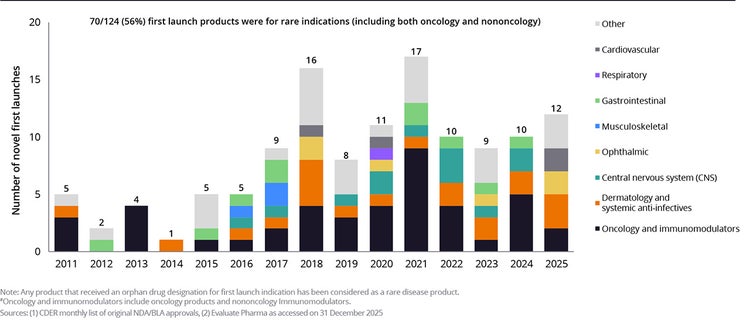
Over this period, there have been 124 first launches of novel products in the U.S., with 56% focused on rare diseases, including 28 in rare oncology indications.
The therapeutic areas in which first launches are occurring reflect these shifts (Figure 1). Oncology, immunology and rare-disease-focused therapeutic areas account for a growing share of first-launch activity, while central nervous system and cell and gene therapy-associated areas have increased in recent years.
This pattern continued in 2025, with 50% of first launches representing advanced therapies, including cell, gene and mRNA therapies.
FIGURE 1: First launches by therapy area (2011-2025)
Approval volumes and launch cadence
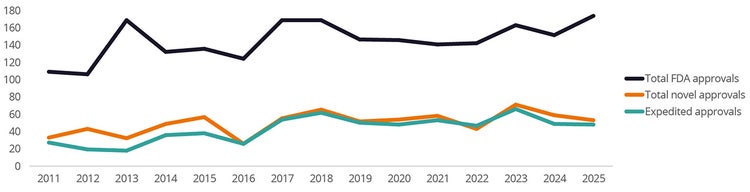
From 2011 through 2025, the FDA approved 2,179 drugs and biologics under the centers for Drug Evaluation and Research (CDER) and Biologics Evaluation and Research (CBER). While total approvals increased modestly, the annual volume of novel drug approvals remained broadly stable while nearly mirroring the number of expedited approvals (Figure 2) below.
FIGURE 2: Total FDA approvals versus novel and expedited approvals (2011-2025)
Commercialization, scale and regional expansion for U.S. first launches
Against this evolving launch context, first-launch companies face a set of interrelated decisions around commercialization models, field force scale and geographic expansion.
Commercialization models and regional expansion patterns
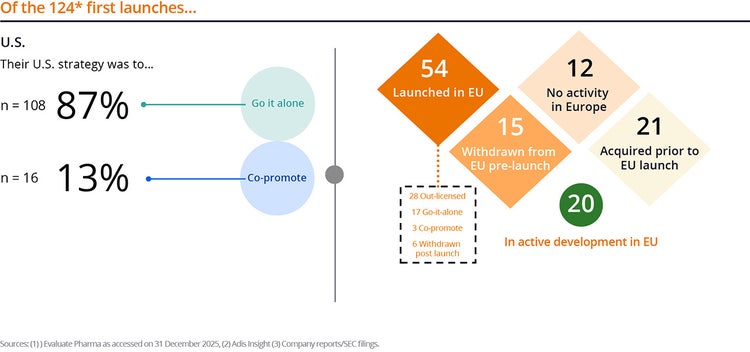
Of the 124 U.S. novel first launches since 2011, 87% commercialized independently at launch via a “go it alone” model. Among this group, approximately 40% have also commercialized in Europe to date. And of those that also commercialized in Europe, 52% were out-licensed, 31% launched independently and 6% were co-promoted.
FIGURE 3: First launch commercialization models (2011-2025)
Commercialization models by therapeutic area
Commercialization approaches differ by therapeutic category, especially when comparing oncology and rare non-oncology assets. For novel first launches of oncology assets, including in rare oncology indications, the vast majority (~80%) launch independently in the U.S., while nearly two-thirds out-licensed in Europe. In contrast, rare non-oncology assets most often follow a go-it-alone approach at U.S. first launch (88%), with a majority maintaining that model in Europe (62%).
Field team differences by therapy area
Between 2011 and 2025, there were 37 novel U.S. oncology and immunology first launches. For these assets, typical field team sizes ranged from 40 to 85 sales representatives, with an average ratio of eight reps for each medical science liaison (MSL). Field teams for hematology assets tended to be significantly smaller than those for solid tumor assets.
In contrast, first launchers in rare diseases have typically deployed smaller teams, usually in the range of 20 to 40 sales reps and with a higher proportion MSLs than in oncology and in immunology.
At the other end of the spectrum, CNS-focused first launches tend to feature field team sizes ranging from 200 to 300-plus, with this added commercial footprint often used to reach a much larger base of specialists and higher-volume primary care physician prescribers.
In similar indications, emerging and small biotech and pharma first launchers tend to deploy significantly leaner field teams and lower levels of investment than their large pharma counterparts. However, companies that co-promote with a big pharma partner often deploy field teams roughly double the size of solo first launchers.
Nearly all will also invest significantly in complementary “omni-channel” engagement digital and non-personal engagement, with many deploying advanced analytics and technology solutions to drive greater productivity from their field teams and patient impact.
Consequences and trajectories for U.S. novel first launches
Once companies have made their early commercialization and scaling decisions, the data reveal consistent downstream patterns in partnership timing, acquisition activity and longer-term outcomes.
From U.S. traction to EU transition: The strategic window for first-launch M&A
Among the 49 first-launch companies acquired following their initial U.S. launch, most acquisitions occurred within two to four years of launch after early commercial traction and payer acceptance had been established.
FIGURE 4: Time to acquisition post-U.S. first launch, by therapy area (2011-2025)
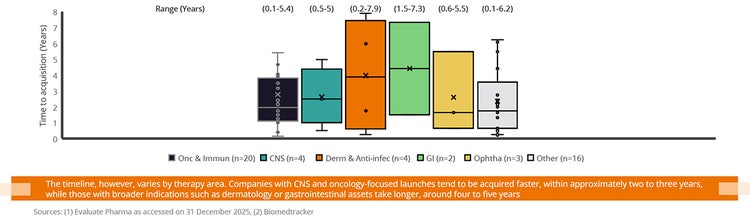
Although sample sizes outside oncology and immunology are small, observed acquisition timelines are approximately two to three years for oncology and CNS assets and four to five years for dermatology and GI assets.
Ex-U.S. companies launching their first products in the U.S.
From 2011 to 2025, 31 ex-U.S. biopharma companies launched their first products in the U.S. market. Of these, 24 firms were based in Europe, five in Asia and two in Australia. About 60% of these first launches targeted rare diseases.
Among this sample, a majority launch independently. Only about 20% were later acquired. The largest share of companies acquired postlaunch hail from western Europe, especially the U.K.; companies based in the Asia-Pacific and Nordic regions, on the other hand, have tended to grow independently or through partnerships.
The 2026 outlook for U.S. novel first launches
We anticipate first-launch volume to remain steady in the year ahead, with continued concentration in oncology, rare disease and advanced modalities. Regional expansion will likely remain a key decision point, as many first-launch companies continue to seek partnerships or acquisitions before full European scale-up.