Sticky by design: Evolving change management with the science of habits and human behavior
Sydney Hartsock and Jordana Tabbush coauthored this article.
Every renovation starts with a vision. A modern kitchen to make dinner easier. An open living space to bring people together. Each project brings the promise of improvement—but realizing that promise takes more than good intentions. It requires time, energy and support to live through the disruption, make daily adjustments and keep moving forward when the dust doesn’t settle overnight. Without that support, even the most thoughtful plans can stall. Tools sit unused. Rooms linger in transition. The people who should benefit become tired and overwhelmed.
Organizational change is no different.
Organizational change success depends on supporting new behaviors
Each initiative—a promising AI tool, a reimagined customer-facing model, a shift in culture and ways of working—starts with a clear benefit in mind. Success depends not only on the strategy itself, but also on the experience of the people living through it. Change disrupts routines, demands new skills and often arrives faster than individuals can reasonably absorb. Without the time, guidance and reinforcement needed to make those shifts, even the best ideas struggle. New behaviors fail to take root—full value is never realized and often employee engagement takes a hit.
Failure isn’t in the vision—it’s in the support. Undervaluing the human side of change turns well-intentioned transformation into unrealized potential. To capture the full value of innovation, organizations must invest not just in the “what” of change, but in the “how”—creating the conditions for people to engage, experiment and ultimately make change stick.
How ZS’s change framework builds Trust + MIND(set)
To move beyond stalled progress and unrealized potential, organizations must rethink how they approach change—not just as a series of initiatives to be launched, but as experiences to be lived by the people expected to carry them out.
Lasting change doesn’t come from strategy decks or timelines alone; it comes from being aware of and then meeting the real, behavioral needs of employees navigating uncertainty, disruption and new expectations. Research in behavioral science and organizational psychology shows that people are far more likely to adopt and sustain change when specific psychological, cognitive and social needs are fulfilled. By intentionally designing change with those needs in mind, leaders can unlock faster adoption, stronger engagement and greater long-term impact.
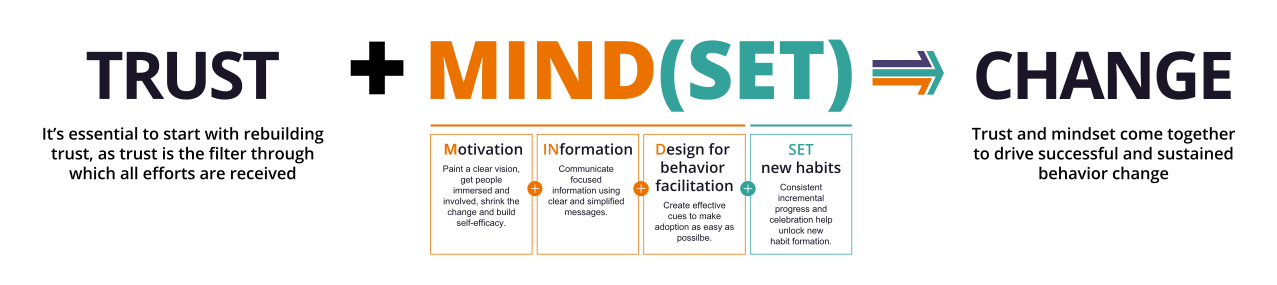
ZS leads companies through change enablement so they can get the most out of their investments, amplifying the value of their team’s strengths while limiting disruption to productivity. This is especially critical at a time when organizations are racing to implement new AI and digital initiatives to get ahead of their competitors. ZS’s Trust + MIND(set) framework highlights the core human needs to address across the full spectrum of change activities, from defining the vision and case for change to performing the stakeholder analysis and delivering a full engagement plan, turning well-intended change into sustained progress.
Trust as the foundation of the ZS change management framework
Why trust matters: Trust is the foundation of successful change. When employees believe in their leaders and the purpose behind a transformation, they’re more willing to engage—even in the face of uncertainty. Without trust, change feels risky and is more likely to be resisted. Unfortunately, leaders often overlook that trust tends to decline during change—even when it starts high—because transformation unsettles what once felt stable. That’s why it’s essential to actively maintain and rebuild trust from the very start of any change effort.
How trust works: In everyday life, trust is built not through grand gestures, but through consistency and transparency. Imagine a friend who follows through when they say they’ll help you move, admits when they’re running late and shares honestly, even when the news isn’t ideal. Over time, their actions create psychological safety: You can count on them. The same dynamic applies at work. When people experience leaders showing up consistently, communicating openly, acknowledging challenges honestly and treating people fairly, trust grows naturally, even when the path ahead is complex. Now think of a recent change you faced: When you heard about it from someone you deeply trusted, you may have questioned it but stayed open to it. From someone you didn’t trust, your reaction was likely very different.
Applying trust to organizational change: In an organizational change effort, trust can be built through visible, credible leadership actions. For example, during an AI transformation, a company might host regular town halls and small facilitated team discussions where leaders not only share progress but also openly discuss known risks and unknowns. They might spotlight real employee stories—both successes and setbacks—to show that experimentation and learning is expected, not punished. And they must demonstrate transparency and a clear, fair process. By involving employees early, being honest about tradeoffs and following through on support commitments, leaders send a clear signal: This change isn’t just being done to you—we’re in it with you. That’s how trust turns into traction.
What research shows: Trust is one of the strongest predictors of change acceptance. As trust in leadership rises, resistance to change falls—because trust reduces perceived threat, fosters psychological safety and makes uncertainty feel less risky. When employees believe leaders are consistent and transparent, they’re more willing to leave the comfort of old routines and engage with new ones. In a recent field study, higher organizational trust was associated with lower resistance to planned change. In that sample, a trust-only regression explained about 40% of the variance in resistance. A meta-analysis spanning more than 60 years confirms: Trust isn’t just helpful—it’s foundational for successful transformation.
Motivation is fickle; sustaining it requires consistent support
Why motivation matters: Motivation is the desire to act in service of a goal, shaped by factors like purpose, rewards, autonomy, belonging and the sense of progress or mastery. It’s essential not just to spark change, but to sustain it. But motivation isn’t a switch you flip once; it ebbs and flows, especially when change feels complex, uncertain or slow to deliver results. Without ongoing reinforcement, even the most committed employees can lose momentum. That’s why successful change efforts require leaders to consistently re-energize motivation, using multiple touch points that speak to the evolving needs of their people.
How motivation works: Involvement is a powerful lever that activates multiple motivational drivers. When people help shape a change—by offering input, testing ideas or defining the path—they feel greater ownership and are more motivated to see it succeed. Just like a child is more excited to eat dinner they helped cook, involvement sparks intrinsic motivation through personal connection and pride. Another key lever is making the change feel rewarding along the way. Big benefits often take time and even an inspiring vision can fall flat without near-term reinforcement. Celebrating small wins (“inch-pebbles” as well as milestones) and building in positive social experiences can keep momentum strong and motivation sustained. Like marathon training—focusing only on race day makes it hard to stay motivated, but celebrating progress and sharing the journey with a friend keeps it rewarding.
Applying motivation to organizational change: During a customer model transformation, for example, frontline teams could be invited to cocreate new engagement approaches or test pilot tools before a full rollout. Their feedback not only improves the design, but it also builds buy-in. When employees see their ideas reflected in the change they shift from passive recipients to active contributors, dramatically increasing the likelihood of adoption. Even when the core decision is already made, leaders can boost adoption by highlighting early wins and recognizing teams who adapt well. Sharing success stories, spotlighting creative problem-solving and celebrating progress—no matter how small—helps build momentum and makes the change feel real and rewarding.
What research shows: People tend to value what they help create—the IKEA effect—which translates to stronger attachment and buy-in when employees cobuild solutions. A decades-long review of change research found that when employees participate in shaping the change, they’re more ready and supportive—and less stressed. Even modest, early involvement reduces stress and withdrawal, which is why cocreating early beats announcing late.
Create clarity and confidence with the right information
Why information matters: Information is a powerful tool in a change effort—but only if it’s delivered in the right way. People don’t just need facts; they need clarity, context and cues about what to do next. If the “why,” “what” and “how” of a change aren’t communicated clearly—or if the format is overwhelming or poorly timed—employees may feel confused or unsure, which erodes confidence and delays action.
How information works: Think about GPS directions—they don’t hand you the whole map at once. Instead, they guide you step by step: “Turn left in 200 feet.” This kind of timely, layered information builds confidence and makes unfamiliar routes feel manageable. Dumping the entire route up front would be overwhelming and easy to misinterpret. How information is framed and sequenced directly affects people’s ability to act. And while information is essential, it’s not sufficient to drive change by itself. Delivering directions isn’t the same as driving movement. Just like a map doesn’t get you to your destination, information only works when paired with broader support to help people move forward.
Applying information to organizational change: In a technology transformation, for example, instead of handing employees a dense user manual or sending a one-time launch email, leaders might introduce short, targeted messages over time—paired with just-in-time training videos, job aids or peer walkthroughs. When information is simplified, repeated, visually supported and spaced out in line with real work moments, employees are far more likely to understand, retain and apply it—turning passive awareness into confident action.
What research shows: Repetition enhances processing fluency—how easily the brain processes a message—which increases perceived truth, liking, trust and credibility in a concept. In change leadership, it’s tempting for leaders to rush through messaging in the name of efficiency—but research shows that repetition to improve familiarity with key information is essential for building trust, credibility and belief in the message.
Design the change context to support the behaviors you want to see
Why designing for behavior matters: Even when people are motivated and informed, change often breaks down in execution. That’s because human behavior is heavily influenced by the environment—physical spaces, social norms, routines and cues. If the environment doesn’t support the new behavior—or worse, reinforces the old one—change won’t stick. To succeed, organizations must intentionally shape the conditions around people to make new behaviors easier, more visible and more rewarding. This is what we refer to in our change enablement model as “designing for behavior facilitation,” or creating effective cues that make adoption as easy as possible.
How designing for behavior works: Putting your workout clothes out the night before, setting a calendar reminder or joining a class with a friend all increase the chances you’ll follow through. These tactics reduce friction, provide cues and add social accountability. Similarly, consider an organization that wants to encourage “meeting-free Fridays” for more focused working time. To design for success, leaders could block this time on calendars, engage administrative support to reschedule meetings and protect time and even temporarily suspend use of virtual meeting platforms. You don’t always need more willpower—sometimes you need the environment to work with you. Small changes in setup can dramatically increase follow-through.
Applying designing for behavior to organizational change: During a sales transformation, for example, an organization might integrate new conversation prompts directly into the CRM, spotlight peer usage in team meetings and track behavior metrics alongside outcomes. These changes embed the new behaviors into daily workflow, create visible norms and provide real-time reinforcement. Rather than relying on reminders or training alone, designing intentionally for behavioral facilitation turns change into the path of least resistance.
What research shows: Research shows that habit drives over 40% of daily behavior, not conscious intention, meaning people often act automatically in response to environmental cues. In one study, students who transferred to a new university were significantly more likely to change entrenched habits (like exercise or TV watching), simply because the environmental context changed. This reinforces a core principle of behavior change: to change behavior, change the context. When organizations design environments that prompt, support and reward the new behavior—rather than hoping people will remember and choose it—they significantly increase the odds of lasting change.
Set new habits with repetition and reinforcement
Why setting new habits matters: Forming new habits takes time. Without repetition and reinforcement, even well-adopted behaviors fade as people slip back into old routines under pressure. Yet organizations often underestimate this reality—pushing for adoption without allowing the space needed for habits to take root. Embedding change means turning new behaviors into automatic, everyday practices—and there’s no shortcut, no matter how urgent the timeline. Ironically, giving habit formation the time it needs is the fastest path to lasting results.
How setting new habits works: Building a new habit isn’t about perfection—it’s about repetition. Imagine you’re starting a daily journaling habit. The goal isn’t to write something profound every day—it’s simply to show up and write something. Some days it might be a thoughtful reflection; other days, just a sentence or two. Over time, you’re building the habit muscle through consistency. The act of journaling becomes part of your rhythm, not because each entry is great, but because you kept doing it, even when it wasn’t. To make a behavior stick, people need regular prompts, encouragement and room to practice without pressure. Celebrating small wins reinforces the behavior and keeps momentum alive. When consistency is acknowledged and incremental progress is visible, new habits are far more likely to take hold and last.
Applying setting new habits to organizational change: Take a shift to digital-first customer engagement. Rather than expecting full adoption from day one, organizations can break the behavior down into manageable pieces, introducing new steps gradually (such as using the new digital tool for five minutes before talking to a customer or choosing one suggested prompt to integrate in a sales conversation), embedding them in workflows and recognizing consistent usage. Managers play a critical role in reinforcing behavior, creating time for discussion and celebrating progress. By pacing rollouts, reducing pressure to “get it right” immediately and maintaining visibility over time, organizations move from momentary compliance to true, habitual change.
What research shows: One study found that forming a new habit takes, on average, 66 days—but can range from 18-254 days depending on the behavior and the person. Crucially, the study showed that missing a day or two doesn’t break the habit-building process—what matters most is consistent repetition over time in a stable context. This reinforces a key lesson for organizational change: Don’t expect instant mastery. Instead, design for ongoing reinforcement, visible progress and tolerance for imperfection—because that’s how real habits form and stick.
To see real change, support new behavior
To move from intention to impact, leaders must recognize that true transformation is built through behavior. When trust isn’t established, people disengage. When motivation is low, even small barriers feel insurmountable. When information is unclear or poorly timed, action stalls. Without the right environmental cues or reinforcement, even the best tools go unused. And when there’s no time to form new habits, change never becomes the norm.
But with the right behavioral support, the outcome is different. ZS’s Trust + MIND(set) framework puts people at the heart of change, turning big ideas into real progress by connecting vision, stakeholders and lasting engagement. When organizations invest in trust, motivation, clear communication, thoughtful design and habit formation, they create the conditions people need to embrace and sustain change. It’s like renovating with the people who live there in mind—offering not just tools and plans, but guidance, reassurance and room to adapt. The result is a transformation that people can engage with, grow into and sustain over time.
Related insights
zs:topic/marketing,zs:topic/sales,zs:topic/strategy-and-transformation,zs:topic/data-digital-and-technology