The agentic I&A operating model: Powering the intelligent enterprise
The next chapter for insights and analytics (I&A) is about better decisions and greater value
Organizations are entering a new phase of AI adoption. The first wave focused on improving productivity through automation and co-pilots. The next wave is focused on something far more transformative: changing how organizations make decisions and create value.
Agentic AI makes this possible by connecting data, analytics, decision-making and execution into a continuous cycle. Rather than producing insights on demand, intelligent decision systems can continuously sense changes in the business environment, evaluate options, recommend actions and learn from outcomes. This allows organizations to operate with greater speed, responsiveness and scale than traditional ways of working permit.
Importantly, these systems aren’t organized around traditional functions. They’re organized around value streams and the decisions that drive them. Decision logic, agents, workflows and governance become aligned to outcomes such as brand performance, customer engagement, market access and patient support. Human teams continue to play a critical role, but increasingly as designers, stewards and governors of these systems.
Organizations working to adopt this model expect to expand decision-making capacity across the enterprise while improving responsiveness, accelerating execution and creating a lasting competitive advantage
I&A is at the heart of the intelligent enterprise
Historically, I&A has helped the business understand what is happening and why. In an intelligent enterprise, the function takes on a broader mandate: defining the decision systems that translate intelligence into action through the right decision logic, business and customer context, and institutional knowledge.
What becomes possible is much bigger than faster analytics. As organizations connect intelligence, decisions and execution, I&A can help the enterprise operate with greater speed, responsiveness and scale. This shift creates new responsibilities, new career paths and new opportunities for influence. I&A professionals play a larger role in determining how intelligence is applied across the enterprise by institutionalizing their knowledge and expertise through decision systems.
The impact can be substantial. Based on our experience, organizations could achieve 30%-70% gains in analytics efficiency while reducing operating costs and reliance on external partners. Capturing that value, however, requires rethinking how I&A creates value, governs decisions, develops talent and evolves over time.
The path to this level of efficiency is through a different operating model, one built around decision enablement rather than insight generation, governance that extends to decision context, talent focused on stewarding intelligent systems and a transformation journey grounded in measured evolution.
Based on our experience working with organizations at the forefront of agentic adoption, we see four defining characteristics emerging as the foundation of the agentic I&A organization.
What it takes to become an agentic I&A organization
1. Operating model and team structure
Value streams become the organizing principle
As agentic systems take on more analytical work, the challenge shifts from generating insights to improving how decisions are made. The operating model must therefore organize around the decisions that drive business performance, not the analytical activities that support them.
This is where value streams become important. Business outcomes are rarely determined by a single decision. They are shaped by a connected set of decisions across areas such as brand strategy, customer engagement, market access and patient support. Organizing around value streams creates a more direct connection between intelligence, decisions and outcomes.
Decision architecture is the new source of value
This changes the work of I&A. Increasingly teams focus on designing, orchestrating and governing the systems that help the business make decisions. Context, governance and decision logic become just as important as the analytics itself.
This also changes how success is measured. The question is no longer how much work gets done, but how much decision-making capacity the organization creates. The shift is from span of control to span of value.
Cross-functional teams manage decision systems
No single function has all the context required to make complex commercial decisions. The most effective way to coordinate work is to bring together business, analytics and technology teams around improving the set of decisions that determine an outcome, such as driving launch success or decreasing patient drop offs. Working in this way reduces handoffs, improves alignment and helps organizations respond more quickly as conditions change. These teams are not coordinating individual analyses. They are continuously improving the decision system itself—refining context, governance, workflows and agent behavior.
Knowledge becomes an enterprise rather than an individual asset
Some of the most valuable knowledge in an organization never makes it into a report or dashboard. It lives with experienced analysts, commercial leaders and brand teams. Agentic organizations will capture and codify that expertise into the context layers of agentic systems, so it can be applied consistently across value streams and strengthened over time.
Roles emerge to shape, architect and enable decisions for scale
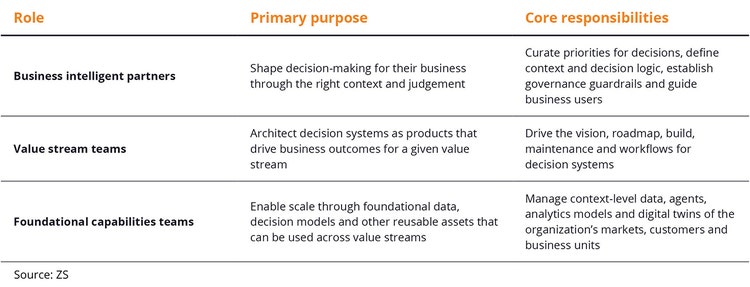
Three roles emerge to support value-stream decision systems: business intelligence partners, value stream teams and foundational capabilities teams. Their primary responsibility is not managing functional work, but ensuring intelligent systems operate effectively, responsibly and at scale. Each plays a distinct role in helping the organization move toward the new operating model (See Figure 1).
FIGURE 1: Emerging roles for the agentic I&A organization
2. Governance
Better decisions require governance beyond data
Context, policies, guardrails and human judgment all shape whether a recommendation becomes a good decision. As organizations deploy decision systems across more value streams, governance becomes less about managing information and more about ensuring intelligent decision systems remain trustworthy, consistent and aligned to business goals.
Organizations must decide what should be continuously sensed, what trade-offs should be modeled, what can be agent-orchestrated and what requires human judgment.
Context management becomes as important as data management
Data alone rarely explains why a decision should be made. Commercial assumptions, market dynamics, business rules and institutional knowledge provide the context that gives data meaning. As agentic systems become more common, organizations that govern this context and enrich their data with it will make better decisions more consistently.
An enterprise intelligence layer enables governance
The challenge for governance is not governing one decision system. It’s about governing dozens of business-specific ones. As agentic capabilities expand, the common enterprise, policies, guardrails, context and decision logic cannot live in isolated systems. Without a shared layer connecting them, governance becomes fragmented and the sprawl doesn’t make financial sense.
A thin enterprise intelligence layer provides that connective tissue. It embeds common policies, observability and controls across decision systems so governing multiagent ecosystems becomes part of how the organization operates, not something applied after the fact.
Human judgment remains the defining component of decision quality
Agentic systems can surface opportunities and recommendations faster than any team can on its own. But speed is not the same as judgment. People remain responsible for evaluating trade-offs, managing risk and determining when a recommendation should become action.
Human involvement is intentionally designed based on the decision. In some situations, humans remain in the loop. In others, they operate on the loop by supervising decisions and intervening when necessary. In the most consequential situations, humans remain the decision-makers themselves. The defining characteristic of an agentic organization is not the absence of people, but the deliberate design of how human judgment and agentic execution work together.
3. Talent and culture
Decision systems need people to design, orchestrate and oversee them
As agents take over more analytical work, the role of I&A begins to change. Less time is spent assembling data, producing reports and running analyses. More time is spent shaping the systems that help the business make decisions.
The goal is not to replace people with agents. It is to enable people and agents to operate together in ways that expand decision-making capacity, improve responsiveness and increase organizational scale.
An agentic transition requires more than AI upskilling
Learning how AI systems behave is only part of the challenge. Intelligent systems still need people to define context, establish guardrails, monitor decision quality and intervene when conditions change. Agents can surface recommendations and execute within defined boundaries, but they cannot determine whether those boundaries remain appropriate.
Becoming an agentic organization requires new skills in areas such as systems thinking, decision design, governance and context management. It also requires new behaviors. Leaders must cultivate transparency, accountability and trust—both in the systems themselves and in the cross-functional teams responsible for governing them.
Leaders become accountable for system outcomes
The role of the leader does not disappear as agents take on more work. It changes. Instead of reviewing every analysis or approving every recommendation, leaders define the rules under which decisions are made. They establish guardrails, determine acceptable risk and decide when human intervention is required. The system may make more decisions. The accountability for outcomes still rests with people.
The metrics change as the work changes
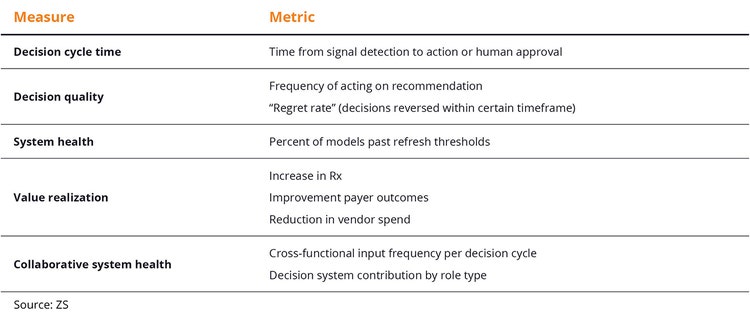
In an agentic organization, success is increasingly measured by the reach and impact of intelligence rather than the volume of work produced. Decision cycle time, decision quality, commercial outcomes and adoption of decision systems provide a clearer view of organizational value than traditional measures such as reports delivered or analyses completed (see Figure 2).
FIGURE 2: Example scorecard for the reimagined I&A organization
4. The transformation journey
The journey unfolds across three distinct horizons
Building an agentic organization is a progression. Organizations create the most value when technology, talent and operating models evolve together in lockstep.
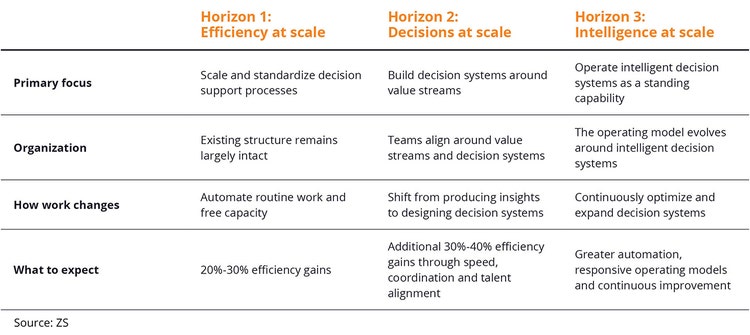
Organizations should progress through a series of stages that build capability and confidence over time. Each horizon lays the foundation for the next, gradually moving the organization from isolated automation toward intelligent decision systems operating at scale (See Figure 3).
In Horizon 1, organizations scale efficiency, capturing 20%-30% efficiency gains without significant structural change. The focus is on making decision-support processes faster, more consistent and scalable across brands, business units and regions. At the same time, investments in upskilling and emerging roles build the foundational capabilities needed for what comes next.
In Horizon 2, organizations can expect an additional 30%-40% in efficiency gains through decision systems—which allow greater speed, coordination and better alignment of talent to value-creating work. Teams begin organizing around value streams and building decision systems that drive desired outcomes. The operating model evolves to combine human ingenuity with AI support, enabling people to spend less time producing insights and more time designing, shaping and improving decision systems.
In Horizon 3, organizations scale intelligence by refining and expanding these capabilities as decision systems become a core part of how the business operates. People focus on dynamic business intelligence, value stream decision logic, proprietary context and continuously strengthening the reusable data products and analytics models that power decision-making. This creates opportunities for even greater automation, new operating models and more responsive ways of working.
FIGURE 3: The three horizons of the agentic I&A transformation
The next step toward an intelligent enterprise
The first step in getting started is to look for where better decisions would create the most value. Start with a single value stream, identify the decisions that matter most and consider how an agentic organization could support them. Agentic organizations are built one decision system at a time.
If you’d like to talk with us about the future of the I&A organization or any of the topics in this article, please get in touch.
Related insights
zs:topic/strategy-and-transformation,zs:topic/ai-and-analytics