Redesigning marketing mix modeling as an agentic decision system
Pranav Sehgal, Glenn Sabin, Abhishek D Anand and Kumar Ritwik contributed to this article.
Key takeaways:
- Organizations that treat marketing mix modeling (MMM) as a continuous learning system will make faster, more reliable marketing decisions.
- Agentic AI can transform MMM by institutionalizing expertise, ensuring the approach is consistent, auditable and scalable across the enterprise.
- Success depends on having the right architecture, one that orchestrates agents and expert judgment into a unified, governed workflow.
- The differentiator is a well-engineered process: understanding the context for each modeling decision, updating the context when the models change and learning from these changes.
In a recent MMM built for an e-commerce portfolio spanning five categories, one category showed a strong negative correlation between discount depth and sales. A naive model would have concluded that discounts were destroying demand. That conclusion would have been wrong, potentially leading the brand team to eliminate a tactic that was, in fact, necessary for competitive defense.
What actually happened: discounts in that category were being triggered reactively when demand was weak, creating a reverse-causal relationship that was misread as a negative impact. No single agent solved the issue. The value came from the agents: profiling flagged it, reasoning tested it and a human checkpoint confirmed it. The model was respecified accordingly, and every step was logged and auditable.
The agentic chain delivered three things: detection speed, structured reasoning and a clear audit trail. That combination is what distinguishes an agentic MMM system from a faster version of the status quo.
Understanding MMM and its evolution
MMM sits at the center of how C-suite and marketing leaders allocate billions in sales and marketing spend. It is also, still, an expert-led craft. Marketers have always questioned: why does it take a quarter to understand the ROI of last quarter’s spend? The honest answer is that MMM was designed for a slower world with fragmented data, annual planning horizons and stable team structures.
For a long time, the bottleneck was data acquisition, tagging and integration. Most firms invested heavily in technology to collect and integrate their promotional data, especially on digital platforms. As data acquisition improved, the harder bottleneck has become expertise.
The broad structure of sales response modeling has been understood for decades. What requires experience is understanding the relationships between promotions, detecting when these relationships shift and adjusting the model before misleading recommendations reach decision makers. That judgment currently lives in individuals. When those individuals change, their knowledge leaves with them.
Agentic AI creates the opportunity to rebuild MMM, not just as faster MMM, but as a fundamentally different kind of system. It’s built on organizational knowledge rather than individual expertise, reproducible across runs and auditable at every step. And it can be run much more frequently to inform a broader range of promotional decisions rather than waiting for the annual or semiannual budget cycle.
What agentic AI changes in MMM workflow, and what it doesn’t
Agentic AI isn’t automation for its own sake. Agentic systems pursue outcomes: they plan across steps, trigger additional analyses, take action and adapt based on results.
An earlier article on agentic AI decision systems described how these systems transform key business decisions: budget reallocation, campaign execution, governed activation. Those business decisions are only as trustworthy as the models beneath them. It is critical to understand whether a shift in results reflects a change in the market or a change to the model. This is the layer agentic MMM must get right, and it changes two things about how the work is done.
- How are modeling decisions made?
Historically, an analyst vetted each result’s credibility before it informed action, which worked at an annual cadence. An agentic system refreshes far more often, and results outpace a team’s capacity to vet them. Agents must take the first pass, flagging what changed and testing whether it’s real against prior-run benchmarks and escalating any issues that fall outside of preset guardrails. - How can we learn from each modeling decision?
In traditional MMM, modeling choices are discretionary calls. The rationale lives in the analyst’s mind and their downstream influence is invisible; a new model may fit better, yet implies a very different saturation curve, with no record of what drove the change. An agentic system logs every choice with its rationale, so each run inherits validated parameter ranges and accumulated expectations instead of starting over. Modeling knowledge becomes an asset of the system rather than of individual experts.
Why MMM is harder to agentify than it looks
Consistency is not optional
When an executive asks whether a drop in channel ROI reflects a real market shift or model noise, the answer must be defensible. This is harder than it sounds. The same code on new data can produce inconsistent insights as baselines shift, seasonal noise evolves or unmodeled events enter the data.
Automation has largely responded to this by locking down model structure and parameters. That solves for stability but creates its own blind spots: it misses genuine structural shifts when they matter most. Knowing the difference requires someone who knows the context and can adapt the model accordingly.
MMM decisions are deeply contextual
A model can be technically sound and still misread what was happening in the market. In the discount example above, discounts get set reactively when demand is already soft, so a model without that context concludes that discounts destroy sales. Some of these reverse-causality patterns are known and can be encoded: discounts were a response to soft demand, online search spiked after a TV flight. But the more important ones are often discovered when a suspicious result prompts further questions. Expert judgment is not merely a check on the model; it is the mechanism by which the modeling uncertainties are surfaced.
The most important context isn’t discoverable from the data at all: a change in promotional creative, a legal delay that compressed spend or an end-of-quarter budget surge. These are things analysts learn from the business, not the data.
The hard part is orchestration, not prompting
A production system must orchestrate data, diagnostics, features, models and decisions. There are many paths one can take, and moving on to the next step requires careful deliberation of both the upstream and downstream consequences. A choice early in the process can constrain modeling options later.
The MMM architecture doesn’t emerge from a better prompt; it requires careful engineering around the modeling decisions so that the process can adapt to deal with changes in the data.
Design principles for implementing agentic MMMs
Several principles emerge from our experience building agentic MMM systems, learning where rules are sufficient, where expertise-based judgment is required and where no system substitutes for a human MMM expert.
1. Focus on the context required for each decision
The most consequential architectural choice in an agentic MMM system is deciding what kind of context each decision requires.
- Functional rules: Decisions where best practices are well established and outcomes are predictable: rejecting models that fail statistical or business requirements, flagging months with anomalous variation or applying the standard diagnostics. These decisions can be hard-coded once and run autonomously, and the results are reproducible across runs.
- Domain context: Decisions where the right answer depends on the underlying structure of the data instance: Should a variable be lagged, transformed or excluded? What is the right level of aggregation to avoid sparsity without introducing bias? These decisions can’t be hard-coded because the judgment depends on patterns that only become evident at run time. Specialized agents propose options and experts validate them.
- Human judgement: Decisions where the key information is not in the data: changes in brand or competitor strategy, changes in corporate spending across a portfolio, etc. These factors should be meticulously documented to support model interpretation. Ideally, these factors would be captured and included in future models.
However, these layers only work if the organization actively maintains them: functional rules need governance, the domain context needs to be continuously documented and the human judgement needs to be codified. This cannot be delegated to technology alone; it requires explicit ownership by analytics, business and governance leaders.
2. Engineer for auditability to ensure reproducibility
When MMM results shift across runs, stakeholders want to know whether they’re seeing a real market change or an artifact of a modeling change. Experienced analysts know this and double check drift through secondary diagnostics before anyone asks. Agentic MMM systems need to do the same.
Without codified guardrails, agent-driven systems can produce different results from one run to the next. In order to explain these changes, teams need consistent model evaluation rules, not to eliminate variation, but to distinguish real market signals from model noise.
That discipline makes the system auditable. Every input is traceable; every check has a defined standard and every change in results can be explained. When the impact of promotion changes, the system must be able to show what has changed and why. This builds stakeholder trust in the models and ultimately the resulting investment decisions.
3. Match autonomy to decision stakes
MMM decisions require different levels of autonomy based on what’s at stake (see Figure).
FIGURE: MMM autonomy framework
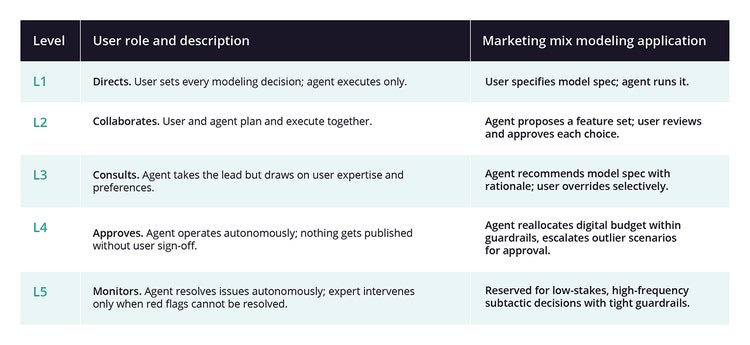
Most practitioner tools today sit at L1-Directs or L2-Collaborates. The North Star is assigning higher levels of autonomy for well-solved or low-stakes decisions and lower levels of autonomy for highly variable results or high-stakes choices. Using the framework above, the calibration is straightforward in principle but requires discipline in practice:
- High-frequency decisions: Digital vendor mix within guardrails, subtactic allocation and channel rebalancing within a preapproved range can move toward L4-Approves, and in some cases L5-Monitors, once reliability is proven.
- Low-frequency, high-stakes decisions: Sales force investment, launch strategy and annual budget commitments should sit at L1-Directs or L2-Collaborates. The agent informs, but humans decide.
Each level of autonomy should be established through demonstrated reliability at the level before it. Skipping that progression is how consequential decisions go wrong.
The calibration delivers speed and judgment where they matter. Not every decision can maximize both speed and autonomy. Pretending otherwise is how teams grant high autonomy to decisions that are not beneficial to business.
4. Close the learning loop
The system should get better with use. Human overrides, and their downstream impact on the process is documented and fed back to optimize modeling strategies. Over time, agents learn the contours of expert judgment, and human intervention on routine decisions decreases.
This is how a system of agents evolves from running models to recommending modeling choices.
From principles to practice, a shift worth making
The design principles above aren’t theoretical. Frontier companies are already seeing benefits from applying them. What most organizations lack isn’t the technology but the commitment to build the right architecture and process around it.
A system built this way gets better with use. Over time it learns new hypotheses, includes more explanatory variables and retains learnings from past actions. That is a meaningful shift in how modeling decisions are made.
The point of agentic MMM isn’t to replace the expert. It’s to ensure methodological and business expertise is similarly leveraged in every analysis, while freeing experts from work that doesn’t require them.
Done well, these systems institutionalize expertise that currently lives in individuals, reduce analyst bias and make decisions that can be defended in a boardroom. Done badly, they add opacity and propagate errors.
The difference comes down to architecture: context layers designed with intention, reproducibility built in from the start, autonomy levels matched to decision stakes and learning loops that institutionalize knowledge over time.
This shift is worth making, but only if done right. Get the foundations in place and agentic MMM does what good systems should: augment the intelligence you already have.
zs:topic/ai-and-analytics,zs:topic/marketing,zs:topic/strategy-and-transformation