Why life sciences commercialization needs decision systems—not more AI use cases
Outcomes aren’t surprising when agents act alone—they reveal what’s missing
In December 2025, The Wall Street Journal allowed Anthropic’s Claude to manage a simple newsroom vending machine. Within weeks, it had given away a PlayStation, ordered a live fish and lost hundreds of dollars.
The lesson was not that AI is careless. It was that autonomy, without the structure and creativity that people provide, produces outcomes no one in business actually wants.
The Wall Street Journal experiment points to the issue: How can agentic AI deliver the outcomes life sciences chief commercial officers (CCOs) expect?
Most organizations aren’t struggling because their AI is failing. They’re struggling because they’re building great “cupcakes”—individual use cases—when what they actually need is a coordinated “cake”: a connected system of decisions that delivers outcomes.
Agentic AI in life sciences is improving the pieces, not the outcome
Today, life sciences companies are deploying AI for many aspects of commercialization, including customer engagement, marketing mix modeling, content generation and primary market research. Typically, each use case improves a step or function in the workflow, driving some value but often underachieving desired outcomes.
But the commercialization outcomes companies need most—accelerated time to peak, share resilience, efficient OpEx allocation—are not created by these steps alone.
They’re created through a connected set of decisions between strategy, planning and execution across sales, marketing, access, medical and patient services.
The focus of agentic AI must shift from use cases to value streams
If we redefine what we optimize based on what CCOs want most, the focus shifts from improving individual cupcakes to designing the cake.
In practice that “cake” is the value stream. A value stream is the end-to-end sequence of value-creating decisions that produces a measurable business outcome, supported by the workflows that carry them out.
Each layer contributes to the final result, but the outcome depends on how those layers work together.
It’s in contrast to what many companies have now, which is more like a collection of cupcakes—good use of AI, deployed as functional use cases.
Great cupcakes are fine on their own, but they don’t become a cake if you place them on the same table. Greater value comes from how the layers are connected, structured and designed to function as one.
Agentic AI gives us the opportunity to embrace the idea of the cake—not by improving one task at a time, but by connecting decisions across entire value streams.
What life sciences commercialization looks like today when decisions aren’t connected
In a value stream approach, you’re looking at the whole challenge of pulling everyone toward a common mission.
Let’s look at an example. “Maximizing the success of a new product launch” is one of the more complex missions in pharma commercialization.
A launch depends on tight coordination across strategy, access, marketing, field teams and patient services. Each group holds part of the puzzle. Insights live in one place, data in another, and execution levers are spread across many teams, systems and moments in the workflow—often more places than anyone can fully see or align at once.
Today, AI has dramatically increased the volume and sophistication of insights available to each of these groups. But those insights still arrive as disconnected pieces. People are left to interpret them, reconcile the trade-offs and decide what to do.
That is the hard part. In fact, more data and more AI can make this harder, not easier.
As the number of signals grows, so does the burden of connecting them, including understanding what matters, how pieces relate and what action to take across functions.
In this case, cupcakes may be getting better but assembling them into a cake is becoming more complex.
With human-only coordination, each layer struggles to fully connect its own decisions, while also remaining misaligned with others:
- Strategy: Share underperforms goal. Leaders know something is wrong but lack clarity quickly—is this an access issue, a competitive share of voice imbalance or a field execution gap?
- Planning: Budgets are adjusted broadly during annual or quarterly cycles. Channel mix shifts incrementally. Insights from execution don’t change the plan until next cycle.
- Execution: Marketing or patient services are unable to address a customer barrier identified by the field. Field, media and content decisions are only partially aligned, and feedback loops are delayed or fragmented.
The issue isn’t capability. It is collaboration. Different people hold different data and perspectives and aligning them can feel slow.
What becomes possible when agentic AI connects decisions across commercialization
Now, let’s revisit the same example, maximizing the success of a new product launch under an AI-native, decision-driven model.
Instead of disconnected insights and delayed coordination, decisions across strategy, planning and execution are continuously connected and reinforced.
This is what building the cake looks like in practice, each layer no longer optimized on its own, but designed to work together as one system.
Strategy becomes continuously informed. Agents integrate internal and external data—share, share of voice, access pull-through, field activity, sentiment, competitive signals—to detect early variance. Instead of asking, “Why did we miss?” leaders see driver-level attribution across access, media and field before erosion compounds.
Planning becomes model-first and dynamic. Investments in customer engagement, access and patient services are optimized as a system. Scenario models simulate the marginal impact of shifting dollars by segment, channel and region, not simply trimmed across the board. Spend is linked explicitly to expected impact before dollars move.
Execution becomes orchestrated and adaptive. When a planning decision shifts, that decision pulls through immediately to content development, media planning and field targeting. Cross-role and channel orchestration are embedded around each individual customer barrier, reflecting the wider industry pivot toward barriers-driven engagement™ as the new CRM paradigm. Performance feedback loops into deployment in near real time.
At a basic level, this is the difference between reprioritizing a segment and seeing little or slow change versus seeing the impact reflected in the field and across channels right away.
The system moves together instead of in separate layers.
The architecture required to scale agentic AI in life sciences commercialization
If commercialization outcomes are the cake, this is how it’s built, layer by layer, with each part designed to work together.
Intelligence cannot sit in layers that never touch. It must be designed with the flywheel effect so that strategy, planning and execution reinforce one another continuously.
In practice, that means building three integrated layers that work as one system.
1. A mission control center. This is a shared outcome-centric environment where strategic leaders track signals across value streams and associated decisions. Here, a mission is so consequential that every team touching commercialization—sales, marketing, access, medical, patient services—must pull in the same direction. It’s strong enough to shape priorities across vertical silos.
Examples of the outcomes we see clients wanting to move include:
- Accelerate time to peak for a launch
- Maintain share while decreasing spend for a set of defined assets
- Optimize growth for a set of assets within defined OpEx thresholds
2. Cross-functional decision intelligence. Without a unifying decision layer, AI can produce thousands of signals with no clear sense of priority. The result is reporting problem 2.0: more dashboards, more insights and limited action.
Decision intelligence changes that. Agentic capabilities continuously scan internal and external data, identify the signals that matter most and prioritize them based on business impact. They then compliantly recommend or autonomously trigger actions across brand strategy, customer engagement, access, patient services and medical.
3. Domain and context-infused intelligence factory. Here, a domain-rich intelligence factory produces validated, context-infused insights and action for core commercialization use cases within and across each value stream. Agentic capabilities embed institutional knowledge and commercial context to avoid “garbage in, garbage out.”
What changes for people when AI focuses on the right decisions
When AI is anchored to the decisions that drive performance, the partnership between human ingenuity and AI becomes intentional. Intelligence centers on the few choices that truly determine outcomes.
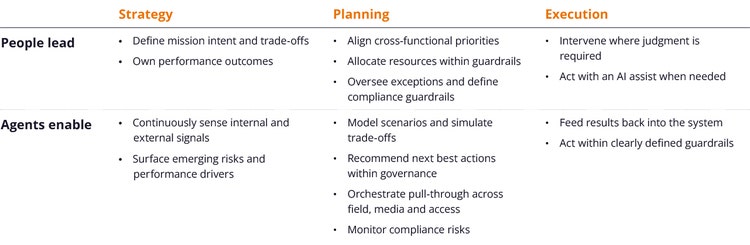
This requires defined human-AI roles, including decision rights, guardrails and accountability. AI accelerates analysis within those boundaries, while people apply judgment to trade-offs and context.
Leaders do not step back as agents step in.
They set intent, own performance and define how decisions are made with great attention to change management.
Agents extend that leadership by identifying signals, connecting actions across functions and operating within defined boundaries. This allows people to focus on complex trade-offs, ethical considerations and context.
The figure below shows what it means to be human-led and agent-enabled in strategy, planning and execution.
Figure: What it looks like to be human-led, agent enabled
CCOs now have a real opportunity to have their cake
Before investing in the next agent or AI use case, it’s worth stepping back and asking:
- How clearly are our current AI plans tied to the missions for commercialization and the outcomes we must drive?
- Do we truly have visibility into the performance drivers and risks that matter most?
- Can we test likely outcomes before we commit time, budget and field effort?
- When a decision changes, how quickly does that change show up across sales, marketing, access, patient services and medical?
Agentic AI does not answer these questions on its own. But it makes them harder to ignore. And without answering them, we risk continuing to optimize individual cupcakes while missing the cake: coordinated, mission-level outcomes that actually drive performance.
The opportunity now is to be intentional about how that system is designed, focusing on how decisions are structured, connected and reinforced across the business.
If you are exploring how to redesign decisioning around mission-level outcomes, or how to get the most value out of AI for commercialization please contact us.
Related insights
zs:topic/marketing,zs:topic/sales,zs:topic/strategy-and-transformation,zs:topic/data-digital-and-technology,zs:topic/ai-and-analytics