The power of using AI to transform market research into a sensing engine
Leesa Sherborne, Lauren Mosadeghi, Mihir Khokani, Peeyoosh Keshava and Will Gatziolis cowrote this article with Karthik Sourirajan.
Agentic AI in market research
Every commercial decision, from launch readiness to brand strategy to field execution, is only as good as the intelligence behind it. Yet one-third of clinically differentiated launches fail to meet expectations three years after launch, and a pharma company’s poor understanding of customers or the market is a common reason why. The intelligence was there to be had in market research. The sensing engine just wasn’t built to deliver it.
Market research should sit at the heart of every commercial decision. But in most organizations, it doesn’t. This isn’t because leaders don’t value it, but because the model wasn’t designed to run forward in real time. It answers discrete questions project by project, producing episodic intelligence that arrives too late and expires too quickly.
This dynamic is changing thanks to agentic AI. Rather than incrementally automating legacy models, today’s opportunity is to transform market research into a sensing engine that accelerates research, enables data to compound across studies over time and integrates insights directly into commercial decisions before the window closes. Leaders who make this shift don’t just reduce cycle time. They extract more value from their research investment and turn it into a sustained competitive advantage.
Four key dimensions of a transformed market research model
There are four dimensions of a transformed market research model that’s operating as a true sensing engine.
Customer intelligence is always on
In the current model, insight arrives at the end of a study. In the transformed model, the sensing engine synthesizes signals from every source the organization already touches: research studies, field rep interactions, digital engagements and patient services. Each signal adds to a continuously evolving picture rather than being trapped in a one-time readout. As AI drives down the cost of research and extracting insights from all the different customer touch points, budgets stretch further and fund sharper questions more continuously.
First-party intelligence compounds to power sharper decisions
Pharma organizations spend tens of millions on primary market research, then effectively discards it after each readout. The respondent-level data—cross-study belief shifts, segment-level signals, longitudinal competitive patterns—is never connected. When primary research is built for reuse and integrated with secondary data at the respondent level, it stops being an underutilized investment and starts becoming an appreciating asset. Every new study adds to a living intelligence layer that makes brand planning sharper, business reviews richer and competitive responses faster.
Decision agility spans the full strategic option space
Most organizations test two or three messaging options before committing to a campaign, a handful of access strategies before launch and a small set of competitive responses before the window closes. AI-enabled simulations make it practical to test hundreds of positioning alternatives, messaging variants, target product profile (TPP) configurations and go-to-market strategies against a representative model of the market.
And they can do this all before a dollar is committed. When something shifts at the eleventh hour, simulated panels provide decision-grade intelligence at the speed of a conversation rather than requiring a six-week study.
People are orchestrators of intelligence, not managers of studies
Skilled insights professionals currently spend most of their time coordinating vendors, tracking data and reformatting decks. The craft of market research—hypothesis generation, strategic synthesis, connecting a data pattern to a brand implication—gets compressed into the last 20% of every cycle. In the transformed model, insights professionals operate more like Tony Stark in the suit: they’re humans at the center of a system that vastly extends what they can do, without ever replacing the judgment that makes it useful. The suit handles execution. Stark decides what it’s for.
Where value leaks today
Most organizations haven’t yet been able to transform market research into a true sensing engine. Three structural gaps help explain why.
Gap 1: Linear workflows deliver insights too late to inform business decisions
Picture a brand team mid-study when a competitor announces a new indication and repositioned message. They need to understand how perceptions are shifting, but the study won’t read out for six more weeks. Should they wait, or decide without customer insight?
Traditional market research runs as a sequential chain: context review, instrument design, fielding, analysis, synthesis and readout. AI point solutions can accelerate individual steps but hit a ceiling when the overall process still assumes insight only arrives at the end.
What the shift actually looks like

By building market research expertise—choosing methods, designing tools, setting quality standards and creating ways to combine findings—into agentic systems, expert research processes can be repeated easily and reliably. This enables codified research expertise at scale.
Target impact: 30% cost reduction, 3x faster cycle times
In practice
What: One top 10 pharma company started with a defined set of study types, built an AI-forward market research execution service line and expanded brand-by-brand once leadership saw measurable gains in speed and cost.
Why: The goal was better strategic insight, freeing researchers to focus on meaning and judgment, with industrialized execution delivering faster and lower-cost insights.
Gap 2: Despite millions invested, intelligence locked in decks never becomes an asset
Commercial organizations spend tens of millions collecting primary research, yet most of that intelligence is locked in decks—tracking studies, message testing, journey work and ad hoc qualitative sitting in separate files, unconnected to each other or to secondary data.
The deeper problem isn’t that decks are hard to find. It’s that the respondent-level data underneath them—cross-study comparisons, longitudinal belief shifts, segment-level signals—is never connected and effectively discarded after every study. The asset that could have been built never is.
The impact is felt in moments that matter most: the brand plan built not from connected intelligence, but from manually stitched decks with no live connection to underlying data.
From static decks to a connected intelligence asset
When AI drives down the cost of research through faster fielding, automated synthesis and reusable infrastructure, organizations can reduce their market research spend even while generating more intelligence, more continuously. Customer signals from every touch point the organization already owns—field interactions, digital engagements, patient services, access conversations—flow into a unified intelligence layer. Research becomes less of a discrete activity and more a constant stream.
Transforming marketing research and broader customer intelligence into a sensing engine requires an architectural shift. It’s vital to design studies for reuse from day one, connect primary research at the respondent or segment level where appropriate, integrate secondary data as standard practice and expose the resulting intelligence directly into business workflows rather than only through static deliverables. Here’s what this shift looks like:
- Brand planning connects attitudinal signals with prescribing, engagement and performance data
- Business reviews focus on interpretation and decision-making, not manual reconciliation of reports
- Teams answer longitudinal questions about belief shifts, behavior changes and competitive movements without starting from zero
When primary market research is connected at the respondent level, integrated with secondary data and continuously replenished through embedded collection across commercial touch points, teams gain a constantly evolving picture of their market that’s accessible on demand—without commissioning a new study.
Target impact: 2x data reuse, 5%-10% lower duplicative market research spend and a constant stream of first-party intelligence flowing into commercial decision flywheels.
In practice
What: One top 10 pharma company consolidated primary market research into an accessible insights layer, including primary-secondary integration.
Why: The entry point is respondent level data teams can access and query, unlocking what already exists before asking the organization to change how it works.
Gap 3: Aggregate insights constrain decision agility in a competitive world
Most market research still informs strategy at the segment average: 62% of KOLs prefer attribute A, 40% of community oncologists cite barrier B. Useful, but no longer enough.
Gaining competitive advantage today comes from knowing which customers matter most, what is shifting at the individual or microsegment level and which strategic choices are most likely to move outcomes. The need for that granularity isn’t new. What’s new is that AI makes it achievable at scale, without prohibitive cost or time.
Three ways to turn granular insights into a decision advantage
Once the underlying data foundation is connected, the next step in transforming your marketing research model into a sensing engine is to move beyond aggregate summaries in three compounding ways:
- N=1 intelligence: Identify n=1 or microsegment drivers and barriers that improve execution. That specificity at scale is a commercial force multiplier, enabling field teams to show up to every interaction with the context that matters.
- AI personas for exploratory brainstorming: AI personas that are prompted to think and respond like a defined customer segment can rapidly pressure-test hypotheses. Personas shine where novelty matters more than precision and brainstorming with personas can expand the option set before formal testing narrows it.
- Model-first simulations for strategic decision-making: AI simulated panels allow commercial teams to test a broad range of strategic choices such as positioning alternatives, messaging variants and competitive response scenarios against a representative model of their market before committing any resources. Running hundreds of scenarios compresses the strategy-to-decision cycle from weeks to hours while dramatically expanding the range of options tested.
Key takeaway: ZS has observed a 90%+ correlation between AI-based simulated respondent panels and real-world market research across multiple pharma use cases. Simulated respondent panels that are built with the right context and trained on decision-relevant information can be a genuine decision support tool and not just a brainstorming aid.
With a connected data foundation, decision support extends to n=1 drivers and barriers, AI persona brainstorming and simulated panels that stress-test the full strategic option space before committing resources.
Target impact: Improved brand trajectories through broader scenario coverage and faster strategic iteration
In practice
What: One top 10 pharma company started directly with simulated panels for message and TPP testing, skipping workflow efficiency as the entry premise.
Why: Advanced decisioning doesn’t have to be the last step. When you prove value early, leaders are more willing to invest in what comes next.
A programmatic reinvention, not just tactical differentiation
For market research to transform into a sensing engine, programmatic reinvention is necessary. Programmatic reinvention involves reimagining and redesigning how the insights function creates enterprise value as the intelligence layer connecting every commercial value stream.
The transformed model is built on proprietary, first-party strategic data that competitors can’t replicate: A longitudinal, respondent-level understanding of how your customers think about your product, your competitors and the treatment landscape. These insights have been built over years of connected studies. No competitor can purchase it. No AI model trained on public data can approximate it.
The transformation is systemic and the value compounds:
- Faster workflows generate more reusable data
- Richer data improves simulation accuracy
- Better simulation increases the strategic relevance of market research across every value stream
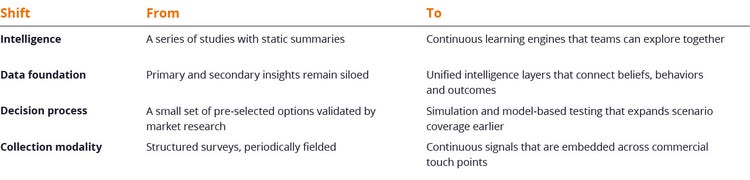
Key shifts in the market research transformation
The human role in market research transformation
The Tony Stark analogy captures the idea of a human at the center, with vastly extended capabilities. But what does that look like for an insights professional?
AI changes how the work gets done, and with it, where time is spent. Execution still happens, as insights professionals stay lightly but deliberately in the loop. AI agents handle synthesis, fielding and analysis, while insights professionals provide judgment where needed and validate quality at key moments. But execution no longer consumes insights professionals.
With less time devoted to execution, they spend more on strategic thinking—interrogating emerging findings in real time, pushing on patterns that don’t fit and building the narrative that connects what the data shows to what the brand team needs to decide.
And increasingly, they’re doing something the old model made practically impossible: running forward. They’re using simulated panels to test how a messaging variant lands before a campaign commits, or pressure-testing positioning choices against competitive scenarios before the brand plan is locked. Insights professionals become true strategic partners with a powerful sensing engine.
Here are four ways insights professionals can be strategic partners with market research as a sensing engine:
Set the intelligence agenda. Insights professionals own the key questions for the brand: Which signals are worth pursuing, which hypotheses deserve testing, what information is needed to make the decision and where to source that information.
Explore the possibility space. Insights professionals can now use simulated panels to run scenarios under consideration for the business, narrowing options before resources are committed. Which of these three positioning alternatives holds up best under competitive pressure? How does this message land with the customer segment that’s hardest to move? These are not hypothetical questions, but examples of what brand teams face every planning cycle. A six‑week study is no longer the only path to answers.
Give marketers access and earn their trust. As insights professionals embrace being orchestrators, they should give brand teams live access to the intelligence layer—not just finished decks, but exploration tools where marketers can probe attitudinal data, test assumptions and interrogate findings. With that access comes accountability, as the insights professional owns the quality, currency and interpretability of what the marketer sees. Trust is earned with the system consistently surfacing intelligence that proves out.
Own the interpretive leap. The suit can fly. Tony Stark decides where. Similarly, AI agents surface patterns for insights professionals. The insights professional then makes the call by connecting data signals to strategic implications, judging what a finding means in the context of a specific launch or competitive threat, and owning the recommendation that goes to the brand team. Brand planning shifts from “here is what we found” to “here is what we think it means and why.” Business reviews become live intelligence sessions where marketing and insights teams explore patterns and pressure-test choices together.
Embracing a transformed market research model with a sensing engine focuses your team on doing what only humans can do: deciding which questions matter, using every tool available to explore the answer and owning the recommendation that follows.
What this means for leaders
The winning move is to rewire market research into a sensing engine by proving value quickly, then scaling until primary research powers every commercial decision the organization makes. The organizations that move first will make sharper decisions earlier, understand their customers more precisely and build an intelligence advantage that strengthens with every study.
Questions to start the conversation
When discussing how your organization should transform, consider these key questions:
- What are the gaps in our current approach to using market research to inform business decisions that are holding us back? What is the size of the opportunity we are missing?
- What would it mean for enterprise outcomes if we close the gap between the intelligence we generate and the breadth of decisions that intelligence informs?
- Where would simulations have the greatest impact and what would decision-making look like in a world where the full strategic option space could be explored before committing resources?
- What is our path to marketing insights transformation and how do we sequence it to deliver value quickly while running the business?