Why clinically differentiated assets miss market expectations in pharma launch strategy
Andrew Singley, Amudha Sharma and Utkarsha Telang contributed to this article.
One third of clinically differentiated launches fail to meet expectations three years after launch. The issue is not execution alone but structural misalignment. A 2025 ZS study of 340 launches found commercial success depends not just on the product but also, to a large degree, on the system around the product. The implications stretch from 2026-2030 and beyond.
At stake for the industry is billions in unrealized launch potential, as seen in the patients reached by the top two to five participants in highly competitive classes from our launch study. And when physicians’ stated priorities differ significantly from what drives actual prescribing behavior, the culprit isn’t portfolio quality or timing but where launch resources are allocated.
The differentiation paradox in pharma launch readiness and adoption
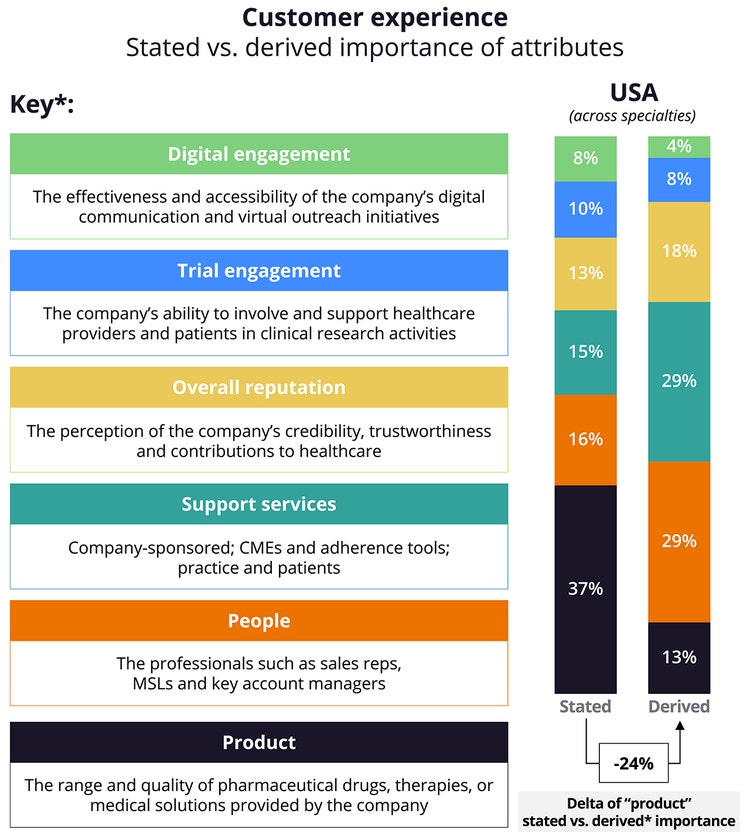
To understand why strong science still produces weak launches, ZS’s 2025 research studied 690 U.S. board-certified specialists using derived importance modeling, a methodology that reveals what drives behavior and not what physicians claim.
The gap is stark.
Physicians say product attributes, including efficacy, safety and differentiation, account for 42% of their prescribing loyalty. Yet behavioral decomposition of what they do shows product explains just 10%-20% of adoption behavior.
Once a therapy meets a clinical threshold, performance is driven by the remaining factors that break down into three categories most launch plans systematically underfund:
- People (29%): Medical science liaisons and reps who resolve practice-level friction—not deliver messages
- Support services (29%): Patient access programs, education and adherence tools that remove barriers between a prescription and a dispensed therapy
- Reputation (18%): Trust in the manufacturer’s reliability, follow-through and long-term commitment to the therapeutic area
This isn’t a soft insight. We call this misallocation a differentiation paradox. The more an organization invests in the product, the more it neglects factors that determine whether it reaches patients. Most launches fail because resources are allocated almost perfectly in the wrong ratio.
FIGURE 1: Optimize drug launch performance by investing in the attributes shown to drive prescriber decisions
How commitment multiplies pharma launch investment
Across our launch database, a typical launch confronts 25-65 discrete barriers—diagnostic hurdles, prior authorization complexity, physician inertia, monitoring requirements, patient affordability and site-of-care constraints.
Yet 70%-80% of launch team effort concentrates on clinical barriers—the “why to prescribe.” Only 20%-30% goes toward resolving what happens after the prescribing decision—the “how to treat.” This is an almost exact inversion of what derived importance tells us actually drives adoption.
High performers reverse the sequence. They begin investing in how to treat barriers 18-24 months before launch and prioritize this investment philosophy across the portfolio. Adoption insights into how to treat are inherited rather than rebuilt across launches with the same customer.
Commitment architecture and drug launch performance outcomes
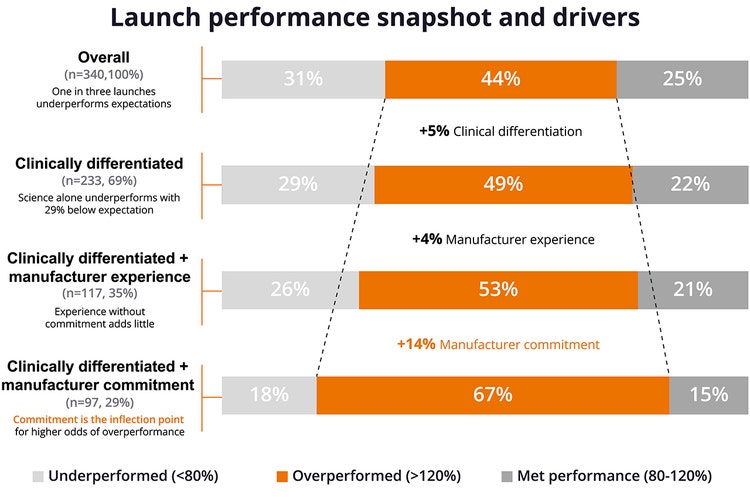
Our retrospective analysis of 340 drug launches from 2008-2025 quantified what this misallocation costs and what separates organizations that achieve repeat launch performance from those that don’t. Clinical differentiation alone lifts overperformance rates from 44% to 49%. Meaningful but hardly decisive. When manufacturer commitment is added, overperformance rises to 67%.
“Commitment” here is specific. It reflects sustained organizational investment in barrier removal, support architecture, access infrastructure and institutional follow-through, beyond promotional intensity alone.
The performance ceiling tells the same story. Differentiation alone tops out at roughly five times analyst consensus. Add commitment and overperformance reaches 10 times. That is the difference between a $2 billion asset and a $4 billion asset often competing in the same drug class.
FIGURE 2: Multiply launch returns by compounding clinical differentiation with manufacturer experience and sustained commitment
The commitment architecture inflection point and durable pharma launch leadership
Across our analysis, commitment separates perennial market leaders from organizations that produce one-off launch successes. Leaders in immunology and oncology aren’t winning only because they have better molecules. They’re winning because they have built repeatable systems that make each successive launch faster to adopt, cheaper to support and harder to displace.
Every barrier they solve, from diagnostic infrastructure to access pathways and site-of-care readiness, becomes a permanent capability the next launch inherits. The organization doesn’t restart at zero. It compounds.
In other organizations, barriers are addressed locally and temporarily. Workarounds resolve the immediate issue but leave the broader launch design unchanged. When the next launch arrives, similar constraints resurface, requiring the same investment again while effort increases and performance stalls.
Aligning the commitment architecture with real-world pharma customer needs
The underlying pattern—barrier-driven investment outperforms message-led intensity—holds across therapeutic areas, but the form of commitment differs.
Immunology—the ecosystem portfolio moat. Clinical differentiation is table stakes. Winners such as Skyrizi and Tremfya separate themselves in gastrointestinal indications with integrated support ecosystems—access tools, patient services and fulfillment infrastructure—that make prescribing the path of least resistance. Each launch builds on the capabilities of the last.
Neurology—the systemic architect. Fragmented diagnostic pathways and underdefined treatment protocols create friction. Rather than launching into that system, Vyvgart reshaped it with 70+ publications spanning clinical results and treatment guidance before approval. Within two years, it reached nearly half of myasthenia gravis customers despite entrenched competition.
Cardiometabolic—the operational scale engine. Volume, payer resistance and adherence friction define these markets, and more so for clinically differentiated therapies. Clinical data is rarely the primary barrier. Success depends on workflow integration, prior authorization management and patient channel coordination at scale.
Oncology—the precision support network. Differentiation remains necessary, but execution complexity is the binding constraint. Administration, monitoring, site-of-care capacity and care coordination are where adoption breaks down. Winners resolve the issue of how to treat long after the question of why to treat is established through clinical guidelines.
2026-2030: The pharma launch cycle rewards systems, not just science
The coming launch cycle will punish fragile strategies that rely on clinical novelty alone. In oncology, cardiometabolic, immunology and neurodegeneration markets, clinical superiority is no longer in question. Launch success itself now triggers systemic stress, including payer backlash, supply constraints and site-of-care capacity limits.
The science still matters. But in this market cycle, the system around the science determines who keeps winning—not for one launch but for the portfolio. That’s a leadership decision before it’s an operational and execution one.
What this means for the pharma leaders making drug launch decisions
Our data points to clear conclusions that challenge how you might be investing today.
This article draws on ZS’s 2025 launch performance study of 340 drug launches (2008-2025) and a customer experience study of 690 U.S. board-certified specialists. Upcoming ZS research will introduce frameworks for diagnosing and scoring organizational commitment architecture across launch portfolios.