From experimentation to execution: How airlines can retain control in AI-mediated commerce
Key takeaways
- AI-mediated commerce creates a new control point in airline retailing. Flight discovery, comparison and, increasingly, transactions now occur in AI environments that airlines do not own.
- Airlines must choose how to participate in AI-mediated commerce. They can be represented passively, participate through intermediaries or connect directly with AI platforms.
- AI-mediated shopping can weaken airline loyalty recognition. When an AI agent shops anonymously, an airline may not recognize a high-value loyalty member or provide personalized offers and benefits.
- Direct participation in AI-mediated commerce requires new airline capabilities. Airlines need to offer orchestration, access and representation governance, and a deliberate commercial architecture for AI channels.
Airlines still control their inventory, pricing and product. What they no longer own is where and how a traveler first encounters that offer.
Today, agentic AI assistants shape which flights enter the consideration set, how competing products are compared and which attributes matter to a traveler, often before that traveler reaches an airline website, app or online travel agency (OTA). That introduces a new control point between supplier and customer, and it determines how the offer is represented, who holds the customer context and where the economics accrue.
Traveler behavior has already moved. Booking.com’s global research found that 67% of travelers had used AI at some stage of a trip, with 31% using it to find and book flights.
Airlines spent two decades rebuilding direct relationships after OTAs and metasearch became the front door to travel shopping. The same ground is back in play, and this time the front door is being built by companies outside the industry.
Our earlier perspective argued that AI is moving influence upstream in travel commerce, while suppliers retain a structural advantage: the real-time pricing, inventory and merchandising intelligence behind the offer.
The challenge now is to convert that advantage into an operating model. As AI mediates discovery, shopping and booking, airlines need their differentiation to travel with the offer rather than remain confined to airline-owned channels.
The path will differ by carrier. An airline that has already modernized offer and order management starts from a different position than one still working through fragmented legacy systems. But the strategic progression follows a similar path. Airlines must understand where control is shifting, decide deliberately how to participate and build the capabilities to scale without diluting differentiation. The framework below translates that progression into a 12-month roadmap.
FIGURE: Airlines can move from AI experimentation to commercial control in 12 months
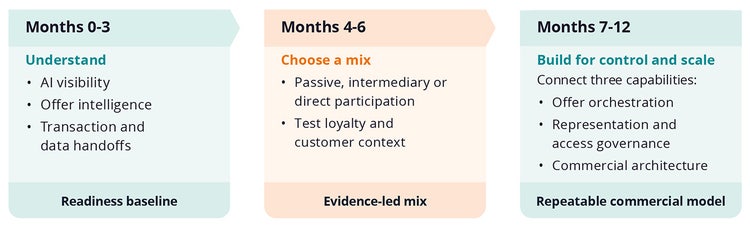
First 3 months: Assessing your current position
The first priority is not to launch another AI pilot. It is to understand what is already happening to the airline’s proposition as travelers move through AI-mediated journeys.
Assess AI visibility and representation
Start with external visibility and representation. Generative engine optimization (GEO) and answer engine optimization (AEO) provide useful lenses for assessing whether an airline enters AI-generated consideration sets and how accurately its proposition is represented.
The questions extend beyond whether the carrier appears in an answer. Does it surface when a traveler describes a need rather than naming an airline? Are premium-cabin attributes, flexibility, loyalty benefits and bundles preserved, or is the offer reduced to schedule and price? If discovery begins in an AI environment, where does control shift over the handoff, attribution, customer context and eventual transaction?
Intermediaries are already investing ahead of demand: Expedia calls AI its fastest-growing marketing channel and has launched travel-shopping integrations with ChatGPT and Claude.
Evaluate machine-readable offer capabilities
The next assessment looks inward: Is the intelligence behind the airline’s proposition actually accessible to machines?
Static content such as product descriptions and amenity lists can be discovered and normalized relatively easily. Dynamic merchandising intelligence is different. It depends on live inventory, pricing, business rules, loyalty status and personalization context—often spread across multiple systems.
That distinction decides how the airline is compared. When rich commercial logic cannot travel with the offer, AI systems default to simplified comparisons that strip away the attributes airlines have invested years in building. A premium product differentiated by flexibility, seat characteristics, loyalty recognition or bundled services becomes another fare.
Airlines should understand which elements of the offer are machine-readable today, which remain locked behind fragmented systems and what would need to change across data, technology and governance to make richer propositions accessible in a controlled way.
Map transaction and data flows
The final part of the assessment is to map the current transaction and data flows. Where does the airline remain a merchant of record? Where does attribution break? Which customer signals are retained, and which disappear when a traveler moves between environments?
This phase establishes where the airline is visible, where differentiation is being lost, which commercial capabilities are technically accessible and where control passes to someone else.
That diagnosis is what makes the next phase a strategic choice rather than a technology exercise.
Months 4-6: Choosing a participation model
Once exposure is understood, the question is not which AI platform to integrate with, but where, and on whose infrastructure, the airline wants to participate.
Compare airline participation models
Three broad participation models are available today:
- Passive participation: AI platforms determine how the airline is discovered and represented from information already available to them. For the airline, it costs nothing, guarantees nothing and yields less visibility over time as others make themselves easier to understand.
- Intermediary participation: AI-mediated demand reaches the airline through the infrastructure of an OTA, aggregator or other distribution partner. Distribution comes with the relationship, but the partner has no reason to protect the airline’s ancillary attach, loyalty proposition or customer relationship.
- Direct participation: The airline exposes selected capabilities to AI platforms itself. It carries the highest investment, and it is the only model where the airline decides how its products are understood and sold.
Each carries a different trade-off between reach, investment and influence.
Early examples illustrate the distinction. Mindtrip, with Sabre supplying content and PayPal handling checkout, closes the booking entirely in-chat on infrastructure the airline does not own. Turkish Airlines exposes live fares and flight status data to Claude through a sanctioned connector, with payment completed on turkishairlines.com. The airline decides what AI systems can reach and keeps the transaction.
Most airlines will operate across more than one model. Intermediaries will continue to matter, and not every interaction warrants a direct connection. The principle is that the mix should be chosen, not inherited, which means deciding where delegation is acceptable and where control over the offer, customer context or transaction is strategically valuable.
Protect loyalty recognition in AI shopping
Loyalty is where that decision bites. Airlines have invested significantly in delivering more personalized offers based on customer status, entitlements and behavior. If an AI agent shops anonymously, much of that personalization can disappear at the point of discovery.
Three questions therefore deserve explicit design: Can the airline still recognize loyalty members when shopping begins in an AI environment? Is the offer being returned personalized or generic? And does customer context carry through to booking, or is it lost during the handoff?
Test commercial assumptions
These are questions for controlled experiments rather than broad “AI pilots.” Airlines can compare two or three priority environments against specific commercial hypotheses: whether richer product information improves premium-offer representation, whether loyalty context changes the offers surfaced and whether more merchandising attributes improve consideration and conversion.
The tests should also expose the price of participation. Airlines need to understand what data the platform requires, how it will be used, what customer context comes back to the airline, who receives attribution and what happens to servicing and payment economics.
The objective is not to force every journey back into an airline-owned channel. Embedded transactions reduce friction in some situations, while retaining the transaction matters more in others because of first-party data, servicing, payment economics or loyalty. What matters is that airlines set those principles before external platforms set them by default.
Months 7-12: Building for control and scale
Once an airline understands which participation model creates value and where it wants to retain control, the focus shifts from experimentation to capability building.
The first priority: Build offer orchestration capabilities
Airlines need controlled ways for external AI systems to reach the right combination of product, price, rules, merchandising logic and loyalty context without exposing the underlying commercial stack indiscriminately.
Emerging protocols and connectors make it easier for AI systems to interact with supplier capabilities, but the protocol is not the strategic advantage. The value sits in what the airline makes available through it: a static fare and schedule, or a richer proposition that reflects product differentiation, entitlements and commercial logic.
The second priority: Establish representation and access governance
Airlines need to monitor how their products are described and compared across AI environments and to define practical rules around authentication, data sharing, rate limits and what actions an external agent may perform.
The third priority: Define the commercial architecture for AI channels
The commercial architecture should cover transaction ownership, payments, servicing, attribution, loyalty recognition and partner economics. Different platforms will warrant different models, but the airline enters those conversations from an established position rather than negotiating each one as an isolated innovation pilot.
That depends on clear ownership inside the airline. AI-mediated commerce crosses commercial strategy, distribution, loyalty, technology, data, legal and customer experience. A standing cross-functional governance model with a named executive owner is more effective than treating these decisions as a series of disconnected platform integrations.
Retaining influence in AI-mediated commerce
The consequences of AI-mediated commerce extend well beyond another shift in customer interface.
Agentic AI shoppers behave differently from human travelers. They search more frequently and compare more alternatives than any human would, pushing look-to-book ratios well past what airline systems were designed for. Deciding who may query what, how often and with what context is now a commercial decision rather than a technical one.
At the same time, if AI agents reach airline content primarily through intermediaries, those intermediaries will increasingly influence how offers are presented and monetized. But access may also shift outside existing traditional channels altogether; emerging agents like Instinct are already handling real travel bookings and rebooking without relying on direct airline integration.
That is why the option for airlines to participate directly matters.
Airlines do not need to displace OTAs, global distribution systems or other intermediaries, which will remain important sources of demand. What they should avoid is a future in which those channels become the only machine-readable route to their products. The goal is not to own every customer interaction. It is to preserve the ability to participate directly when differentiation, loyalty recognition and commercial control matter most.
Airlines should respond to AI-mediated commerce by assessing how their offers appear in AI environments, choosing where to participate directly and building the capabilities needed to preserve differentiation, loyalty recognition and commercial control.
AI-mediated commerce is still evolving, and no one knows which interfaces or transaction models will ultimately prevail. That uncertainty is the argument for building now, not for waiting.
Related insights
zs:topic/marketing,zs:topic/sales,zs:topic/strategy-and-transformation