Beyond segments and journeys: Purposeful engagement starts with barriers
Key takeaways:
- Flip your customer engagement strategy: Barriers-driven engagement starts with what’s blocking action—then aligns plays to remove it and drive behavior change.
- Make the customer engagement model more precise: Strategy stays segment-led, but execution becomes barriers-driven—focused on the constraint that matters most for each customer.
- Turn “next best action” into “next best play.” Barriers-driven engagement shifts next best actions from optimizing engagement to driving outcomes.
- Operationalize what matters: Evolve your customer engagement strategy by measuring barrier resolution and scaling from focused use cases.
What if your engagement model started with this question: what’s stopping this customer from changing their behavior today? In a barriers-driven engagement™ model, teams rally around specific barriers to action with a clear purpose: remove what’s blocking progress. The result: sharper strategy, smarter patient journey management, faster adoption and more demand capture—powered by tighter cross-functional execution.
As barriers-driven engagement gains traction, the next question is inevitable: how do barriers connect to the tools marketers already use: segments, journeys, sequencing and next best action (NBA)? In this Q&A, ZS’s customer engagement leaders explain how these constructs fit together, what each is built to do and how to build a customer engagement strategy that drives real behavior change.
What problem is barriers-driven engagement solving for customer engagement strategy that traditional customer engagement strategies—built on segments and journeys—cannot?
Saby Mitra: Barriers-driven engagement solves a gap in how most engagement models work. Segmentation, targeting and sequencing can tell you who to focus on and how to reach them, but they don’t tell you what’s actually keeping a specific customer from taking the next step right now.
A journey is a strategic map; it describes the stages a customer moves through and what an ideal experience looks like at each; it’s the specific order of touch points engineered to move a customer from one stage to the next. The problem is today’s journeys don’t tell us why a specific customer isn’t acting. Oftentimes, it’s not engagement that’s blocking the customer journey, but feasibility to act. When frictions exist in the system and there is a feasibility question, we can improve engagement but still lag on conversion.
The personalization question is shifting beyond best-channel-content-timing combinations to “what are the customer’s decision drivers and barriers in the context they are operating in?” What barriers are preventing the decision or action? Barriers and broader customer context offer us a step change from the current sequencing-based journey paradigm, to help with decision-making.
Carolyn Morrow: For example, many barriers can be found in the practical realities of care: access hurdles, workflow constraints and day-to-day operational friction. So it’s not about sharing another efficacy or safety message, it’s about working with practitioners to unlock the constraints in their system.
Namita Powers: Barriers also appear in the broader decision environment—and today there are just too many “decision contexts” to map one clean, end-to-end journey for everyone—account archetype, patient mix, local market dynamics, payer rules, site of care and more. So rather than forcing a single journey across all that complexity, we flip the model: use barriers to guide execution.
As an example, in one case, a patient services workflow conflicted with how a provider’s office actually operated, so it created confusion and resistance. The issue wasn’t awareness or a better message; it was a process misalignment that needed a different kind of intervention across roles. Tweaking the segment or the journey wouldn’t have fixed it.
How do barriers and plays redefine the role of segments and journeys in a modern HCP engagement model?
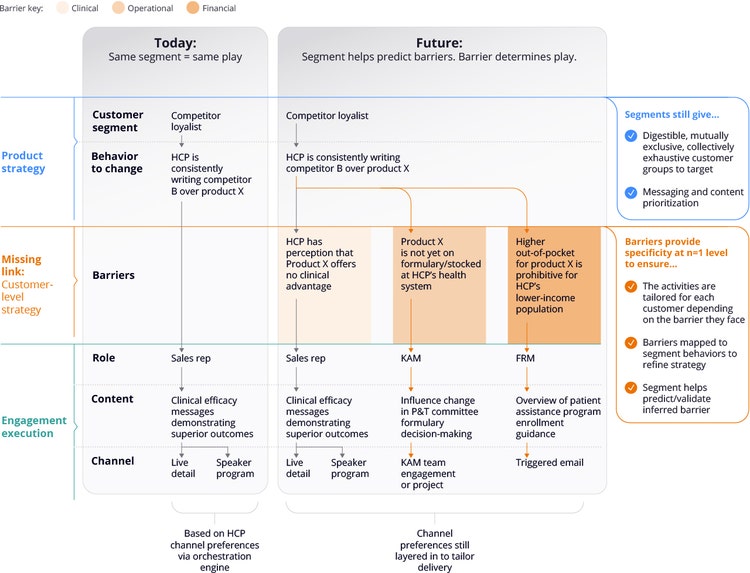
Ankur Batra: They fit together, but they play different roles. Segments and journeys help marketers organize engagement and set foundational strategy, but they don’t reliably tell you why behavior isn’t changing. Segments still help define where to play by grouping customers and helping you anticipate likely barriers. Barriers add a layer of personalization by helping teams remove the obstacles blocking action. Good segmentation can point to likely drivers and barriers, but barriers help you act on what matters.
Greg Shapiro: Barriers shift the focus to the most important constraint the customer faces. While two customers in the same segment may have similar mindsets and motivations, they can also face completely different issues and need different actions. That’s why strategy stays segment-informed, but planning and execution become barriers-driven, with plays defining how you address those barriers in the real world.
FIGURE 1: Barriers are the missing link between segment strategy and personalized execution
How does barriers-driven engagement change our thinking about next best action in the HCP engagement model?
Srihari Sarangan: The fact is, most NBA models today are optimized for engagement, not outcomes. The engine learns what message this provider is most likely to respond to, in what channel, at what time. That’s genuinely useful. But “most likely to respond” is different from “most likely to move.” If a doctor isn’t prescribing because the drug requires EKG monitoring that they don’t have capacity to support, no amount of optimized sequencing resolves that.
NBA without barriers is a powerful engine without a destination—without purpose; it gets you in front of the right customer at the right time but has no way of knowing whether that interaction is addressing what’s actually blocking them. Barriers provide a much clearer rationale for the underlying reasons the provider isn’t responding, so that the brand can take more purposeful action.
AB: Sequencing and NBA still matter, but their job changes in a barriers-driven model. Traditional NBA optimizes what to do next based on observed behavior. “Next best play” starts one step earlier: it’s clarity on what it will take to overcome a specific barrier.
Once a barrier is identified, plays define the set of actions that can resolve it. NBA can then help pick what to do next with the associated sequencing. Our systems of intelligence are built to now home in on that barriers prioritization—because in reality, there are multiple barriers for a given customer across their various patient types, so we have to ensure the most relevant barriers are addressed at a given point in time.
SS: The difference is the starting point. Behavior-based models react to what someone did. Barriers-driven models diagnose what’s blocking progress, then coordinate the right actions to remove it. Overall, it shifts personalization from “more efficient activity” to “more effective outcomes.”
I’m excited about the way co-pilots and chatbots will enable a two-way dialogue between intelligence and insights and execution. There will be a virtuous cycle of enhancing intelligence, understanding associated barriers and predictable approaches for the NBA.
What needs to change—across mindset, capabilities and operating model—to make barriers-driven engagement real?
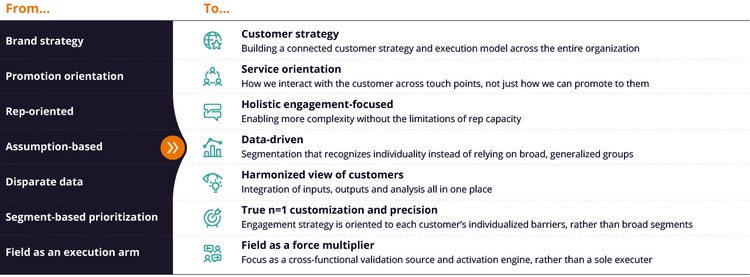
GS: The biggest shift is moving from organizing around activity to organizing around solving a specific customer problem. That problem becomes the shared purpose, we want to fall in love with the problem. That shift changes how decisions get made, how teams work together and what “good” looks like.
Today, teams are usually set up to operate by function, which makes it hard to align around one customer problem. A barriers-driven model works best when cross-functional teams align on shared customer barriers and when roles coordinate around plays—not separate activity plans. It isn’t just that coordination is more efficient, but that a lack of coordination is ineffective since the customer risks getting overwhelmed with multiple engagement efforts and stops engaging altogether.
FIGURE 2: Enablement will require marketers to take on several mindset shifts
NP: This also helps the marketers get better with content planning. Tagging content to barriers allows us to really be most effective in our engagement approaches and allows us to see where we are overindexed and where we have gaps in our content strategy. As we’re doing some of this content planning, we’re realizing today: pharma overindexes on the safety and efficacy content and underindexes on the more operational barriers to care. The analogy I use is if you imagine a 10-hurdle race, we’re leaping hundreds of feet over the first few hurdles and slamming into the remaining ones. We have to get thoughtful about how we allocate resources so that we can clear all the hurdles.
Importantly, with all this, measurement shifts. Instead of rewarding volume of activity or reach, you track whether barriers are getting resolved and whether customers are moving forward faster as a result. In practice, this means tracking metrics like speed to barrier identification, barrier resolution rate and customer progression across adoption stages, not just call frequency, email open rates or customer engagement scores. The KPIs you reward signal what the organization actually believes matters.
Where do organizations start when adopting barriers-driven engagement and evolving their customer engagement strategy?
SM: Most organizations don’t start with a full transformation. They start with focused use cases, usually the ones where the current segmentation, journey or NBA approach isn’t delivering the outcome brands need.
A common first step is a cross-functional customer barrier identification exercise to align on the barriers affecting the brand’s customers. From there, teams assess the current state of plays against all the barriers and ideate on plays that will most effectively address the barriers and align roles around execution.
NP: You can do this without a big-bang operating model change. Most teams start with one use case, using the data and processes they already have, and then build the new capabilities as they scale.
Organizations are applying this to problems like improving adoption, fill rate or addressing access challenges. As those early use cases prove out, they expand by scaling barrier identification, play orchestration and measurement across brands and teams. That’s what makes this model practical: you don’t have to redesign everything at once. You start where the barrier is clear, prove impact and build from there.
Related insights
zs:topic/ai-and-analytics,zs:topic/marketing,zs:topic/sales,zs:topic/strategy-and-transformation,zs:topic/customer-experience