Connected intelligence in life sciences: Make better decisions with agentic AI
Connecting data, science and evidence to support better patient outcomes
Life sciences organizations have more data and scientific evidence than ever before. But too often, teams struggle to reuse what they’ve already learned. This leads to the same datasets being reassessed, analyses repeating and valuable insights remaining isolated across functions. A survey showed 70% of teams spend an average of seven months integrating and cleaning data before they can generate a single insight. Twenty-seven percent of respondents agreed that the presence of siloed teams posed significant challenges to the effective use of technology and data. Another survey also confirmed that about 50% of scientists’ working hours are dedicated to retrieving and reshaping data rather than interpreting it.
We can do better.
A connected intelligence operating approach addresses this challenge by connecting data, science and evidence through a shared layer of context. It puts a reusable knowledge foundation within reach by capturing the context, assumptions, decisions, rationale and outcomes behind every analysis. Connected intelligence helps teams build on previous decisions instead of starting from scratch.
AI agents can help build the shared context required by the connected intelligence approach. Agents can gather information, monitor new developments and coordinate activities, while humans remain responsible for evaluating scientific relevance and making key investment decisions.
Life sciences decision-making: Where decisions lose their context today
Responsibility for a single business question crosses several groups. Data teams assess the quality and determine who can use the data. Scientific and medical teams interpret scientific findings. Evidence teams choose what to study and how.
Their insights then inform decisions made by regulatory, market access, commercial and portfolio leaders. But as information moves across functions, critical context is lost. What falls out is often specific context: why a dataset was rejected, which patient subgroup an analysis could support, what an investigator meant in a particular discussion or which gap a study was designed to close.
When that context is unavailable, teams must spend time recreating prior thinking, making assumptions and retracing earlier decisions. The result is duplicated effort, slower progress, inconsistent conclusions and avoidable governance challenges.
And while metrics such as datasets acquired, studies completed, publications produced and analyses delivered are important, they don’t capture whether decision-making actually improved. Faster access to information or quicker content generation can improve productivity, but in a connected intelligence operating approach, decision-makers have the right evidence and can consider relevant alternatives as they work toward a sound conclusion.
Three capabilities that power connected intelligence in life sciences
Connected intelligence brings together data intelligence, scientific intelligence and evidence intelligence so teams can make decisions with the context behind earlier decisions. Together, these three capabilities help determine which data can answer a question, which scientific findings matter and which evidence gaps warrant investment. By preserving the reasoning behind each decision, they allow teams to build on previous work and support a continuous learning model.
Data intelligence helps a team decide whether information is trustworthy, fit for the question and permitted for the intended use. It connects data discovery, quality, access and investment decisions that often sit with different owners. A source useful for one endpoint or population may be unsuitable for another. AI agents and accelerators can coordinate these activities, prepare recommendations and route exceptions for review. Human experts, meanwhile, are still responsible for data suitability, approvals and investment decisions.
In a connected intelligence approach, teams access data trust scores that measure coverage, lineage, transformations, quality, limitations, permitted purposes and the reason for selecting or rejecting a source. Future teams could test that assessment against their own questions.
For example, these scores can help an organization make better licensing renewal decisions rather than relying on vendors’ claims. Agents and accelerators can link a reviewed assessment to governed, AI-ready data assets. This preserves the rationale and constraints so future teams can reassess suitability without reconstructing the original work.
Scientific intelligence helps medical and scientific leaders decide which developments should change a position or priority. In a connected intelligence approach, teams appraise literature, trial results, real-world findings, stakeholder insights, competitor activity and policy changes. This helps them judge the quality and relevance of a signal, its implications for the asset or therapeutic area and whether it warrants action.
Teams are able to preserve the evidence behind a position, uncertainty and the alternatives they considered. When a position changes, it shows which new findings or assumptions change it. A planning team can review that reasoning without repeating the whole appraisal, while remaining responsible for checking whether it still holds.
Evidence intelligence helps teams decide which gaps deserve investment and which study design could resolve them. It links the research question to feasibility, protocol choices, execution, dissemination and the decisions the results are intended to inform. Keeping scientific intent attached reduces the chance that a well-executed study answers the wrong question.
In the connected intelligence approach, the evidence context connects existing studies, data selections, analytical assumptions, stakeholder needs, design trade-offs and observed impact. It can reveal that an answer already exists or that a proposed study would not resolve uncertainty. A decision to defer or stop work belongs to the context too.
The foundation of connected intelligence in life sciences: Semantic and context layers
The foundations of connected intelligence are the semantic layer and the context layer.
Semantic layer: The semantic layer provides a common language for the enterprise, defining key scientific and business concepts—including cohorts, endpoints and evidence gaps, along with their relationships to data and evidence. These definitions are governed and updated over time to ensure consistency across teams.
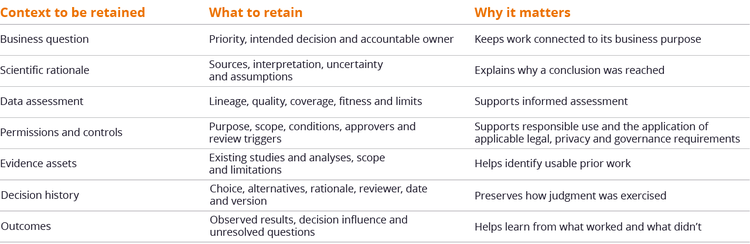
Context layer: The context layer assembles, links and maintains the information needed for a decision, including its question, objective, scope, assumptions, uncertainty and constraints. It preserves relevant prior assessments, rationale, approvals and outcomes. It’s not merely a historical log or an agent’s prompt.
In the context layer, each decision record is versioned, owned and traceable, with clear source references and review requirements. As data, evidence, regulations or business needs evolve, the context can be revisited and updated while maintaining a history of prior decisions.
Together, these two layers can help organizations reuse knowledge, build on previous decisions and make faster, more consistent choices while supporting appropriate oversight, governance and trust.
FIGURE 1: The context that makes decisions reusable
Illustrative example: Should we commission a real-world study?
To show the power of a connected intelligence approach, consider the example of a team deciding whether to commission a real-world study about clinical outcomes in a patient subgroup.
First, they determine whether resolving open research questions could change a business or clinical decision. Next, they review existing evidence, assess available data sources and evaluate whether current analyses are sufficient or if new research is needed.
In the connected intelligence approach, the semantic layer provides a shared definition of the patient population, outcomes and evidence gap being assessed. The context layer, meanwhile, captures the evidence reviewed, data sources considered, assumptions made, alternatives evaluated and the rationale for the final choice.
AI agents can help gather evidence, identify gaps and route work to the appropriate experts. However, your people remain responsible for evaluating scientific validity, assessing data fitness and making investment decisions.
Once the study is completed, the team can compare the results with its original assumptions to better understand the evidence gap. The context layer preserves what was learned, what changed and why, allowing future teams to build on prior decisions rather than start from scratch.
What a connected intelligence approach needs to succeed
Connected intelligence in life sciences combines human judgment with AI automation across the decision cycle to identify signals, evaluate options, make decisions, take action and learn from outcomes. Each cycle creates a foundation for future decisions by capturing what was decided, why and what happened next.
While agents can gather context, monitor evidence, prepare review materials and coordinate workflows, people remain accountable for scientific judgment, governance, approvals and investment decisions. A ZS survey showed that among pharma functions, the highest shares of technology leaders reporting measurable AI outcomes were in enterprise IT (70%), commercial sales and marketing (56%) and supply chain and manufacturing (53%).
Scientific functions remain earlier in their AI journey, but within those functions drug discovery rose from 17% to 35% in a year, while clinical and medical stayed relatively flat. The industry’s focus should be to build a connected use case. The same survey showed that only 38% of organizations report measurable AI results across multiple business functions, and 72% of those AI value leaders rank data for AI as mission-critical, compared with 46% of other organizations.
Success in the connected intelligence approach depends on trust. Every recommendation should be traceable to its source, follow approved permissions and include clear oversight. When evidence is missing, conflicting or uncertain, agents should escalate to human reviewers rather than proceed.
Most importantly, teams must improve decision handoffs before automating them. Automating a broken process only makes the same problems happen faster. It’s vital to build the foundations around the first decision stream.
How do you build the foundation for connected intelligence in life sciences?
Connected intelligence can’t operate on technology alone. It requires a shared foundation that makes data usable, ensures consistent meaning and makes decisions trustworthy. Organizations should establish these capabilities around an initial decision stream, then expand them as needs and adoption grow.
Decide where to build, buy or partner
As part of the connected intelligence approach, your organization will want to buy mature storage, compute, pipeline, quality and enforcement tools where appropriate. It’s important to build and retain appropriate rights and control over the data mappings, scientific vocabulary, policy rules and decision context that encode your organization’s business. Those assets need to be exportable so that platforms remain replaceable. Partners can add specialist depth or accelerate delivery, but your organization should retain appropriate rights and control over definitions, controls and decision-related assets.
The role between platform engineering and scientific work is important, and it should be staffed deliberately. This person must translate a research question into a data specification, explain the resulting limitations to decision-makers and review how agents retrieve and represent the evidence. They need practical scientific, data and governance judgment, not only the ability to use a tool.
Putting connected intelligence into practice requires clear choices about accountability, investment and measurement. Organizations must determine who owns each part of the approach, which capabilities they should control and how they will assess its effect on speed, reuse and decision quality.
All this is for the outcomes that matter: Measure speed, reuse and decision quality separately
Adoption and hours saved show whether tools are used and work is faster, but they don’t establish whether a study was worth commissioning. Organizations should measure not only how quickly decisions are made, but also whether teams are reusing knowledge effectively and making sound judgments.
One NVIDIA survey found that 70% of healthcare and life sciences organizations are actively using AI, up from 63% in the previous survey—and 85% of executives reported that it is helping increase revenue. As adoption grows, the harder question is whether it’s improving decisions. A recent shift showed experts asking whether adoption is leading to any measurable business value and supporting key business decisions.
FIGURE 2: How to measure connected intelligence
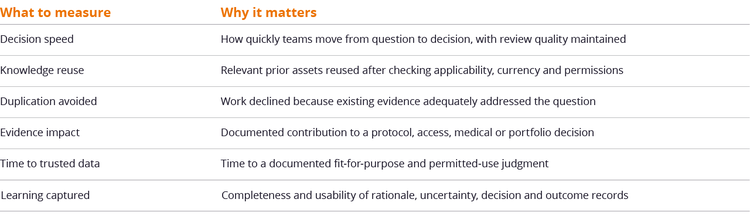
As part of a connected intelligence approach, you’ll want to pair these measures with periodic expert review of a sample of decisions, checking for evidence adequacy, treatment of uncertainty, validity of assumptions and consideration of alternatives. Count work as duplication avoided only when existing evidence genuinely answers the question. Reuse should mean verified relevance, not copying an old conclusion.
It’s prudent to distinguish early operating signals from outcomes that take longer to observe. Capture completeness, reuse and review turnaround may all change before study findings or stakeholder decisions do. That’s why you should set observation periods to the decision stream, rather than assuming every outcome appears within a year. If evidence influenced a decision, rather than claiming sole causation, document its contribution and competing explanations.
The realities of implementing connected intelligence in life sciences
Start with a single, high-value decision process where inefficiencies are already visible and where a business sponsor can drive change across functions. For many life sciences organizations, the study commissioning process is a strong candidate because it often involves repeated evidence reviews, data assessments and feasibility evaluations.
Your teams will need to agree on what can be observed during the pilot, even if downstream outcomes take longer. The phases below are a sequence, not concurrent growth horizons.
Focus:
- Map one stream
- Name owners
- Agree on records, controls and baseline
Evidence to review: A clear decision, an accountable sponsor and documented handoff problems
Focus:
- Curate context
- Repair handoffs
- Pilot bounded agent tasks
Evidence to review: Verified reuse, review quality and changes in cycle time
Focus:
- Extend to adjacent streams as results support expansion
Evidence to review: Reuse across streams, current permissions and sustained decision quality
When implementing a connected intelligence approach, life sciences organizations will need to assess the stream, build the capability needed, pilot it and expand after review. The first stream can test whether the context survives real handoffs and remains current. Then you can extend to adjacent streams that share data, definitions and stakeholders. But be careful not to assume a successful feasibility workflow will transfer unchanged to every decision.
4 mistakes to avoid when implementing connected intelligence
Several patterns consistently undermine implementation and adoption. You’ll want to avoid these four mistakes:
- Mistake 1: Starting with technology instead of the decision. Tools cannot fix a process that lacks ownership or accountability.
- Mistake 2: Treating context as documentation. If context isn’t embedded in the workflow, it quickly becomes outdated and unused.
- Mistake 3: Choosing a low-impact pilot. A meaningful pilot should involve real decisions, real trade-offs and real governance challenges.
- Mistake 4: Measuring adoption instead of outcomes. High usage doesn’t necessarily mean better decisions.
Success requires both fresh context and strong oversight. Decision records should be reviewed regularly, assumptions should be challenged and sponsors should be accountable not only for speed and delivery, but also for the quality of decisions being made.
Make every decision a foundation for the next one
Connected intelligence helps life sciences organizations turn fragmented data, evidence and reasoning into knowledge that teams can trust, challenge and reuse. It not only helps teams make individual decisions faster, but also strengthens each decision that follows.
We recommend starting with one high-value decision that crosses functions and that you can revisit frequently. Define the context that should persist, assign ownership and pilot a focused, agent-supported workflow. Then measure not only speed, but also how much knowledge is reused and how decision quality improves.
The ultimate test is simple: Can the next team understand, challenge and update the reasoning rather than reconstruct it? When the answer is yes, decisions stop being isolated moments and become enduring organizational intelligence.