Drug development mission control: Transforming oversight and risk management in pharma R&D
Over the past decade, pharmaceutical R&D organizations have made substantial investments in digitizing clinical execution. Core systems such as electronic data capture (EDC), clinical trial management (CTMS), electronic trial master files (eTMF), safety, quality and financial platforms are now firmly embedded, and many organizations have layered dashboards and functional control towers on top.
These investments have improved transparency and operational efficiency. Yet for many senior leaders, portfolio decision-making in drug development remains constrained—not by a lack of data, but by operating models that fragment insight across assets, functions and geographies. As a result, AI and analytics investments often remain siloed, improving isolated tasks without transforming how decisions are made across the development value stream.
Development portfolios are growing more complex, while timelines are compressing and costs are escalating. Executive decisions increasingly hinge on questions that dashboards alone cannot answer:
- How healthy is my portfolio today and how will it evolve over the next three to five years?
- What financial, operational, regulatory and safety risks could affect portfolio success?
- How will local execution issues cascade into downstream timelines, value and regulatory readiness?
- What tradeoffs exist between speed, cost, risk and probability of success—and which are worth making?
- How resilient is my portfolio against external shocks, such as regulatory shifts and competition?
We believe the next frontier is not more reporting but new executive decision capabilities.
The limitations of dashboard-led oversight in drug development
Dashboards and control towers have become essential tools for clinical development leadership. They standardize metrics, surface trends and support functional accountability. However, most remain optimized for retrospective visibility, not forward-looking decision orchestration.
For example, in many portfolios, a three-month enrollment delay might not be fully visible in portfolio net present value impact until the next formal review cycle. And by that point, mitigation options have likely narrowed.
In practice, dashboard-led oversight creates several structural limits at the executive level:
- Fragmented interpretation: Insights remain distributed across functions, requiring manual synthesis in governance forums.
- Lagging indicators: Status is often based on what has already happened, rather than what is likely to occur.
- Point-in-time decisions: Portfolio choices are revisited periodically, even when underlying conditions are changing continuously.
- Disconnected action: Decisions made at the top do not always translate into coordinated downstream execution.
These limits are not an execution failure. They reflect the fact that most oversight models were designed for a slower, more linear development environment.
The question for today’s leaders is not whether dashboards work but whether they are sufficient for governing portfolios in which even modest delays can erase significant asset value.
But if these dashboards aren’t the answer, what is? Drug development mission control.
What is drug development mission control?
Drug development mission control offers total pipeline visibility, powered by AI and guided by human ingenuity. It’s an executive-first oversight and orchestration layer designed to reshape how portfolio decisions are made and acted upon across clinical development.
More fundamentally, drug development mission control enables value-stream transformation by connecting data, workflows and decisions into an intelligent, AI-enabled operating model. This is a big improvement from layering new tools onto existing structures.
Rather than adding another reporting surface, mission control can:
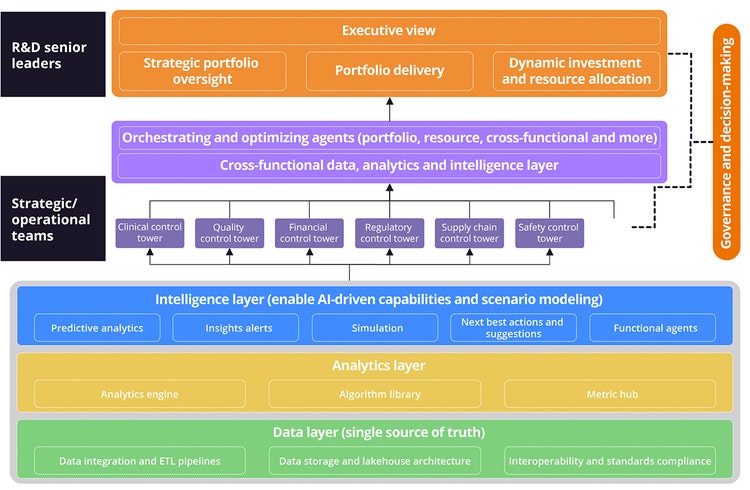
- Connect existing systems and control towers into a unified intelligence layer
- Elevate oversight from descriptive to predictive, using probabilistic and scenario-based insight
- Link decisions to coordinated action, supported by governed analytics and AI-enabled workflows
Here’s what mission control is not: a replacement platform for control towers, a dashboard overlay or a centralized project management office.
Here’s what mission control is: an operating model that amplifies prior digital investments, turning isolated insights into portfolio-level decision capability.
At its core, mission control enables leaders to govern drug development through risk-adjusted, end-to-end portfolio visibility, rather than static milestones and spend.
What technology needs to reshape executive decision-making
A useful analogy comes from broader digital transformation efforts across industries. Many organizations have invested heavily in advanced analytics and AI, yet struggle to translate these investments into measurable impact.
The underlying lesson is consistent: Technology creates value only when it changes how decisions are made, executed and governed.
In clinical development, the same principle applies. Drug development mission control is valuable not because it introduces new analytics, but because it enables four critical shifts in executive capability that help leaders understand risks and make decisions.
FIGURE: What makes mission control possible: Its core components
4 executive capability shifts enabled by drug development mission control
Drug development mission control changes executive capability, not just reporting outputs. These four shifts define what this evolution looks like in practice and how it elevates drug development oversight from passive review to active portfolio steering.
Shift 1: From human-dependent synthesis to asset-based portfolio intelligence
Traditionally, portfolio insight has lived in people and presentations. It’s assembled through bespoke analysis ahead of governance meetings.
Mission control shifts portfolio insight into institutional assets, including standardized metrics, predictive models and scenario engines that are continuously refreshed and consistently applied.
What this means for executives: Leaders move from consuming interpretations to steering decisions with reusable, governed intelligence that scales across assets and time.
Shift 2: From intermittent review to continuous portfolio steering
Most governance models operate on fixed cadences—monthly reviews, quarterly portfolio updates and milestone gates.
Mission control preserves formal decision forums while enabling continuous sensing and earlier intervention. Some decisions remain episodic, while others become faster and more responsive as leading indicators signal emerging risk or opportunity.
What this means for executives: Time is spent deciding what to do, not reconciling whether the data is current.
Shift 3: From siloed performance views to cross-functional impact awareness
Functional dashboards optimize local performance but often obscure how risks propagate across the development value stream.
Mission control explicitly maps cross-functional dependencies that show how enrollment delays, data quality issues or regulatory feedback cascade into timelines, cost and value across the portfolio.
What this means for executives: Tradeoffs become explicit and evidence-based, enabling more deliberate prioritization and capital allocation.
Shift 4: From reporting analytics to decision orchestration
Many organizations have strong analytics capabilities but limited mechanisms to ensure insights translate into coordinated action.
Mission control links insight, decision and execution through governed workflows and agents. Recommendations are visible, ownership is clear and outcomes are tracked.
What this means for executives: Oversight shifts from “knowing” to “steering,” with accountability anchored at the portfolio level.
What drug development mission control enables for senior leaders
When implemented with discipline, mission control offers executives:
- End-to-end risk-adjusted portfolio visibility across assets, indications, phases, geographies, budgets and timelines
- Probabilistic delivery forecasting with early signal detection, not just milestone tracking
- Scenario simulation to evaluate speed, risk, cost and value tradeoffs before committing resources
- Dynamic portfolio orchestration, enabling cross-asset impact assessment
- Cross-functional risk anticipation spanning clinical operations, quality, safety and regulatory readiness
- Decision-to-action traceability, ensuring strategic intent translates into execution
The goal is not more detail but greater decision leverage.
Why now: A narrow window for redefining development governance
Three converging forces make this a decisive moment for drug development leaders:
Digital clinical foundations are in place: Most sponsors have already digitized core execution systems. While fragmented, these investments provide a starting point that mission control can build upon rather than replace.
AI is moving from insight to action: Agentic and predictive capabilities now make it possible to reason across domains, simulate outcomes and support coordinated execution. The remaining constraint is not technology but scale. It requires embedding these capabilities across the development value stream through redesigned governance, connected workflows and enterprise-grade accountability.
The cost of delay has become strategically intolerable: Compressed patent windows, competitive intensity and rising trial complexity mean that even modest delays can materially erode asset value.
Together, these shifts create both opportunity and urgency. Organizations that act deliberately can redefine oversight for the next decade. Those that wait risk accumulating more intelligence without improving outcomes.
The real transformation: Executive capability, not technology
Drug development mission control ultimately succeeds or fails based on leadership behavior, not on how well the technology is implemented.
Organizations that realize value from drug development mission control often:
- Redesign governance around portfolio outcomes, not functional metrics
- Build comfort with probabilistic and scenario-based decision making
- Clarify ownership of cross-functional risk and intervention
- Treat mission control as an operating model, not an IT deployment
The leaders who embrace this shift move from periodic oversight to continuous, intentional portfolio steering.
Drug development mission control: A new model in a complex era
Drug development is entering an era defined by speed, complexity and uncertainty. In this environment, traditional oversight models—however well digitized—are reaching their natural limits.
Drug development mission control offers a path forward that builds on existing investments to give executives the visibility, foresight and coordination required to govern portfolios with confidence.
The question is no longer whether organizations will adopt these capabilities, but how deliberately they will design them.
This article includes contributions from Aashima Kalia, Sharma Ramanathan, James Bierman, Richa Gupta, Shilpi Mathrani, Ayush Singh and Sowmyanarayan Srinivasan.
Related insights
zs:topic/research--development,zs:topic/data-digital-and-technology