In silico: The numbers that change the math of clinical development
The explosion of multimodal biomedical data, agentic AI, digital twins and computing power, plus growing regulatory acceptance for nontraditional evidence, have recently brought the “what” of in silico drug development into focus. What’s been missing has been the “how” and the “how much.”
ZS investigations and meta-analyses show that the next wave of in silico drug development technology—which includes digital twins, trial design simulations and broader model-informed drug development (MIDD) practices—could eventually cut clinical trial development costs by as much as 60% and shorten cycle times by up to 40% as models mature, regulatory comfort grows and adoption expands.
These technologies will do this by tackling R&D’s biggest bottlenecks, including slow recruitment, avoidable amendments and high phase 2 failure rates. Grounded in real-world case studies, validated sources and financial models, we’re seeking to categorize and then quantify the impact of in silico drivers across the drug development life cycle.
These figures reflect modeled scenarios and early proof points, not industry norms today.
Cutting phase 1 cost and cycle time by 75% with in silico clinical trials
AI-based simulations and modeling are reshaping large swaths of the traditional development life cycle. We’ve already seen drug discovery transformed by these advances. DeepMind’s AlphaFold, for instance, has revolutionized protein structure prediction and molecular design, demonstrating the transformative potential of modeling and artificial intelligence. Now we’re anticipating similar progress in the preclinical space as well, with the FDA recently recommending modeling and simulation as alternatives to animal testing.
Advances in in silico modeling and statistical inference can now predict human pharmacological responses by integrating strong animal data, physiologically based pharmacokinetic (PBPK) models and real-world evidence (RWE). PK/PD modeling outputs are already influencing decisions related to first-in-human starting doses. In time, and with continued advances in model validation and regulatory acceptance, we see potential for phase 1 trials to eventually shift from broad, exploratory designs to targeted cohorts that serve mainly to confirm the accuracy of modeling outputs.
Consider a representative phase 1 design: In place of six single-ascending dose (SAD) cohorts followed by three multiple-ascending dose (MAD) cohorts, we can imagine a world in which trial sponsors submit outcome models to regulatory bodies in advance with the understanding that, if confirmatory SAD and MAD cohorts align with simulated outcomes, the program can safely progress to phase 2.
This assumes healthy volunteer studies rather than first-in-patient phase 1 trials common to rare disease or oncology.
Bottom line: In modeled scenarios, sponsors could see up to 75% reduction in expenses and cycle times for phase 1 studies where models consistently demonstrate accuracy in healthy volunteer settings.
Streamlining mid- and late-stage development with in silico clinical trials
Building on early-phase efficiencies, in silico methods are now streamlining mid- to late-stage development by addressing long-standing operational bottlenecks. From digital twins that shrink control arms to AI-assisted recruitment, protocol optimization and site selection, we expect in silico methods to reduce trial size, duration and complexity while maintaining scientific rigor and regulatory confidence.
Shrinking control arms with digital twins
Digital twins in clinical development are high-fidelity virtual representations of individual trial participants. In many ways, they represent an evolution of long-standing approaches such as external control arms (ECA), which use historical or real-world data to contextualize single-arm or underpowered randomized trials. Despite regulators’ growing embrace of externally controlled trials, real-world use of ECAs and related external-data designs remains limited and concentrated in select oncology and rare-disease programs.
This leaves substantial headroom for broader adoption as digital-twin methodologies mature. With improved modeling accuracy and increasing availability of multimodal health data, these virtual counterparts increasingly mirror real patient trajectories with clinical-grade precision.
Thanks to this, we expect to see overall sample size shrink as virtual patients replace a growing number of live ones.
CASE STUDY:
Advanced statistical techniques, such as PROCOVA (prognostic covariate-adjustment), exemplify this evolution. In an Alzheimer’s collaboration with Roche, Unlearn demonstrated retrospectively how its Neural-Boltzmann digital twins and PROCOVA could have cut control arm size by up to 35%. This demonstrates the potential these methods have to improve precision and accelerate timelines.
Although substantial control‑arm reductions are possible in select settings, the magnitude Roche and Unlearn demonstrated in their Alzheimer’s retrospective work is not yet reliably repeatable across all indications. This is likely to change rapidly as richer multimodal data inputs, growing regulatory acceptance and foundation models trained on biomedical data enable more robust and generalizable inference across therapeutic areas.
With digital twin capabilities (such as GAN and LLM twins) evolving and model fidelity improving, digital twins could become a reliable partial control arm replacement. In time, this could reduce control arms by as much as 60% while reducing sample sizes by as much as 30% across the development pipeline.
Today, digital twins are applied disproportionately in rare diseases and high-mortality conditions. As quality improves, we anticipate growing regulator trust in these techniques to allow sponsors to expand their use to more common therapeutic areas.
Bottom line: With growing regulatory acceptance, this could lead to as much as a 30% reduction in enrollment requirements across the development life cycle
Reducing recruitment time with in silico trial designs
Patient recruitment remains one of the most persistent bottlenecks in clinical development. Between 2010 and 2020, average patient enrollment periods increased by 37%, driven largely by protocol complexity. Between those years, clinical endpoints almost doubled and procedures rose by more than 40%, according to the Tufts Center for the Study of Drug Development (CSDD). This trend reflects a shift toward highly granular data capture and multiendpoint designs that, while scientifically valuable, significantly slow site throughput and patient recruitment.
Recent advances in electronic health record (EHR)-based patient modeling and AI-driven inclusion and exclusion optimization offer a practical path to reverse this trend.
CASE STUDY:
Research published in Nature shows that adaptive modeling of eligibility criteria can double the pool of eligible patients. Other pilot studies, meanwhile, have achieved recruitment rate increases of up to 70% in some therapeutic areas.
In the future, AI will be able to simulate thousands of protocol designs in parallel—testing small adjustments to inclusion and exclusion criteria against EHR and historical recruitment data to identify the optimal trial design. At a minimum, we expect trial design simulation to reverse the 37% increase in enrollment duration reported by Tufts—delivering roughly a 25% reduction in recruitment time and associated costs—with meaningful impact on overall trial cycle times.
Bottom line: Based on early pilots, trial design simulations could help reverse recent increases in enrollment time, potentially reducing recruitment duration by as much as 25% in future-state models.
Eliminating avoidable amendments with simulated designs and operational modeling
Protocol amendments are among the most disruptive drivers of delay and cost in clinical trials. A Tufts CSDD 2022 analysis found that 23% of amendments are avoidable—17% “completely” and 6% “somewhat.” Of the rest, 37% are considered “somewhat unavoidable.”
Many "completely" avoidable amendments stem from feasibility and operational-design issues, such as eligibility criteria that don't align with actual patient availability, recruitment challenges, site underperformance or overly complex protocols. Simulated protocol design and operational modeling can help surface these risks earlier, reducing the need for midstream changes.
Many “somewhat” avoidable amendments are triggered by new learning or external input, such as endpoint refinements, dosing or regimen adjustments, evolving safety or efficacy signals or regulatory feedback. Even with these, we expect PK/PD modeling and trial simulations to play a greater role in shaping critical design decisions preemptively, reducing how often protocols need to change after initiation.
Bottom line: In scenarios where modeling is deeply embedded into design and operational planning, avoidable amendments could decrease by as much as 42%.
Reducing site needs by eliminating underperforming sites
Site inefficiency remains a persistent challenge in drug development. Studies show that 11% of trial sites fail to enroll a single patient, while 37% underenroll. These underperforming sites drive cost, delays and monitoring burden without contributing meaningful data.
Site selection models driven by RWD and AI can now use historical enrollment data to identify and prioritize high-performing locations for each indication. As simulations evolve to include site- and investigator-level modeling—simulating recruitment rates based on EHR and historical performance data—these tools could be used to target high-performing sites, avoiding the roughly 50% of sites that fail to meet their enrollment goals.
With an assumed 30% site reduction driven by the aforementioned in silico patient cohorts, we anticipate that site and investigator twins may eventually enable a continued reduction of total site needs by up to 50%—specifically, by eliminating underperformers. These estimates assume broad adoption of site-level simulations and reliable access to fit-for-purpose EHR data.
Bottom line: If fully optimized, advances such as virtual patient models, trial design simulation and site-level modeling could reduce overall site-related costs by as much as 30% and shorten phase 2 and 3 cycle times by roughly 15%.
Portfolio-level impact of in silico clinical development: Lower costs and faster cycle times
While in silico methods deliver clear efficiencies at the trial level, their true impact compounds at the portfolio level. By reducing the number of trials required per asset, improving phase transition success rates and accelerating decision-making between stages, simulation-based development has the potential to redefine R&D productivity.
In silico innovation drives asset-level value through three levers: fewer trials, higher success rates and faster decisions.
FIGURE 1: Estimated cost and cycle-time reductions enabled by in silico methodologies across development phases
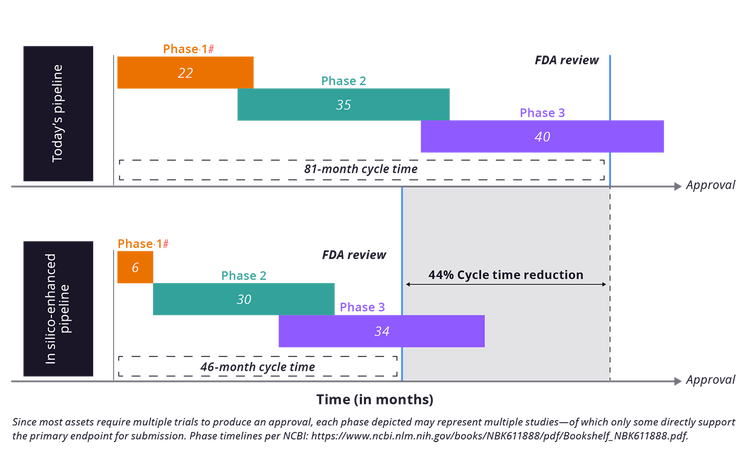
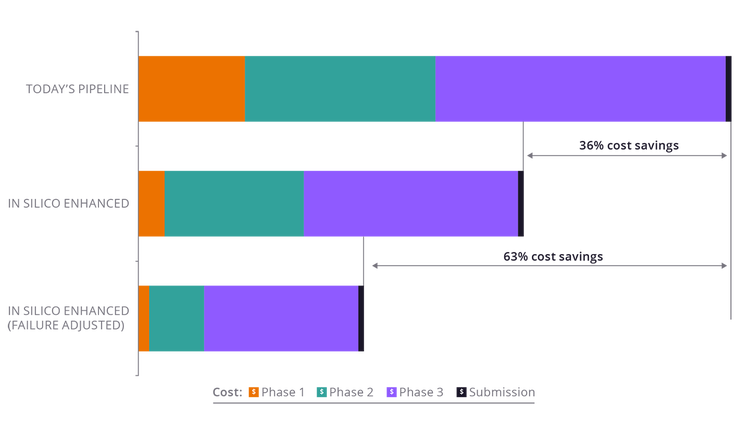
1. Fewer trials per asset. Asset development rarely follows a straight line. Each approved asset typically requires multiple trials to produce an approval. On average we see 1.7 phase 1 studies per approved asset, 1.5 phase 2 studies and 2.7 phase 3 studies. Incorporating in silico methodologies across phases could cut aggregate development costs by as much as 36% per approved asset, even with no change to phase success rates—as shown in the middle row of Figure 3 (below).
2. Fewer failures per success. Failure is the single largest driver of high R&D costs, particularly because the success rate drops sharply between phases 1 and 2—from 60% in phase 1, down to 36% in phase 2 and then up to 66% in phase 3—resulting in an overall success rate of about 12%. As multimodal data and model-informed design become more tightly integrated into development, companies can use simulation to better predict efficacy, refine dose and identify higher-probability assets earlier. This should flatten the traditional “efficacy trough” while raising transition rates across phases.
CASE STUDY:
Pfizer achieved transition rates of 47%>60%>85% across its portfolio through use of its “SOCA” framework, which mandated advanced knowledge of asset exposure at the site of action, asset binding to the pharmacological target and expression of pharmacological activity at site of action before advancing an asset into trials. These criteria can be accurately predicted using current modeling techniques.
FIGURE 2: Improving phase-transition success rates through model-informed development
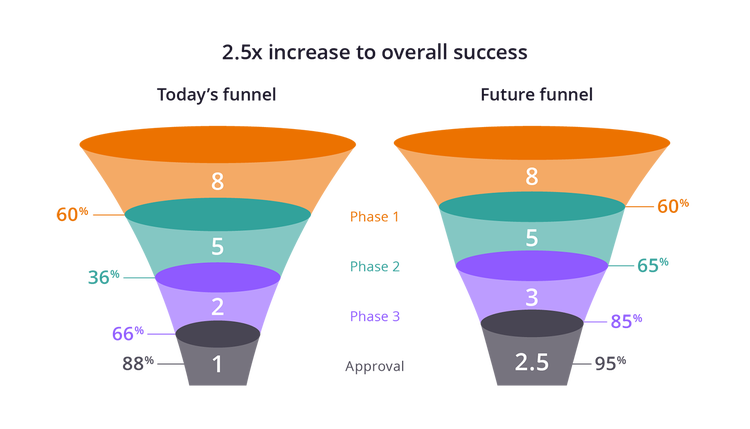
As multimodal data expands and simulation technologies mature, other organizations are likely to not only replicate but also build on Pfizer’s success. We expect this to become increasingly common across the industry—maintaining strong phase 1 safety outcomes while improving phase 2 and 3 success rates through deeper disease understanding and greater asset confidence, effectively narrowing the traditional “efficacy trough.”
In future-state scenarios where simulation-first design, digital twins and model-informed decisions are consistently adopted across the portfolio, we project a future transition-rate benchmark as high as 60% > 65% > 85%. This would translate to roughly a 2.5x increase in overall success and a corresponding 2.5x increase in approved assets using the same resources needed to bring a single asset to market today.
When applied across the full development continuum and portfolio, in silico methodologies have the potential to reduce the cost of development per approved asset by as much as 63%—as shown in the bottom row of Figure 3. This estimate accounts not only for trial-level efficiencies but also for the many failed studies no longer required to reach a single approved asset.
3. Faster progression decisions. Even after data collection ends, months are lost between study phases. On average, these transitions take about 20 months from phase 1-2, 30 months from phase 2-3, and another 30 months from phase 3 to submission. Simulation-based evidence can help shorten these gaps by informing earlier go-versus-no-go calls and supporting conditional regulatory submissions.
CASE STUDY:
With its AZD8233 program, AstraZeneca submitted model-level data from phase 1, helping the company progress to phase 2 six months earlier than it otherwise would have. This represents a 30% reduction in time between trial phases.
As regulators gain confidence in these approaches and apply them beyond phase 1, models could begin to play a surrogate-endpoint-like role. They would offer an early read on an asset’s impact while traditional clinical data is still being generated. We expect this to enable an across-the-board 20% reduction in lag time between study phases. Notably, this does not shorten the actual trial execution time—full trial completion will still be required—but completion may no longer be necessary before submission and approval.
Pairing faster decision-making with the cycle time reductions outlined earlier, ZS’s analysis projects a potential 44% reduction in overall trial cycle time.
Taken together, these effects reveal the compounding potential of in silico R&D: fewer trials, smarter bets and faster, more confident decisions across the entire development continuum.
Bottom line: Efficiencies made possible by running fewer trials per asset, higher phase-transition success rates and faster go/no-go decisions can translate into an as much 63% reduction in development cost per approved asset and a 44% reduction in overall cycle time.
FIGURE 3: Portfolio-level impact of in silico methodologies on development costs
A framework for getting started with in silico clinical trials
To help clinical development organizations capture immediate value from in silico while also laying the groundwork for long-term transformation, we developed the 4R Framework (reduce, refine, replace, repeat) inspired by the seminal 1950s work of W.M.S. Russell and R.L. Burch on the ethical use of animals in research.
Our framework identifies where modeling and simulation can deliver impact today and how those capabilities can scale over time to fundamentally reshape clinical development.
First, lay the foundation for in silico clinical trials
1. Reduce trial participants with external control arms and patient digital twins
Use external control arms to replace all or part of a trial’s control group using historical data and current modeling techniques. This approach can reduce the number of participants needed in the control arm, while preserving statistical rigor—particularly when historical data is high quality and relevant. New modeling techniques for digital twins continue to emerge, including ZS’s ClinicalGAN model. Clinical development teams are already using many of these models to reduce study sample size.
2. Refine trial designs to expand patient pools and shrink recruitment timelines
RWD- and AI-informed protocol design are already informing study design and inclusion and exclusion criteria, enabling more streamlined trial designs. This can dramatically increase patient pools and reduce recruitment- and site-related expenses. Sponsors can now use platforms such as ZS’s Trials.AI for trial design optimization, using data to inform design decisions across the development life cycle.
Then build the capabilities for in silico clinical trials at scale
3. Replace entire trials using existing clinical data and model-informed approaches
In time, we expect in silico methodologies to replace some trials altogether. We’re already seeing this in select use cases, where validated model-informed approaches are being used in place of entire confirmatory trials for new formulations or indications.
CASE STUDY:
Pfizer demonstrated this in bridging the efficacy and safety of the immediate-release tofacitinib formulation to an extended-release formulation for ulcerative colitis. Pharmacokinetic/pharmacodynamic modeling established bioequivalence and supported regulatory approval without the need for new phase 3 efficacy trials in the extended-release population. More recently, GSK used MIDD and quantitative decision making (QDM) to advance a novel investigational therapy straight from phase 1 to phase 3.
For clinical development organizations, the key will be to ensure modeling outputs are well integrated with the overall asset strategy, that expectations for how models will close key evidence gaps is mapped out, and that return on investment expectations are clearly articulated in advance. Operating models will need to evolve to fully apply in silico’s potential to replace trials.
4. Repeat to compound value and accelerate discovery
The impact of in silico methodologies compounds with use. As models are refined and reused across programs, their predictive accuracy, applicability and return on investment increase exponentially. Over time, this value should manifest across three dimensions:
- Exponential model and value improvement. The iterative nature of model-informed approaches means that, over time, predictions become more precise, even as they become more broadly applicable. Each use for trial design, patient selection or endpoint prediction feeds high-quality data back into the system, accelerating learning and optimization.
- Lower marginal cost. Once established, in silico trial infrastructure can be reused across multiple programs, indications and even therapeutic areas. This should significantly reduce marginal costs for subsequent trials. As trial organizations refine modeling platforms, RWD pipelines and analytical tools, the incremental investment required to apply them to subsequent trials and assets shrinks toward zero. This mirrors patterns seen in SaaS, cloud computing and other zero-marginal-cost business models.
- Accelerated clinical discovery. In silico methodologies built on RWD, disease registries and models that integrate multiple data sources can simulate a far broader range of patient responses, treatment conditions and disease trajectories than a single clinical trial can feasibly capture. As these models grow in scope and fidelity, we expect them not only to validate existing hypotheses but also to reveal patterns and correlations that traditional trial designs may miss. By simulating underlying disease pathways, these models can illuminate poorly understood conditions, lessen dependence on late-stage outcomes (such as mortality or hospitalization) and support faster, more adaptive decision-making.
Transform your clinical development with a partner with deep in silico experience
Real-world precedents increasingly support the case for in silico development, even if its most ambitious applications remain theoretical. As modeling fidelity, real-world data availability and regulatory confidence grow, organizations that begin building capability today will be best positioned to lead the next era of clinical development.
ZS partners with R&D and clinical teams to help identify high-value use cases, assess readiness and design pragmatic roadmaps for scaling in silico approaches. To explore where to start, connect with a ZS clinical development or digital R&D expert.
The authors would like to thank Sam Dowd and Jiren Wang for their invaluable behind-the-scenes contributions to this piece.