The human factor behind successful agentic AI adoption
Where generative AI asked people to learn new tools, agentic AI asks them to build new relationships with intelligent digital teammates that act on their own. Unlike prompt-based systems, agentic AI can initiate tasks, make recommendations and coordinate behind the scenes, often without direct human input. Yet there are key moments when these agents and humans meet, when outputs are reviewed, decisions are validated or actions are approved. This interaction point between humans and “on-stage” agents reveals a critical new challenge—not building AI, but helping people work alongside it.
A recent MIT study found that despite $30-40 billion in enterprise spending, 95% of organizations saw little or no measurable return on their generative AI investments. That shortfall foreshadows the challenge now facing agentic AI. If organizations struggled to capture value when humans were fully in control, those barriers will only deepen as AI begins to act autonomously. Technology is advancing faster than the human systems built to absorb it, making strong adoption support essential to helping organizations realize value from agentic AI.
Why agentic AI adoption is a human problem
Behind these organizational struggles lie the human factors that ultimately determine success. Beneath the surface, employees face three deeply felt barriers to agentic AI adoption: uncertainty about how to navigate trust in autonomous systems, fatigue from continuous oversight and a sense of identity disruption as AI becomes a semiautonomous partner. Until leaders address these psychological and behavioral friction points directly, even the best agentic AI investments will struggle to take root:
- Trust navigation: As AI becomes more human-like in its roles, trust is no longer just about functionality—it’s multidimensional. Building the skill to navigate when, how and why to trust AI is essential to effective collaboration and delegation.
- Oversight and collaboration overload: Continuous supervision and collaboration with constantly evolving live systems, often spanning multiple use cases, can create overload and fatigue, overwhelming people’s ability to focus and adapt.
- Identity disruption: As AI assumes more autonomous roles, people are challenged to redefine the value and meaning of their own contributions.
Let’s look at each challenge and how organizations can enable confident, human-centered adoption.
Learning to navigate trust with agentic AI systems
Consider a field sales representative adopting an autonomous sales support agent, designed to schedule client meetings, draft follow-ups and recommend next steps. At first, the rep reviews every suggestion carefully, double checking the AI’s decisions. When the system sends generic or mistimed messages, the rep’s trust erodes. Even after the technical issues are fixed and output improves, confidence and adoption may not recover.
The nature of trust in agentic AI is fundamentally different from that of earlier technologies. Traditional systems fostered a “fixing” mindset. When something went wrong, users assumed the tool was broken and needed correction. Agentic AI, by contrast, calls for a shift toward leadership: when the system errs, the human’s role is not merely to judge or repair it, but to guide and develop it as a capable yet still-learning partner.
Building this kind of trust depends on three things: the human’s ability to adopt a leadermindset that actively guides and improves the AI’s performance, the system’s ability to act predictably to build functional trust and its ability to act transparently to deepen cognitive trust.
What works
- Cultivate a leader mindset to guide trust navigation, one where users see themselves as responsible for guiding and improving the AI’s performance. Encourage people to take an active role through structured feedback loops, user-led review sessions and transparent correction processes that show how their input shapes system behavior. Provide simple tools or interfaces that let users rate, revise and annotate AI outputs, turning everyday interactions into opportunities to teach and refine the system. When users see their guidance directly influencing outcomes, trust shifts from passive reliance to a confident, accountable partnership.
- Build functional reliability from the start by focusing on predictable, consistent performance in real work scenarios.Begin with a single high-value use case that delivers clear, relevant results, allowing users to see the agent reliably support core tasks. Create a controlled, low-pressure environment where people can experiment, observe patterns and develop confidence in the system’s behavior before expanding to broader applications, just like one might focus, then grow, the scope of responsibility for a junior teammate.
- Build cognitive trust by helping users understand how the AI thinks, making its reasoning visible, traceable and easy to interpret. Equip users with basic data literacy and create transparent feedback loops that reveal how and why the system acts. For example, show the sales rep which data points, like past meeting frequency or client sentiment, inform a suggested next step. When people can trace recommendations to familiar inputs, the AI feels transparent, teachable and open to guidance.
Ultimately, success lies in helping people find the balance between trust and leadership, knowing when to rely on the AI’s initiative and when to step in, coach and steer its learning toward better performance.
Managing oversight and collaboration overload
Consider how a clinical trial manager might oversee a study supported by several agentic AI systems—one assisting with protocol version tracking, another monitoring site performance metrics and others drafting summaries or notifications for review. These systems operate semiautonomously, surfacing recommendations, alerts and draft outputs for the manager’s approval. While this promises efficiency, it also introduces a new layer of oversight. The manager must continually review updates, validate AI-generated content and respond to flagged issues. Instead of reducing operational burden, the steady stream of autonomous activity can heighten the cognitive load and create supervision fatigue, adding complexity to an already rigorous process.
This phenomenon, oversight and collaboration overload, is becoming widespread. Agentic AI introduces constant decision checkpoints, alerts and opportunities for intervention. Research confirms that where large enterprises lead in pilot count, their success rates are far lower than midmarket peers because internal users struggle with fragmented workflows and constant relearning.
What works
Combat overload by reducing unnecessary friction and supporting behavioral consistency:
- Reimagine future workflows to align with human behavior and efficiency in an agentic AI environment. Rather than layering AI into legacy system dashboards, start with a zero-based redesign built around where humans and AI interact.In a traditional setup, our clinical trial manager may toggle between multiple dashboards, validating updates and responding to issues as they arise. In an AI - firstworkflow, those systems feed into an agentic interface that can act in a responsive way to organize outputs by priority and context. The manager engages with the AI directly—approving updates, validating insights or addressing exceptions—reducing noise while maintaining control. This shift means resisting the instinct to simply “make our dashboards smarter with AI.” Doing so risks layering complexity on to outdated processes and leaving value on the table, when in fact, the most efficient future workflow may not involve a dashboard at all.
- Organize rollouts around stakeholder personas—not tools. Deployments designed by function or capability often feel fragmented. A persona-centered approach, mapping how agentic AI solutions touch daily tasks and pain points, creates cohesion in the change experience and reduces friction. For our clinical trial manager, training should reflect an integrated view of how multiple agentic AI systems intersect in daily work—drafting protocols, generating patient communications and updating reports—so learning mirrors the real flow of work.
- Make learning part of the job. Don’t just permit experimentation; protect time for it. For example, schedule time for short, recurring “AI rehearsal” sessions where team test autonomy settings, share missteps and exchange quick wins. Encourage team leads to participate to signal that learning and adaptation are expected. These microhabits turn exploration into muscle memory. Another way to embed this learning is by integrating forward-deployed engineers directly into business teams. Working alongside end users, they help advance AI capabilities in real time while supporting adoption, experimentation and shared learning within the team.
- Emphasize repetition and habit-building. Encourage consistent, low‑effort daily uses of agentic AI that build familiarity and confidence over time. These small, repeatable actions, like approving an agent’s suggested site update or verifying an automatically generated patient message, turn supervision into a familiar rhythm instead of a sporadic high-effort task.
- Reinforce progress early and visibly. Track and celebrate small wins, such as when the AI autonomously completes a documentation update or flags a potential compliance risk before human review. Sharing these successes reinforces confidence and reduces anxiety in the oversight role.
Without careful design, autonomy can shift work from doing to monitoring, creating a new kind of fatigue for the humans in the system.
Redefining identity and purpose in human-AI work
Consider an analytics team member who has built their reputation on deep data exploration and nuanced interpretation. As agentic AI systems begin to analyze datasets, generate insights and even refine reports autonomously, this person may feel their expertise and judgment are being overshadowed. Even when the AI’s conclusions are accurate, the analyst hesitates to engage, worried their professional value is being reduced to something any system can replicate.
As AI takes on judgment-driven tasks once considered human territory, employees may fear not just job loss but loss of purpose and recognition. In one report, 67% of employees said they expect AI to make their work more efficient, but nearly as many worry it will erode their unique value. That duality captures the identity tension now emerging as AI acts more autonomously.
This fear is seldom voiced directly. It leaks out instead as hesitation, detachment, quiet refusal to engage or a joke with nervous laughter that’s a little too true. The analytics team member may resist agentic AI analysis not because it’s inaccurate, but because it feels like a shortcut that undermines hard-won credibility. To make matters worse, there’s now evidence that using AI can carry a social evaluation penalty, where people may be judged as less competent or less deserving of credit when their work involves AI, even if the quality is the same.
What works
Plan for sufficient time and support to help employees navigate identity disruption and evolve their roles in positive partnership with AI:
- Combine intentional framing of the user-AI partnership with deliberate role evolution. For the analytics team member above, this means treating the AI as a junior analytical teammate that autonomously surfaces trends, identifies anomalies and drafts insights, while the human acts in a leadership role, interpreting nuance, challenging assumptions and ensuring relevance. Design workflows and checkpoints where people validate and refine AI actions, especially in sensitive or high-impact scenarios, so accountability, ownership and credit remain human-centered.
- Provide targeted learning support for new high-value skills. As agentic AI automates more analytical and process-driven work, organizations should reinvest that time into higher-value capabilities such as strategic thinking, contextual interpretation and creative problem solving. For example, the analytics professional who once focused on building models or dashboards must now strengthen skills in framing the right questions, evaluating AI insights and connecting data to business strategy. These new capabilities can feel abstract or intimidating—like learning to use a muscle they’ve never needed before—so leaders should provide clarity on how roles are evolving and offer hands-on learning that develops judgment, collaboration and ethical reasoning.
- Track signs of agentic AI readiness with a behavioral-emotional index. Create an “agentic AI readiness index” to track how employees are adapting emotionally and behaviorally—not just how much they’re adopting. Measure confidence in delegating, supervising and co-creating with agentic systems and watch for the shift from avoidance (“this system threatens my expertise”) to agency (“this system extends my capability”). This helps leaders detect lingering identity tension, tailor support to rebuild confidence and ensure employees see their expertise as critical to guiding AI, not displaced by it.
When people feel their value is respected and evolving, not replaced, they engage more willingly.
Human-centric AI adoption is the differentiator
Most AI initiatives fail not because the technology underperforms, but because human enablement lags behind autonomy. To succeed, organizations must treat agentic AI adoption as a behavioral evolution. Adoption hinges on three keys to success:
- Build two-way trust: Create AI systems that behave predictably, transparently and in alignment with human goals while helping people develop the judgment to trust, verify and lead them as capable but still-learning teammates.
- Make oversight human-friendly: Redesign workflows around how people naturally work, think and decide—simplifying interactions, protecting focus and ensuring humans stay in control of outcomes, not buried in supervision.
- Reinforce evolving identity and leadership: Help employees see AI not as a replacement but as a capable teammate to lead and develop—reinforcing pride, purpose and the uniquely human judgment that elevates AI performance.
Because in the end, success with agentic AI isn’t just about what AI can do. It’s about what people feel empowered to do with it and through it*.*
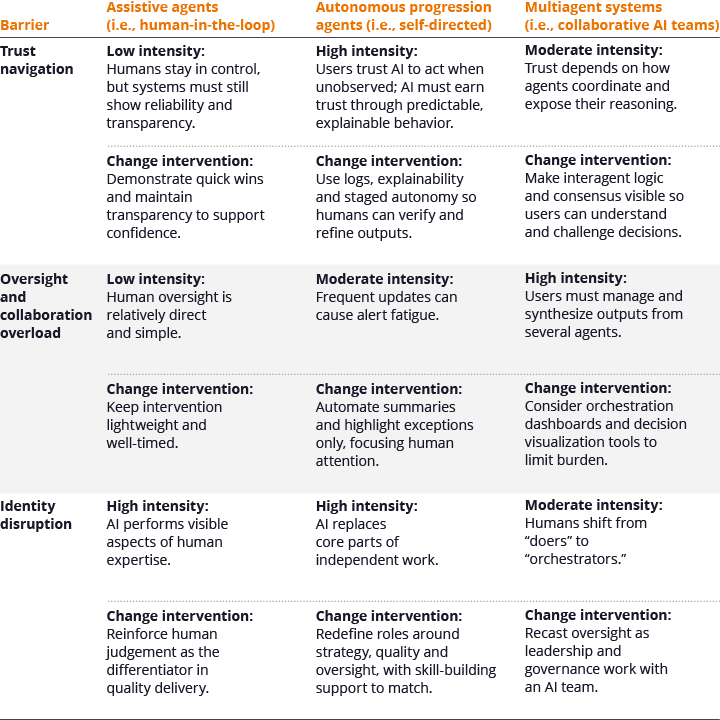
Considerations for different forms of agentic AI

Across these types, the change support considerations—such as trust, role clarity and perceived control—spike in unique ways depending on how directly the AI reshapes human behavior and workflows.
FIGURE: Change support considerations for agentic AI
Want to keep reading? Learn about how the ZS change enablement approach leverages behavioral science to make change sticky by design.
Related insights
zs:topic/ai-and-analytics,zs:topic/strategy-and-transformation