Why mission-based execution is the next life sciences supply chain operating model
Vikas Hegde and Daniel Yang coauthored this article.
Key takeaways:
- Build a life sciences supply chain operating model around clear missions. Teams see operational risk sooner, and leaders can act before impact crosses functions.
- Apply a mission-based execution model at the seams between functions, where the impact of operational risks compounds. Agents gather facts earlier, and humans make the governed call.
- Fix regulated manufacturing decision workflows by addressing the root causes at those seams—unclear roles and responsibilities and coordination that relies on informal tools such as spreadsheets and calls.
A batch completes manufacturing and enters the release corridor. Before it can move, teams may spend days gathering evidence, reconciling hold signals and confirming whether the batch can be released. The process is documented and the systems work, but the evidence-to-decision work remains manual, fragile and slow. The same drag shows up in steady-state work, from every planning cycle to every batch moving to disposition, and compounds when supply tightens, a complaint escalates or a disruption forces a new schedule. Either way, leaders get less time to act as issues emerge, making it harder to protect supply commitments before impact spreads.
A mission-based operating model helps life sciences supply chains close that gap by organizing execution around bounded, repeatable units of work that agents can support and humans oversee. Some missions sit within a function. Others create disproportionate value where work crosses boundaries and decisions carry risk.
How missions and agent teams speed regulated supply chain decisions
The operating model organizes execution into missions: bounded units of work with clear triggers, defined outcomes and explicit human decision rights. Processes define the intended flow, but missions make the work executable, measurable and governable. Some missions matter most at the seams between functions, where coordination, judgment and governance carry the most weight. A completed batch, planning cycle or disruption can trigger a mission. What matters is not whether the trigger is routine or exceptional, but whether the work requires evidence, judgment and governed decision-making. From there, the work centers on getting the right evidence to the right decision-maker quickly enough to act. Agents create value by improving the preparation that happens before the decision—assembling evidence, surfacing trade-offs and reducing reliance on manual coordination—and, within the boundaries the mission sets, by taking routine action rather than only preparing it.
In life sciences operations, the execution burden concentrates across four familiar value streams: plan-to-deliver, supply-to-make, make-to-release and complaint-to-close. Each runs on missions that recur on a cadence, from every plan to every batch to every release, and each mission also absorbs the exceptions that arrive against that cadence. In both cases, work slows for the same reason: Evidence, ownership and decisions must move across functions and through seams where ownership becomes unclear. The value streams are familiar. The opportunity is to make mission-level execution explicit and deliberate as the way steady-state work runs, not as a layer that activates only when something breaks. For example, missions may include the following.
- Demand-supply reconciliation and allocation conflict resolution in plan-to-deliver
- Incoming material disposition and critical material supply exception management in supply-to-make
- Batch release readiness and deviation triage in make-to-release
- Complaint intake, triage and recall assessment in complaint-to-close
The operating model does not replace systems of record. Enterprise resource planning, manufacturing execution, laboratory information management, quality management, warehouse management and regulatory systems remain authoritative for the data and transactions they govern. The mission-oriented execution layer sits above them, assembling context, detecting triggers, tracking case progression, routing work and preparing decisions for accountable humans. Above that sits the human governance layer, where review, adjudication, disposition, approval and sign-off remain explicit.
Why the highest-stakes missions sit at the seams
The missions that matter most often cross functions, and that is where friction concentrates. Most crossings are routine: a release moves through disposition, a plan rebalances against new demand and a step clears conformance. The same crossings also carry the worst exceptions. A material shortfall can idle production, a release slip can break a commercial commitment and a quality signal can pull planning, manufacturing, procurement and quality assurance into one decision chain. Whether the trigger is cadence or exception, coordination runs through the same seams, and today the signal often surfaces late through manual escalation. A mission-based operating model makes the impact visible closer to its origin, while leaders still have time to respond.
Take the path from schedule to release. It looks like one job: Turn the master supply plan into a schedule and run it to a released batch. In practice, the work spans several missions, and the hard part sits in the handoffs between them. Production scheduling commits the schedule and rebalances it as conditions change. In-process conformance confirms each step held and resolves excursions. Batch release readiness assembles the disposition package and works deviations to a recommendation. Each is a distinct mission with its own trigger, outcome and decision rights, and a mission-based operating model puts an agent team inside each one to prepare evidence, hold context across the seam and signal downstream impact early. The accountable human still decides at the boundary: The scheduler commits the schedule, manufacturing dispositions the step and quality releases the batch.
FIGURE: From schedule to release, missions make signals visible earlier while humans decide at every boundary
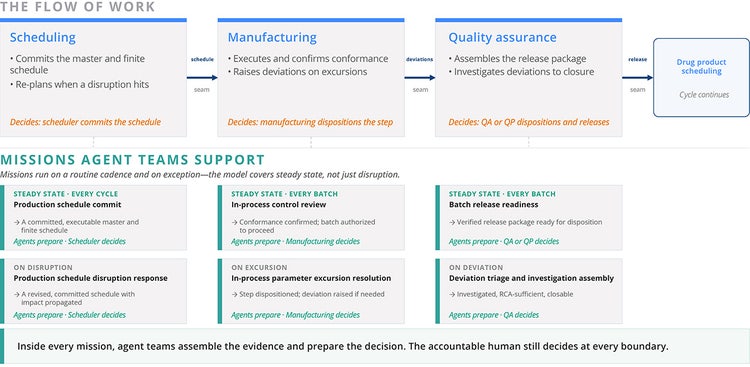
The value shows up in the handoffs, where signals are most often delayed or lost. When a mission detects a risk—a schedule slip, an in-process excursion, a release that will miss its date—the agent team routes it straight to the owner who can act on it, whether that is procurement, the next plant or the release owner, instead of leaving it to surface in an escalation call after the impact is already visible.
That structure matters most in regulated work, where speed only creates value when accountability remains clear.
Keep agents bounded and humans accountable
In regulated life sciences work, agents can only help when their boundaries are clear. Leaders need to know what agents can prepare, what humans must judge and how each decision will be governed. Missions create that context before the work begins by defining the trigger, outcome and decision rights.
A deviation triage mission requires quality assurance review of every agent-assembled evidence packet before any disposition recommendation is surfaced. A demand exception triage mission might operate with an agent team preparing recommendations that a planner reviews and approves. In lower-risk missions with prequalified parameters, such as approved alternative suppliers, agreed schedule flex ranges and established retest triggers, agents can execute within those boundaries without waiting for human approval on each action. The governance question is how much autonomy the mission’s risk profile permits.
Bounded autonomy is not a static design. Each mission generates evidence about where its agents helped, where they missed and where human review caught what the agent did not. That evidence becomes the basis for tightening or loosening the boundary over time.
The future is unlikely to be fully autonomous. It’s more likely to be agent-supported, human accountable and governed in proportion to the risk of each mission.
Redesign the work, not the org chart
The functional model exists for sound reasons. It concentrates domain expertise, preserves regulatory and quality accountability and aligns with how regulated organizations operate. Leaders can keep the functional structure in place while redesigning how work moves within and across functions and building the skills teams need to support that work.
The most important missions need explicit ownership, typically from a named leader in the function accountable for the mission’s outcome. That owner governs how the workflow operates, how the supporting agent team is configured and how performance is measured. Functional owners retain their decision rights. Quality assurance still makes disposition decisions, planning still commits the schedule and procurement still manages the supplier. The work that prepares those decisions becomes more deliberately designed, orchestrated and measured. This approach strengthens the connective tissue between functions and improves the execution quality within them.
Start where the execution burden is highest
Leaders should start by identifying the missions with the highest execution burden and redesigning them deliberately. A practical filter is to look for missions where cycle time varies most across sites, products or teams. That variance usually signals execution built on local heroics rather than a repeatable model. Then prioritize the missions where a stall creates the most downstream disruption. Those are the places where earlier detection and faster resolution carry the highest operational leverage.
In life sciences, the missions that score highest on both filters often include batch release readiness, critical material supply exception management and complaint intake and triage. These missions are large enough to affect product availability, commercial commitments and compliance risk, but bounded enough to redesign.
War rooms and email chains will not disappear overnight. But every mission that moves from improvised coordination at the seams between functions to structured, agent-supported execution reduces dependence on local heroics. Leaders can keep relying on the right person being available at the right moment, or they can build a governed execution model they can measure, improve and scale for more reliable supply performance.
zs:topic/supply-chain-and-manufacturing,zs:topic/strategy-and-transformation