Designing AI-native operating models for pharma and life sciences
What to do when AI demands a new operating model
Nearly every organization in the world is built on the same assumption: people do the work.
That assumption has shaped everything from hierarchies and reporting structures to decision rights and operating models.
Now, for the first time, that assumption is no longer completely true. Intelligent agents don’t just help people work. They become participants in the work itself.
If you want to know whether your operating model is ready for this shift, look at the team leading your most important AI initiative. When no one owns the business outcome, no one owns the agentic backlog tied to that outcome and no one owns how work should be redesigned around it, the technology is being deployed onto an organization built for a different era.
That’s a sign the operating model itself—not just the technology—needs to be rethought. This notion is challenging leaders’ organizational playbooks, particularly where hierarchy slows action, coordination depends on people and every handoff strips away context.
So, if agents change how work gets done, how should the operating model change with them?
From our work with organizations navigating this transition toward an intelligent enterprise, three design principles consistently emerge.
First, understand why AI-native organizations operate differently from human-centric ones. Second, organize transformation around how value is created, rather than isolated use cases. Third, prove new ways of working before reshaping the organization, not the other way around.
Together, these principles help leaders move beyond deploying AI to designing an operating model that can sustain its value.
1. Understand why AI-native organizations operate differently from human-centric ones
The strongest argument to use agents only makes sense if you unpack why human-era assumptions break. If you don’t, if you treat agents as faster spreadsheets, you’ll reach very different conclusions.
The properties of agentic systems change fundamental assumptions for how organizations are built, for example:
Agents share state; humans hold meetings. Two people on adjacent decisions coordinate through documents and status calls, an inherently slow, context-losing process. Two agents in the same context layer know what the other did the instant it happens. Coordination stops being an organizational problem solved with handoffs and RACIs and becomes an infrastructure problem solved with shared context.
Agents act; earlier AI only informed. In earlier AI, co-pilots and dashboards could produce outputs a human could act on. Agents can execute those actions themselves: scheduling a call, filing a submission or launching a campaign. With agents, the human’s role shifts from doing the work to designing, supervising and intervening when judgment is required.
Agents can be rebuilt in minutes; human organizations, much longer. When a process changes in an agentic organization, you update the agent. When work changes for people in a human-only organization, leaders must invest in new skills, redefine roles and support adoption. The speed of technology now outpaces the speed of organizational change.
Agents take feedback, not coaching. Correcting an agent is one intervention that updates the instruction set immediately, so the cycle of improvement collapses from quarters to minutes and management shifts from coaching people to tuning systems.
Agents rely less on hierarchy. In traditional organizations, management layers exist to align people, communicate priorities and move decisions through the business. As intelligent systems increasingly share context and execute independently, organizations can streamline those coordination layers and shift leaders’ focus from directing work to governing outcomes.
Why this matters
The common thread is simple: coordination with agentic systems becomes dramatically cheaper.
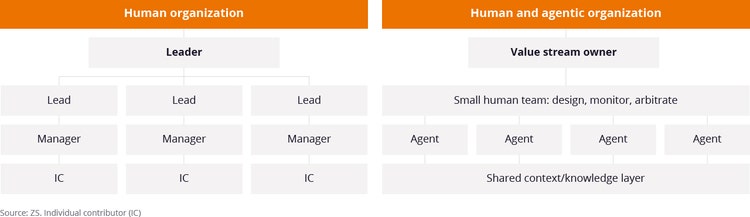
Organizations have historically relied on hierarchy, functional boundaries and management layers to coordinate people at scale. Yet as intelligent systems share context and execute work in parallel, historical structures start to have thinner layers (see Figure 1).
Three assumptions change when layers thin:
- Span of control loosens, because a person can oversee only so many people, but an AI product manager can direct orders of magnitude more agents. Leaders can increasingly compete on span of value rather than span of control.
- Functional boundaries blur, because handoffs that are expensive across human teams are nearly free across agents.
- Hierarchy compresses, because the layers that exist to translate strategy into execution have less to do when context is shared and execution is parallel.
FIGURE 1: When agents share context, human layers thin
Signs are emerging that organizations are already changing
Today, intelligent systems still perform only a small share of enterprise work. That share will climb, and the organizational assumptions above will start bending early, long before agents carry more of the work.
Two recent examples show how the old model is giving way to the new one:
- One global pharmaceutical company began, in 2025, to reorganize around three mission-based axes, with cross-functional brand squads owning end-to-end missions rather than functional slices.
- Separately, a Fortune 500 life sciences company has launched a restructuring into roughly 70 self‑directed customer squads, with internal targets on the order of €2 billion in savings and the removal of around 12,000 management roles. The effort remains underway, and the savings and role reductions are targets, not confirmed outcomes, but the direction is clear: large organizations are beginning to test flatter, more customer-centered structures.
These examples are notable because they reflect a broader recognition that traditional functional structures are becoming less effective. They suggest that the organizational changes required to realize the full value of agentic AI may already be taking shape.
After you understand why AI-native organizations operate differently from human-centric ones, the next question is where to apply that insight. That answer is in where better coordination can create measurable business value.
2. Organize small operating teams around value streams rather than isolated use cases
Most enterprise AI investment is organized around the wrong unit. The fault is not that any one structure is wrong on its own. It is that all of them organize around the use case or the platform rather than the value stream: the end-to-end sequence of value-creating decisions that produces a measurable business outcome, supported by the workflows that carry them out.
Examples of value streams in pharma include brand planning, payer contracting, medical-information response and field deployment. A value stream has P&L impact, clear inputs and outputs and a definable end state. It is the smallest unit of which AI investment can be governed, measured and held accountable.
Start where the organization is ready
The pull on where to start an AI-led transformation is almost always toward the most visible workflow: the forecast review everyone complains about, the omnichannel orchestration that has been on the roadmap for three years. The right answer, however, is rarely the most visible. It’s the most ready.
Three signals reveal readiness:
- Decision density: Does the work involve many recurring decisions rather than a handful each year?
- Measurement clarity: How clearly can you measure the outcome to improve?
- Human appetite: Is the team asking for help rather than being told to accept it?
When all three are present, you’ve found a strong place to begin. When only one exists, the technology may succeed, but the transformation likely won’t because the conditions for lasting adoption aren’t there.
Build the roles for success
Anchoring to a value stream means standing up a small operating team around it, and the jobs to be done are specific. These roles only emerge when the organization is ready to commit to the value stream; it’s not a full-scale reorganization and these roles can exist alongside existing roles.
Five roles carry the work:
- Value stream owner. P&L-accountable for the value stream, owning the AI investment and the trade-offs as a first-class part of the role, not AI bolted onto an existing leader’s day job.
- AI product manager. Owns the agentic backlog and sequences transformational and incremental builds against business value, paired with a senior practitioner who carries the business logic.
- Forward-deployed engineers (FDEs or, often, just AI engineers). Techno-functional builders embedded in the business rather than sitting in a distant platform team. Junior friendly by design: six months of agentic build experience is enough at entry, with depth coming from proximity to the work.
- System health lead. Owns validation and evaluation as a capability built into how the system runs, not a person checking outputs one by one. Manual checking is a transitional state that invites automation bias and burns people out, so it gives way to automated evaluation, drift monitoring and regression testing the system runs continuously. The human keeps that capability healthy, sets the criteria and steps in when the system flags something, paired with an engineer who builds the checks.
- Human systems lead. Owns trust, adoption and reskilling, upstream of traditional change management. Change management sells a finished transformation; this role helps design it, partnering with the AI project manager on how work is reshaped and where displacement happens.
Design the decision rights, not just the roles
Defining the team is only half the job. The more important question is who has the authority to make each decision.
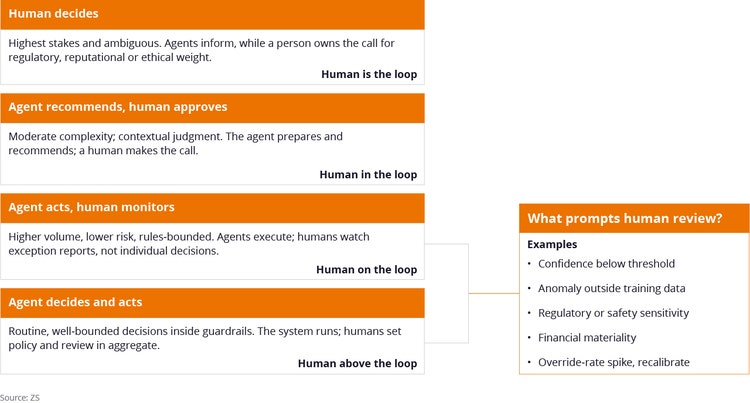
Each role should own clear outcomes, but leaders also need to decide which decisions the AI can make independently, which require human review and which always remain with people. As the risk or business impact of a decision increases, the level of human oversight should increase as well.
These decision rights shape everything that follows, from governance and workflows to the operating model itself. In practice, they often become the biggest bottleneck. Building capable AI systems is increasingly achievable. The harder challenge is determining where leaders are willing to delegate decisions to AI and where they are not (see Figure 2).
FIGURE 2: Decision rights for different levels of agentic systems
It’s one transformation, using three lanes
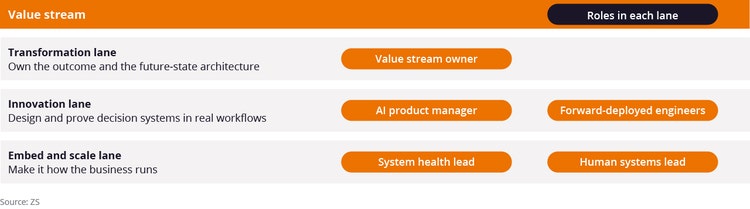
Ultimately, the path toward an AI-native operating model depends on three kinds of work: redesigning the business, building new AI capabilities and embedding them into day-to-day operations (see Figure 3). Each of the five roles is incentivized and rewarded to drive transformation in different ways.
- The value stream owner leads transformation.
- The AI product manager and forward-deployed engineers drive innovation.
- The system health lead and human systems lead embed and scale the capability into everyday operations.
These lanes move simultaneously but at different speeds. The challenge isn’t accelerating one lane. It’s keeping all three moving together so innovation never outpaces the organization’s ability to absorb change.
FIGURE 3: One transformation, different lanes
What this looks like in practice
The shape is easier to see in a single moment. Consider a mature brand with a prescribing drop-off in a key region.
In today’s model, the sequence is serial and slow. The field flags softness. Someone asks analytics to look into it. A study is scoped, a deck is built, weeks pass, and a recommendation arrives at a leadership meeting where the problem is described for the first time, long after the window to act cleanly has narrowed.
In the value-stream model, the senior brand leader and the analytics lead see the same drop-off signal at the same instant, surfaced by the system. The relevant agents have already explored the data, run the scenarios, and surfaced candidate actions with confidence scores. The meeting is no longer about discovering the problem; that has already happened between agents. It is about resolution: judgment, trade-offs and sign-off on an action the system has prepared. The leader’s role shifts from approving a months-old answer to exercising judgment on a live one, and the relationship with the team shifts from “why didn’t you catch this” to “we both see it, how do we solve it.”
That is the difference the operating model makes. The agents are necessary but not sufficient; the value shows up only when the roles, the decision rights and the meeting itself have been redesigned around what the agents now do.
Once a value stream proves that people and agents can create better outcomes together, the next question is how far and how fast the organization should change around it.
Prove success before disrupting the organizational structure
The core idea here is to be clear about the destination, then be patient about how fast you get there. Change how work flows first. Let the structure follow when the evidence is clear and the new model has consistently created value.
The destination is not a better version of today’s organization, but rather a different operating model altogether. As agents carry more of the work, the management layer becomes smaller because their role changes. Leaders shift from coordinating work to setting direction, making decisions and managing trade-offs across far broader parts of the business. In this model, span of value replaces span of control as the defining measure of leadership.
Earn the right to reorganize
Reorganizing a business is disruptive, and leaders are right to protect accountability for the P&L until a new way of working has consistently proven itself. Only then does it make sense to redesign reporting lines or organizational structures.
That’s why most organizations will spend several years in an interim state. The operating model should change before the organization. During this time, business unit leaders should continue to own the P&L while AI, analytics and platform teams help redesign how work gets done.
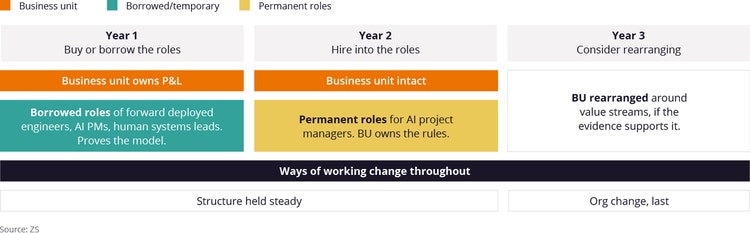
In practice, that usually begins with business leaders asking analytics and capability teams to deliver more, faster against priority value streams. That’s the right place to start because it changes how work flows without requiring the business to reorganize. The risk is staying there by treating AI capability as a service to consume rather than a chance to shift the operating model. The progression below is designed to keep the transformation moving (see Figure 4).
For some organizations, that transition may happen in three years. For others, it may take much longer, depending on how much organizational risk leaders are willing to take and how quickly they’re prepared to redistribute decision rights.
Technology can enable the change, but leadership decides when the organization is ready for it.
A practical progression looks like this:
Year 1, change how work flows. Stand up the value-stream operating team with borrowed or contracted talent—forward-deployed engineers, an AI product manager, a human systems lead—working alongside the existing business unit (BU). The BU keeps its structure and its P&L; what changes is how the work flows. The challenge is staying focused. Prove the model on one or two ready value streams, not 10. What triggers the move to Year 2 is that the borrowed team has shipped something into production the business actually uses, and a leader can point to an outcome that got better because of it.
Year 2, institutionalize roles and career tracks. Convert the borrowed capability into permanent positions. Manual validation gives way to an automated evaluation capability owned by a system health lead, engineers deepen into domain expertise through pairing, and the AI product manager becomes a real career line rather than a contracted function. The constraint here is talent. These roles barely exist in the market, so you build them from people you already have. Engineers who pair with experienced leads pick up the domain faster than outside hires learn the business, which makes growing the talent more reliable than buying it. What triggers the move to Year 3 is that a second and third value stream adopt the model without a matching rise in headcount, and the existing structure becomes a visible drag on progress.
Year 3, consider structural alignment. Only once the roles exist and the model has demonstrated compounding value does structural rearrangement become a live option: repositioning leaders into value stream owner roles, compressing the layers that no longer earn their place. The challenge shifts from technology to politics. This is the step that moves reporting lines and touches status, so it needs executive conviction and air cover, not just evidence. It is a choice to make when the case is overwhelming, and many business units will move toward it cautiously, on their own timeline.
FIGURE 4: Change ways of work and roles before structure
The value comes from changing how work gets done
A competitive edge was never going to come from the agents. It will come from an operating model that combines human ingenuity with technology.
Every organization will have access to intelligent agents. Far fewer will redesign how work flows, how decisions are made and how accountability is shared between people and intelligent systems. That work takes more than deploying technology, which is exactly why it becomes the source of advantage.
If you’re beginning that journey, let’s connect on how ZS helps organizations design their own AI-native operating models.
Related insights
zs:topic/ai-and-analytics,zs:topic/strategy-and-transformation