Most health plans measure payment integrity savings—few measure the value they keep
Payment integrity: How health plans can keep more value
Joji Thumma and Soumajeet Roy contributed to this article.
For decades, health plans have optimized payment integrity (PI) to maximize recoveries. The harder question now is whether some of those savings still make economic sense to buy.
Many plans have limited visibility into the true economics of their PI ecosystem, including vendor fees, duplicate savings attribution, operational cost shifting and the long-term strategic implications of outsourcing core capabilities. At the same time, advances in cloud platforms, enterprise data environments, AI and analytics have changed what health plans can achieve internally.
The decision is no longer simply how to generate more recoveries. Health plans also need to determine which savings are worth buying, which capabilities are worth owning and how to measure the difference.
For a health plan with $10 billion in annual medical spend, even a 0.5%-1.0% improvement in payment accuracy can represent $50 million-$100 million in annual value.
Most PI strategies begin with a familiar question. How much additional savings can we identify?
Increasingly, leading organizations are asking broader questions:
- How much value do we actually retain after fees, cost shifting and ecosystem inefficiencies?
- Which capabilities should we continue to outsource versus own?
- How has AI changed the economics of PI?
These questions form the foundation of a new approach focused on maximizing net PI value (NPIV).
3 shifts are changing the economics of PI
Signal 1: Provider sophistication is accelerating
Provider reimbursement rates have risen materially over the last decade as providers increasingly invest in AI-enabled revenue cycle tools, coding optimization technologies and workflow automation to maximize reimbursement and accelerate collections. Recent analysis conducted by Blues Health Intelligence (BHI) identified a subset of providers exhibiting materially higher coding intensity growth than peers despite limited observable changes in patient mix or service mix. Across a subset of Blue Cross Blue Shield companies representing 62 million members, BHI’s analysis identified a 9% increase per member in inpatient costs from 2023 to 2024 estimating that ~20% of that increase is attributable to rising coding intensity. The analysis further demonstrated that these patterns could be traced to specific providers, encounter types and coding behaviors.
While coding optimization is not inherently inappropriate, the growing sophistication of provider reimbursement strategies reinforces the importance of modern PI capabilities. For health plans, the challenge is no longer simply detecting historical payment errors. It is developing the analytical, operational and technological capabilities necessary to keep pace with increasingly sophisticated reimbursement practices.
Signal 2: PI vendor spending has become material
Historically, health plans relied heavily on specialized PI vendors. The rationale was compelling. Vendors possessed proprietary rules, specialized expertise and technology capabilities that were difficult and costly for plans to develop independently. Many delivered meaningful recoveries and generated attractive returns.
Over time, however, most PI ecosystems expanded significantly. Health plans frequently added vendors to address new claim types, payment methodologies, coding scenarios and recovery opportunities. As these ecosystems grew, new challenges emerged:
- Contingency fees consuming a significant portion of realized savings
- Overlapping vendor capabilities and redundant reviews
- Duplicate attribution of recoveries across multiple vendors
- Increasing administrative burden to manage and reconcile results
- Limited transparency into underlying methodologies and performance drivers
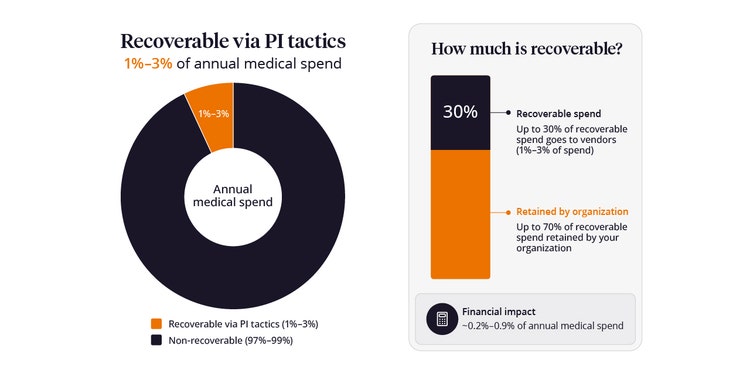
For a large national health plan, the cost of operating a full PI vendor ecosystem spanning pre-pay, post-pay, clinical validation, coding review and recovery services can plausibly reach into the hundreds of millions of dollars annually. The fee-bearing portion of a PI program alone implies vendor spend equal to roughly 0.20%-0.90% of total medical spend. For a plan managing tens to hundreds of billions of dollars in annual medical spend, PI savings can reach 1%-3% of medical spend. A comprehensive PI vendor ecosystem can therefore reach eight or nine figures and consume up to 30% of PI savings, even though significant portions of the ecosystem may no longer be differentiated.
FIGURE 1: Overlapping vendor capabilities can erode NPIV
PI vendors historically competed on proprietary, internally developed edits, but litigation and market pressure pushed the industry toward transparency, with many vendors now building on open-sourced CMS and AMA edit sets instead. Modern editing platforms host millions of edits, with primary rule sets increasingly sourced from CMS and the AMA and customization layered on for payer-specific policy.
Because multiple vendors draw from this same underlying public foundation, meaningful overlap can exist across a health plan’s vendor opportunity inventories. Based on PI concept inventory-level reviews supplemented by interviews with PI leaders at major health plans, ZS estimates this overlap at approximately 20%-30% of vendor opportunity inventories.
Health plan PI leaders must consistently maintain intake and reconciliation processes to validate that vendor-reported savings estimates aren’t double-counted across overlapping opportunities. Given this increasing responsibility, many plans are evaluating opportunities to better manage this process, and additionally, this overlap creates a meaningful insourcing opportunity. Not all vendor fees associated with the 20%-30% overlap are addressable in the near term. The opportunity depends on technology maturity, operational capacity and the extent to which a plan’s platforms can directly access publicly sourced edit sets.
Categories increasingly evaluated for insourcing include coding compliance edits (e.g., CCI/NCCI), duplicate claim detection, medically unlikely edits, unbundling logic and modifier-based edits. Many rely on the same standardized CMS coding tables already used elsewhere in a plan’s PI program, enabling relatively efficient expansion once the underlying technology is in place.
In a fully mature target state, where enterprise platforms provide direct access to publicly sourced edit sets and internal technology and operations can configure, maintain and absorb these edits, ZS’s experience across health plan PI programs suggests insourcing potential can reach up to 40% of vendor fees.
Realizing that potential typically requires a multiphase ramp as health plans build coding engines, expand from post-pay into prepay application and develop the operational capacity to manage deduplication and configuration internally.
These findings suggest that the PI vendor value proposition is shifting, not disappearing. As portions of the ecosystem become less differentiated, built on the same public coding foundations available to any competitor, the economics originally negotiated for a more proprietary, higher-differentiation era warrant fresh scrutiny. The savings are real. But the economics are often incomplete.
Signal 3: Cloud, data and AI advancements are changing the build-versus-buy equation
Advances in cloud platforms, enterprise data environments, AI, and analytics have fundamentally changed what can be achieved internally. Five years ago, many PI capabilities were difficult to replicate internally.
Today, the environment looks fundamentally different. Health plans have invested heavily in enterprise data platforms, cloud infrastructure, advanced analytics environments and automation technologies, as well as AI and generative AI capabilities.
At the same time, PI methodologies have become increasingly standardized through regulatory guidance, industry practices and widespread market adoption.
The result is a dramatically different build-versus-buy equation.
This does not mean vendors disappear. It means the optimal allocation of responsibilities between health plans and vendors is changing.
Many health plans are reassessing long-standing outsourcing decisions as investments in enterprise data platforms, analytics, automation and AI expand the range of capabilities that can be developed and operated internally, making capability ownership a strategic decision.
NPIV shows how much health plans actually retain
Historically, PI performance has been measured through gross recoveries, identified savings, vendor performance, payment accuracy rates or avoided spend. While these metrics remain useful, they often provide an incomplete view of the true economic impact generated by PI investments.
As PI ecosystems become more complex and technology lowers the barriers to capability ownership, health plans need a broader measure of success, one focused on the enterprise value they retain rather than recoveries alone.
NPIV provides that measure.
NPIV = gross savings − vendor costs − cost shifting − ecosystem inefficiencies + strategic capability value
Where:
- Gross savings represent recoveries, avoided payments and identified cost reductions.
- Vendor costs include contingency fees, licensing costs, service fees and associated expenditures.
- Cost shifting reflects downstream impacts such as appeals, disputes, clinical review costs, operational burden and other expenses created elsewhere in the organization.
- Ecosystem inefficiencies include duplicate attribution, overlapping vendor activities, fragmented workflows and administrative complexity.
- Strategic capability value reflects the long-term value created through ownership of data, analytics, AI capabilities, operational expertise and reusable enterprise assets.
FIGURE 2: Gross PI savings can overstate the value health plans retain
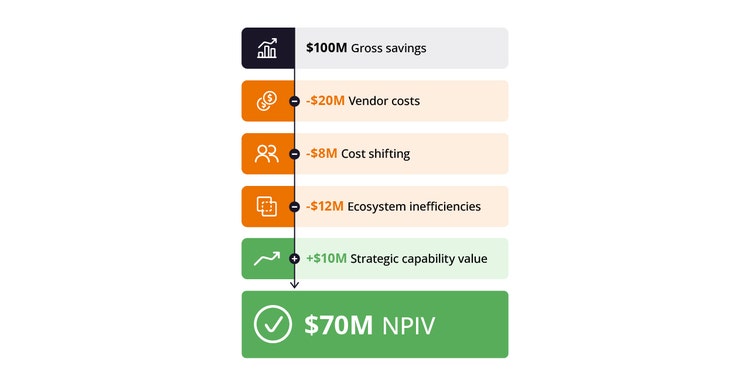
In many organizations, the largest opportunities to improve NPIV come from reducing vendor-related leakage and eliminating ecosystem inefficiencies. Health plans can also retain more value by shifting commoditized capabilities into lower-cost operating models instead of adding new recovery programs
PI’s future is retaining more value and stewarding healthcare dollars
Gross savings alone no longer provide a complete view of PI performance. Health plans also need to understand how much value they retain, where value is leaking and which capabilities are still worth buying.
NPIV can help leaders determine which capabilities are worth owning, outsourcing or redesigning. That matters not only for margin improvement and market resilience but for the broader responsibility health plans must manage healthcare dollars thoughtfully on behalf of employers, members, government programs and communities.
Assess how much value your organization retains, where value may be leaking and which capabilities may be worth owning, outsourcing or redesigning with these eight questions.
- Are we measuring gross savings or enterprise value?
- How much of our PI savings do we actually keep?
- Where are we paying multiple parties for the same outcome?
- Which capabilities are differentiated and which have become commodities?
- Are we measuring costs that appear outside the PI function?
- How has AI changed our build-versus-buy assumptions?
- Do we own the capabilities that create long-term strategic advantage?
- Are we optimizing for recoveries or stewardship?
The answers can help show whether the economics of your current operating model still hold. If you’re reassessing your PI strategy, let’s compare where value may be leaking and which capabilities may warrant a different ownership model.
Related insights
zs:topic/ai-and-analytics,zs:topic/strategy-and-transformation