The enterprise AI spine: How to scale AI agents without losing control
There’s a missing middle in your AI architecture
Technology leaders recognize this scenario, because they have likely seen a variant of it inside their own estate: A medical information AI assistant gives a healthcare provider off-label dosing guidance. The error is caught before it reaches anyone, but the real question takes four days to answer: how many other AI workflows across the enterprise are doing something similar unobserved?
Most leaders aren’t in a good postion to answer that question. Every team built their agents well, but nothing was built together.
Where else is this happening?
This is the gap at the center of the intelligent enterprise: AI is running in every function, but nothing connects it. There are no common guardrails, no shared observability and no way to answer, “where else could this be happening?”
That gap is what an enterprise AI spine can close.
Why an enterprise AI spine?
What you don’t see, you can’t govern
There is a single question every chief information officer should be able to answer about their AI program: can you see and govern all of it as one estate, every workflow, every guardrail, every trace?
In our experience, for most enterprises the answer is no. One team builds a research assistant, another an operations agent, a third a document-review workflow. Each works well on its own. But each independently solves for model selection, memory, orchestration, guardrails, evaluation and access controls, and nothing connects them.
When you can’t see the estate, you can’t govern it. And the stakes are rising as AI becomes part of regulated business processes. In April 2026, the FDA issued its first warning, citing the inappropriate use of AI in pharmaceutical manufacturing. These are the visible failures—the ones that surface, attract scrutiny and get adjudicated.
The more common failures happen inside the enterprise, long before anything reaches an external entity such as a customer or a regulator.
Scaling AI costs more without a spine
AI experimentation has become cheap. Teams can assemble prototypes in days, and pilots show promise very quickly.
But the economics of scaling AI hasn’t changed. They are still determined by integration cost, governance review, security signoff and the slow accumulation of operational obligations that determines whether an experiment becomes a system.
That’s where success becomes the problem. Every pilot that works adds another bespoke implementation to the enterprise—another set of guardrails defined in isolation, another system that logs differently or not at all and another island the enterprise cannot see or govern as part of the whole.
The business impact is straightforward: every new use case inherits the full burden of governance, integration and operational readiness from scratch, so the marginal cost of each new use case tends to climb rather than fall. All of this is normal. It is the predictable byproduct of healthy innovation moving faster than the enterprise architecture can absorb it. But what transforms innovation into an enterprise system is a spine that gives it structure, consistency and scale.
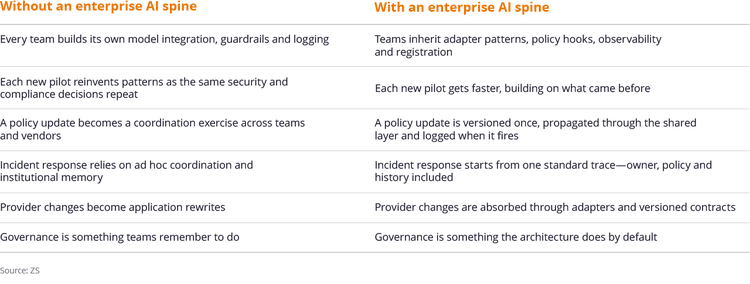
FIGURE 1: What you gain with an enterprise AI spine
Think design principle before anything else
An enterprise AI spine is a thin, connective architectural layer between business-facing AI solutions and the infrastructure beneath them. Its job is to make the enterprise’s AI governable as a whole, creating consistency where control matters most while preserving speed where teams need it most.
And if your first reaction is that the cloud platform already does this, hold that thought. It deserves a precise answer, once we’ve discussed what the spine does.
Above the spine sit the vertical, business-specific solutions: domain workflows, applications, user experiences and functional logic.
Below it sits the elements most likely to change: model providers, vector stores, cloud infrastructure, identity systems and orchestration technologies.
The spine creates a stable middle layer so teams don’t have to redecide the same foundational questions before they can build anything.
This is what makes the estate governable. When every AI workflow runs through a common layer, the enterprise can answer the questions fragmentation otherwise makes impossible: what each workflow touches, whether a policy reached all of it, what happened when something broke.
Guardrails, observability and enforcement stop being per-team decisions and become properties of the layer itself—consistent across all functions rather than redecided workflow by workflow.
FIGURE 2: Clarifying the role of the enterprise AI spine
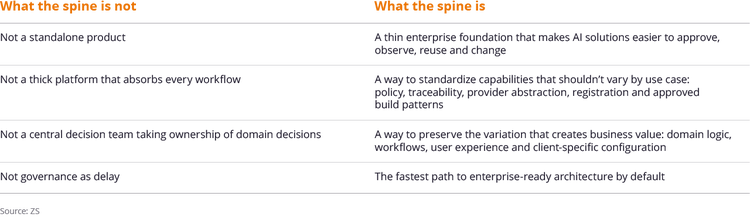
The spine is thin, between domain solutions and infrastructure
A well-designed spine sits in the middle between domain solutions and infrastructure (see Figure 3). It does three jobs—govern, accelerate and enforce—each with a distinct audience.
FIGURE 3: The spine owns what must stay consistent
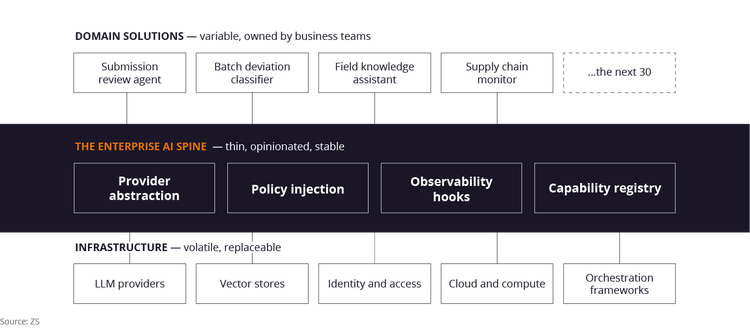
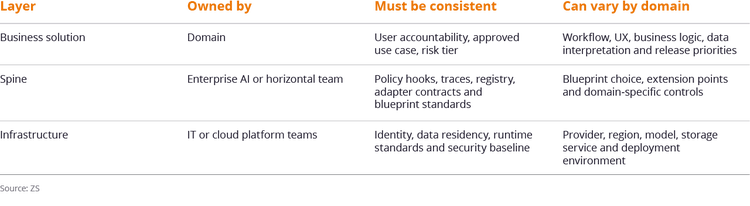
As Figure 4 shows, the spine owns what must stay consistent, while domain teams retain ownership of workflow, user experience, business logic and release priorities.
FIGURE 4: Where the spine creates consistency and where domains retain flexibility
What the enterprise AI spine does: Govern, accelerate and enforce
Across these three jobs, the spine turns governance from a project-by-project burden into a shared architecture that teams can build on.
1. Governs via foundational services
These are the shared capabilities that every AI application in the enterprise consumes—whether the application team knows it or not. Enterprise IT owns this layer. Its defining characteristic is that it is invisible to the application developer by design. A team building a deviation classifier should not have to think about where traces go or how personally identifiable information (PII) gets redacted, for example. That is handled beneath them.
There are four foundational services. Each changes slowly and deliberately, because consistency is the entire purpose.
Provider abstraction. Business logic should not be hard-wired to a specific model, vector store or orchestrator because that’s what creates lock-in. Instead, every application should connect through a thin software development kit (SDK) that routes requests to the selected provider through versioned interface contracts. When it’s time to swap a component, the infrastructure team updates the configuration once with no application rewrites.
Policy injection. Sensitive data-handling and prompt safety and compliance rules are enforced systemically. When policy is optional, it is absent. In practice, a runtime policy engine intercepts model and tool calls before they leave the trust boundary. Policies are versioned, declarative, logged with the version that fired and updated once to apply everywhere. For application teams, this is what removes compliance work from their critical path: they inherit enforcement rather than building and reproving it use case by use case.
Observability hooks. Every AI interaction should be traceable. This includes how it behaved, what it consumed and produced and where it failed. If you can’t observe it, you can’t govern it. In practice, the spine writes a standard trace for every interaction by default, so observability is opt-out, not opt-in, and an escalation becomes one trace to pull instead of days of reconstruction across systems. Raw signal is not enough, though: without intelligent triage that separates routine activity from the small subset of interactions warranting review, those traces become noise and the highest-risk events get harder to see.
Capability registry. Someone must be able to answer what AI is running across the enterprise, what it depends on and what it is authorized to do. In practice, that requires a versioned registry where every application registers at deployment. The registry becomes the enterprise’s single source of truth for discovery, dependency tracking and authorization, making it possible to see what depends on a component before it is updated or retired.
2. Accelerates via solution blueprints
Above the foundational services sit opinionated, precoded implementations of common AI patterns: retrieval-augmented generation, multistep orchestration, document extraction, classification pipelines and agent scaffolding. Each blueprint is an enterprise-standard instantiation that already has the foundational services wired in.
This is where reuse materializes. For example, a team starting a new retrieval-augmented generation (RAG) application does not start from scratch. They do not decide which vector store SDK to use, how to format audit logs or how to handle model fallback. They pick the RAG blueprint, and those decisions are already made—tested, compliant and connected to the foundational layer beneath. A commercial team building a field knowledge assistant picks the RAG blueprint and has a compliant, observable, production-wired application scaffolded in weeks instead of months.
The AI center of excellence or platform engineering team owns these blueprints, and they evolve faster than the foundational layer. New patterns get added as the organization learns. Existing ones get refined as the technology matures. The key principle: blueprints are opinionated but not mandatory. A team with a genuinely novel pattern can go off-blueprint. But the moment they do, they still inherit the foundational services. They are opting out of the accelerator, not opting out of governance.
3. Enforces via AI workbench
This is the layer most organizations miss. Even those that build it find it the hardest to keep current as hyperscalers and model providers rapidly evolve developer tooling.
The workbench is where developers build. It provides predefined pathways for common patterns, guiding teams to the right blueprint and ensuring the appropriate foundational components are connected. But its real benefit comes from how it equips the coding agents that teams already use. Modern coding agents, such as Claude Code and Codex, read skill files (the open SKILL.md format both support) that tell them how to build in a given environment. Developers describe what they want, and the agent generates spine-compliant code by default because those skill files define the only approved way it knows to build.
The workbench blueprints are what creates the operating reality. Without the workbench, the foundational services and blueprints are a library that teams should use. With it, the architecture is encoded in the skill files the agent reads on every task, making spine-compliant patterns the path of least resistance. Using the spine becomes easier than not using it.
That distinction matters more than it might seem. Governance-by-documentation does not work. Teams under pressure will take the fastest path available, and if the fastest path routes around the spine, they will route around it. The workbench ensures the fastest path goes through the spine. With the steering embedded in the agent itself, compliance becomes a byproduct of velocity rather than a tax on it.
How the layers of the spine relate
Here’s the logic of how the three layers relate, from bottom to top: govern creates consistency, accelerate creates speed, enforce creates adoption. You need all three. The first two are useless if nobody uses them. The third is empty if there is nothing underneath.
This is also the difference between a spine and a platform. A platform tries to contain everything and grows heavier over time. A spine connects everything and stays thin. The govern layer is deliberately narrow—four services, not forty. The blueprints are opinionated accelerators that leave room to extend. The AI workbench guides without constraining. At every layer, the design principle is the same: make the right thing the easy thing.
Proof point: Scaling AI for a global specialty launch
A global biopharma company was preparing a specialty launch across eight priority markets. Regional teams had already built AI assistants for account planning, formulary interpretation, objection handling and competitive intelligence.
Each assistant used different retrieval patterns, content sources, logging standards and medical review processes. Medical, legal, regulatory and IT teams could not easily determine which content was approved, which responses were traceable or whether policy updates had reached every market.
The company moved the next generation of launch assistants onto an enterprise AI spine. Every assistant inherited the same retrieval blueprint, registered content sources and policy controls. Higher-risk responses were automatically routed for human review, and every interaction generated a complete evidence trail linking the user request, supporting content, policy version, model execution and final response.
The result was more than faster AI development. Commercial teams launched new market workflows without redefining governance. Medical reviewers inspected evidence instead of reverse-engineering assistant behavior. IT could see which workflows were running, what enterprise assets they depended on and whether required controls were in place. While the AI assistant drew attention early, ultimately the complete evidence trail gave stakeholders the confidence to scale the solution beyond the first market.
Why the enterprise AI spine can’t wait
What a hyperscaler provides
An obvious first reaction is that the cloud platform already acts as a spine. It provides managed guardrails, model swapping, identity and audit logging.
But a hyperscaler provides primitives, not enterprise standards. It can offer guardrails as a capability, but it cannot define your off-label detection policy, your PII redaction rules or your audit format. Every enterprise still must encode those decisions for itself.
Without a common architecture, each team implements them differently, even when building on the same cloud platform. The result is the fragmentation this article describes, now recreated inside a single vendor ecosystem.
Three implications follow:
- Abstraction within a platform is not portability: your business logic stays coupled to that platform’s APIs, identity and storage, so the day a workload needs to move—an acquisition on another cloud, a data-residency rule or a client requirement—you rewrite it.
- Cloud-scoped observability is not enterprise-scoped: if any workflow runs on another cloud, on-premises or inside an SaaS product, the platform’s own traces cannot answer the opening question of what else is running.
- The upper two layers of a spine simply do not exist in any hyperscaler. No cloud ships a blueprint with your controls wired in, or a workbench whose assistants steer developers toward your patterns. Those are enterprise-specific by definition.
The spine is what makes a “wait and see” strategy possible
Organizations that wait to build a spine are quietly locking themselves into the first tools and architectures they adopt. With a spine, the tools and architectures keep evolving while the business logic stays stable.
Without a spine, operational burden eventually outweighs any value. At 30, 50 or 100 AI-enabled workflows, fragmentation begins to outpace governance. Controls become difficult to verify, the dependencies harder to trace and every platform shift triggers another round of integration work.
Organizations that build the spine early gain a structural advantage that compounds over time. The advantage comes from the architecture itself—one that lets innovation accumulate rather than fragment.
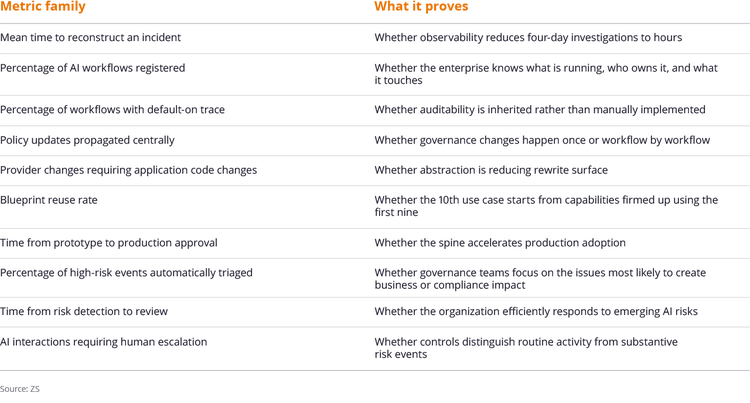
That advantage is measurable. It appears in incident investigations resolved in hours instead of days, new use cases that leverage previous work instead of starting from scratch and provider changes absorbed without costly application rewrites. Figure 5 highlights the metrics that show whether your spine is delivering on that promise.
FIGURE 5: Operating metrics that can make the spine measurable
Consider the pharmaceutical company from the opening. With a spine, the off-label dosing incident still happens. Models will always produce outputs that need to be caught. But the investigation takes hours, not days. The trace is immediate. The guardrail gap is visible the moment it is queried. And the question that went unanswered, “How many other workflows are operating under similar conditions?” now has an answer because every AI application in the enterprise is observable through the same layer.
9 questions for Monday morning
How to assess where you are today
Your answers to the questions below will reveal whether you have a spine or a growing collection of disconnected AI solutions.
Most organizations we work with answer “no” to four or more, which signals a need for change:
- Does any single team know which AI workflows are in production right now, who owns them and what they touch?
- Can your security team list every LLM call made by every AI workflow in the past 30 days, with full input/output trace?
- When a complaint about a hallucinated response is escalated, what is the mean time to reconstruct what happened?
- Do you have a consistent way to measure whether your AI systems are performing the same way they were three months ago across all workflows, not just the ones with dedicated teams watching them?
- If a new data residency regulation arrived next quarter, would you patch the policy in one place or in every workflow?
- When you require a new control, for example off-label detection or PII redaction, is it enforced automatically on every workflow, or does each team have to implement it correctly on its own?
- If you replaced your primary LLM provider tomorrow, how many applications would require code changes, and could you give the count today?
- When the last three teams started new AI projects, did they begin from a shared, prewired pattern or did each one assemble its own stack?
- If a developer starts building an AI workflow tomorrow, does the default tooling route them through your enterprise standards or do they have to know to go looking for them?
Every team can keep building well. The spine is what lets them build together and it needs to be in place before the patchwork becomes the architecture.
If you’d like to discuss what this approach could look like in your organization, contact ZS.
Related insights
zs:topic/data-digital-and-technology,zs:topic/ai-and-analytics,zs:topic/research-and-development,zs:topic/portfolio-strategy-and-management