From prime time to precision: Pharma’s next moves beyond DTC TV
The authors would like to acknowledge contributions to this article by Abhishek D. Anand, Pranav Sehgal, Mehul Singh, Victoria Summers, Namita Powers and Howard Deutsch.
For more than two decades, direct-to-consumer (DTC) advertising—particularly broadcast television—has been one of the industry’s most frequently used plays, shaping how patients recognize symptoms, seek care and stay on treatments. Brands that could command prime time shaped how patients learned about conditions and treatments were able to change the game.
That model has also drawn sustained scrutiny. Physicians point to patient requests for specific branded therapies, while payers cite higher utilization of costly treatments. Proponents counter that DTC remains one of the most effective ways to surface undiagnosed or undertreated conditions and support adherence once patients begin therapy.
Today, the rules are under review. While there has been no outright ban on DTC advertising, regulators have signaled a renewed focus on broadcast fair-balance requirements, even as digital branded promotion remains unaffected. Any meaningful tightening—particularly for TV—would reshape how pharma competes for awareness and demand. As the regulatory landscape comes into clearer focus, companies should begin preparing for a world in which the traditional playbook no longer guarantees an advantage.
Why DTC advertising became pharma’s growth engine
For more than two decades, DTC advertising has become one of the most defining features of the U.S. pharmaceutical commercial model (Figure 1).
FIGURE 1: How DTC spending in U.S. pharma has evolved

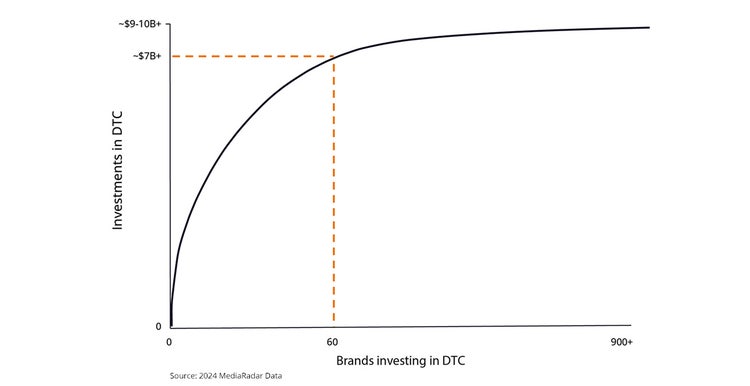
In 2024, pharma invested between $9–$10 billion in DTC ads in the U.S., but ZS research found that more than $7 billion of that is highly concentrated in only 60 brands, largely limited in therapy areas such as immunology, respiratory, diabetes and obesity, HIV and antipsychotic therapies.
More than 80% of that spend sits in TV, the channel that has historically delivered the greatest scale, strongest returns and highest dependence for growth.
That concentration is what makes TV so exposed. ZS analyses show TV campaigns generate 2x-3x long‑term ROI, with over half of incremental sales driven by repeat patients. Remove or materially constrain branded TV and the impact is not marginal: current spending levels imply a $15-$20 billion top‑line gap for advertising brands.
The question then is not whether TV matters, but how pharma sustains awareness and demand when it no longer works the way it used to.
FIGURE 2: Only 60 brands contribute to more than 80% of total DTC spend
What changes if branded TV advertising is constrained?
If branded TV reach declines, the impact will extend beyond the handful of brands that currently dominate TV spending. The overall mechanics of patient discovery will shift, affecting how all brands generate awareness, engage patients and compete for attention across the healthcare journey. No brand is truly safe, and every marketing leader will feel some degree of impact.
Other channels become more expensive. Brands that are advertising on TV already invest heavily in other consumer tactics such as social media and paid search, the next set of channels in the customer engagement journey. As the pressure to drive awareness through unbranded campaigns and engage patients who are seeking more information increases, competitors will likely bid up the costs of these. In fact, more budgets will concentrate within a limited set of inventories of keywords. Brands will need to maximize the impact of their consumer outreach through high-quality unbranded content and influencer or community credibility, rather than via branded advertising alone.
Brands will need to adapt to AI-driven search. At the same time, the prevalence of AI-generated summaries in online searches will challenge branded visibility. These summaries provide direct answers and reduce clicks on ads by pushing them further down the page. This shift is evident from Google’s paid search revenue figures, which grew by double digits in 2025 compared to 2024, largely driven by higher cost per click rather than increased search volume. Brands with strong search engine optimization foundations and robust unbranded content libraries will have a head start, but all brands will need to adapt their strategies as discovery becomes more algorithm-driven.
Growth will depend on identifying and addressing the barriers patients face. At a more fundamental level, this shift exposes a structural difference in how patients are engaged. Broadcast TV has historically functioned as a broad “push” instrument, delivering uniform messages to wide audiences regardless of where individual patients are in their journey. Its strength has been scale, not contextual precision. If branded broadcast becomes constrained, growth will depend less on pushing awareness broadly and more on identifying the specific barriers that prevent patients from progressing and addressing those barriers with targeted, contextually relevant engagement.
The ability to identify patients gets more complex. In this environment, the ability to identify patients earlier in their diagnostic journey, understand the questions they are asking and reach them at the right moment becomes critical, especially in complex or underrecognized conditions. Approaches that combine patient-finding with digital activation, such as ZS’s ZEBRA platform initially developed for rare diseases, illustrate how intent-based patient identification and highly targeted engagement can help compensate for the scale historically delivered by broadcast TV as discovery becomes increasingly data-driven.
Who wins and who loses in a post-TV era
The commercial effects of any major shift away from branded TV advertising will be uneven across the industry. Although TV spending is highly concentrated in a limited number of categories and brands, those brands are not equally reliant on branded TV promotion. The appropriate response will differ by strategic position, but all organizations will need to rethink how awareness, intent, access and persistence are generated across the patient journey.
We can think of it as a tournament bracket. Every brand is seeded by its current position: market share, TV reliance and competitive intensity. And the rules of the game can potentially change soon. Here’s how the bracket breaks down.
Category leaders
Seed and standing: These brands are structurally advantaged but must actively defend share. In many chronic and specialty therapy areas where one brand holds clear market share leadership, including in therapy areas such as immunology and diabetes, category leaders have often become synonymous with the underlying condition in the minds of patients and healthcare providers (HCPs). These products enjoy strong clinical familiarity, broad payer coverage and durable brand recall. In short, brands that dominate with high market share in their respective categories will always benefit from unbranded ads.
Scouting report: These brands are relatively well positioned to pivot from branded advertising toward disease state and condition-led awareness campaigns without materially eroding demand. Shingrix, which is synonymous with shingles, is a clear example. But operating in environments where more clinically competitive alternatives are gaining traction means that name recognition might not be sufficient to protect share. For example, Ozempic is indicated for diabetes, although it has become widely perceived by much of the public as a weight-loss therapy, while its higher-dose formulation Wegovy is indicated for obesity. Unbranded campaigns may continue to stimulate demand and often benefit category leaders by expanding the overall market, but alternatives such as Mounjaro and Zepbound are closing the gap.
Game plan: These brands should move deliberately toward unbranded disease leadership. The objective is not simply to replace branded TV with generic messaging, but to own the diagnostic and treatment narrative at the category level. Investment should prioritize large-scale disease education, earlier identification of untreated and undertreated patients and stronger patient engagement programs. As broadcast visibility declines, these brands should ensure that their disease content, access tools and support programs dominate the environments where patients and physicians now seek information. For these category leaders, the shift to unbranded requires active monitoring of new-to-brand patient lift and market share and ongoing adjustment of direct-to-patient efforts to ensure both initiation and continuation remain strong.
Large brands in crowded categories with high levels of TV advertising
Seed and standing: These brands are the most exposed to revenue risk. They’re the brands fighting for survival in the next round.
Scouting report: In therapy areas where several brands compete at similar market share levels, such as respiratory, gastroenterology and dermatology, high-spend competitors operate in challenging commercial environments. These brands rely more heavily on TV to differentiate themselves among patients. They have the most to lose in a TV-constrained environment, as they depend on broadcast scale to compete.
Some of the high-spend competitors operating in these environments include brands like Rinvoq, Tremfya, Fasenra and Opzelura. These brands face the greatest revenue risk given the historical 2x-3x long-term return on investment associated with TV for leading franchises. As the pressure increases to drive awareness through unbranded campaigns alone, competitors will likely bid up the costs of digital channels as more budgets get concentrated within a limited set of keyword inventories. The combination of rising digital costs and declining broadcast reach makes this the most commercially vulnerable archetype.
Game plan: Replace scale with precision. The decline of broadcast visibility requires a pivot toward tighter targeting. The new approach should be tailored for an LLM-driven media landscape across high-intent, data-rich channels such as social media, paid search and online video, where education, personalization and measurement are far stronger than in 60-second TV spots.
These brands will need to build more advanced capabilities in audience identification, journey orchestration and content personalization. For specialty therapy areas, this includes systematically identifying patients earlier in the diagnostic process, using real-world data and analytics to prioritize high-value segments and coordinating digital, field and access interventions around those patients. Approaches that combine patient finding with digital activation, such as ZS’s ZEBRA platform, illustrate how intent-based identification can replace some of the scale historically delivered by TV.
Beyond identification, pharma companies will also need to redirect investment toward generative engine optimization as AI tools like ChatGPT, Gemini and Copilot increasingly become the first stop for patients and HCPs researching conditions and treatments. As discovery shifts from clicks to AI-generated answers, influence will depend less on traffic and more on how accurately and consistently brands are represented across trusted sources.
For those brands that deployed TV despite weak underlying economics (i.e., low return on investment), the reduction of TV may force a recalibration toward more durable and sustainable strategies such as barriers-driven engagement.
The combination of intent-based, highly personalized targeting and funneled brand discovery would help partially bridge the revenue gap that may be left due to a ban on branded TV advertising.
Midsize and low TV spending brands
Seed and standing: These companies arerelative beneficiaries of a post-TV era, externally based on category and internally based on portfolio.
Scouting report: Midsize brands that are low on TV spend, particularly those who have historically been overshadowed by heavy-spending TV competitors, may quietly benefit. As market leaders are forced to pull back from broadcast advertising, the relative visibility of these smaller brands will improve, creating more room for them to compete for patient attention.
For many of these brands, the next phase represents a serendipity moment rather than a constraint. As larger advertisers reduce broadcast presence, they can increase their relative visibility and compete more effectively for patient attention without the distortion created by heavy media spending.
Game plan: The focus should be on strengthening discoverability, improving patient-facing engagement and expanding adherence and support programs. In parallel, these brands should be prepared to make the case for greater internal investment. Due to portfolio prioritization of larger flagships, many midsize assets were historically underfunded to support TV-heavy brands. As companies look to close revenue gaps left by reduced TV spend, these brands may have a stronger case for marginal budget reallocation and a clearer opportunity to drive incremental growth.
FIGURE 3: Pharma DTC advertising spend: Market landscape
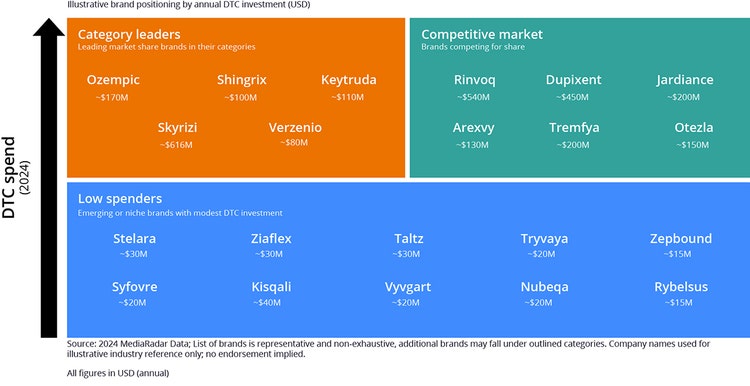
Each brand needs a differentiated strategy to tackle any DTC policy changes.
Rethinking the digital advertising strategy for a new era
Across all archetypes, the mechanics of awareness and discovery will continue to evolve. AI-generated summaries and conversational search interfaces will increasingly determine which disease information and brand resources patients encounter first. Brands will need to adapt their content, search strategy and digital presence so that they remain visible, accurate and credible in these emerging channels.
As this environment takes shape, brands will need to regularly reassess their position within these archetypes and remain prepared to adjust strategy, investment mix and operating models accordingly.
Success will depend less on protecting historical channels and more on building the capabilities required to compete in a patient journey that is increasingly data-driven, customized and outcome-focused.
Success also depends on how quickly organizations can assess their position, adapt their strategies and reallocate resources as the market changes. This will be an evolving situation and there is no single playbook that applies to every brand. Nearly all brands will be affected in some way, whether they are heavy-TV investors or competing in categories shaped by those investments.
The future of commercial excellence will not be defined solely by choice of channels, but by how well organizations reduce the barriers patients face at each stage of their journey from awareness, to access to persistence.
As broadcast TV becomes less reliable as a growth engine, advantage will shift to brands that can replace scale with insight, understanding where patients struggle, meeting them earlier and engaging them with relevance rather than repetition. In a market where attention is harder to win and easier to lose, the brands that adapt fastest will define the next era of commercial excellence.
Related insights
zs:topic/marketing,zs:topic/ai-and-analytics