AI’s value in pharma: 5 signals shaping the 2027 outlook
Pharma’s AI leaders are managing near-term wins and long-term bets at the same time
More pharma companies are reporting measurable business outcomes from AI, according to ZS’s 2027 CDIO Outlook Survey. The progress is encouraging, though returns are not arriving on the same schedule for every AI investment.
Some applications are already producing near-term productivity gains. Others require a longer runway, especially where value depends on scientific workflows, enterprise capacity and trust.
That split is becoming one of the more important management issues for technology leaders in pharma.
AI value in pharma arrives on two timelines
AI value in pharma is still arriving in two modes. It is the same pattern we saw last year, and it appears likely to hold into 2027.
The first mode is about quick wins. The second is about broader transformation, where the returns can be larger but take longer to prove. Both matter, and both need to be managed deliberately.
Quick wins: This mode captures near- and midterm value in faster-moving areas with clearer boundaries, manageable risk and structured workflows. These are the places where AI is easier to deploy and value tends to show up sooner, including enterprise IT, supply chain, manufacturing and commercial effectiveness.
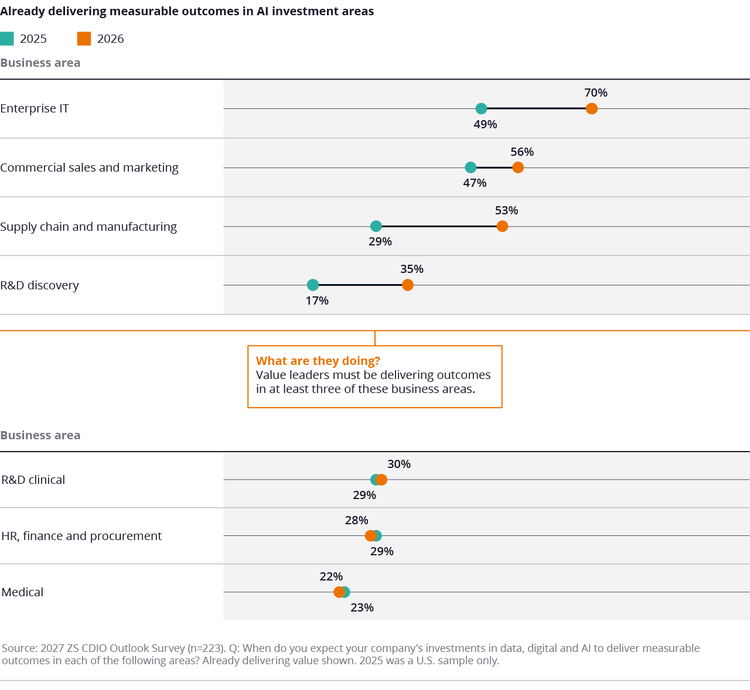
Longer-term bets: This mode covers longer-horizon value areas where work is less linear, the evidence bar is higher and impact unfolds over longer cycles. That includes discovery, clinical and medical domains, where value can mean something different. Even here, more CDIOs are starting to prove returns. The share of technology leaders who say their companies deliver measurable outcomes in drug discovery doubled year over year, from 17% to 35%, according to our survey.
The most effective companies treat AI investment as a portfolio problem. Near-term wins help build confidence and release funding for longer-term bets.
Why AI value leaders deserve a closer look
Our survey identified a group of companies that offer an early view of what two-track AI value looks like in practice.
The survey identifies AI value leaders as the 38% of respondents reporting measurable results through strategic business outcomes or key results across at least three of four core business areas: enterprise IT, commercial sales and marketing, supply chain and manufacturing, and R&D discovery (see Figure 1).
This group is worth studying because its results are showing up across several functions at once. Their experience points to the operating choices that help AI scale beyond individual domains.
Their advantage is not that they want different outcomes. Like other companies, they are focused on measurable value, shared ownership with business teams and disciplined funding decisions. What makes their experience useful is how far those practices have traveled across the enterprise, giving them a more reliable path to turn new investment into advantage.
FIGURE 1: More are turning AI investment into value
Signals from AI value leaders about what comes next
They’re making sharper choices about where AI should scale, where it should stay closer to human judgment and what needs to change so value shows up in the business. This year’s survey shows what's important to them and what they’re planning next. Here are five takeaways.
High quality, trusted data foundations are a greater control point
Value leaders are not treating AI-ready data as a technical prerequisite alone. They are investing in control of the trusted data foundation: modern platforms, stronger governance and secure, high-quality data that AI systems can use with confidence.
That distinction will matter more over the next two to three years. Companies with greater control of their data foundation will have a clearer path to protect sovereignty, reduce reliance on outside partners and scale AI capabilities on their own terms.
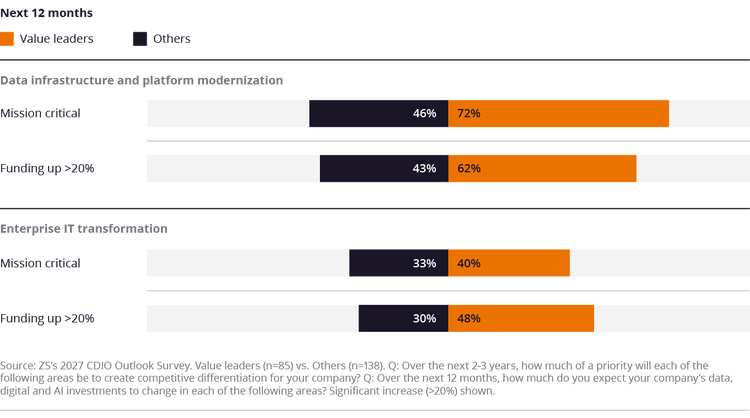
Nearly three in four value leaders (72%) rate data infrastructure and platform modernization areas as mission-critical priorities for competitive differentiation, compared with 46% of others.
Their investment plans reinforce that view: They’re nearly 1.5 times as likely as peers to expect significant funding increases for data infrastructure and platform modernization in 2027 (see Figure 2).
That bet extends to the capabilities needed to make AI reliable and controlled, including who leads data engineering and how the company handles data governance, privacy and security.
Value leaders are also more likely to prioritize data governance, privacy and security as a top bet, with 66% citing it compared with 50% of others, a 16-point gap. They see governance maturity as a scaling prerequisite rather than a constraint.
For core data engineering specifically, 69% of value leaders plan to keep the capability in-house, versus 53% of others, treating it as proprietary rather than a commodity to buy.
The logic is straightforward: Platforms shape where AI can operate. High-quality, secure, exchangeable and contextualized data determine what AI can know and how confidently it can act.
That is why the work increasingly looks like infrastructure, not experimentation. As one U.S.-based CIO put it: “The accurate measurement of data quality and value matters more than the volume of pilots. Fewer initiatives, measured correctly, yield more sustainable results.”
FIGURE 2: Value leaders are backing data foundations and IT transformation as a mission-critical priority and an investment focus
Autonomy is advancing where guardrails are specific
Value leaders expand AI autonomy where guardrails are clearly defined. They keep people closer to decisions with clinical or regulatory implications. Notably, more autonomy doesn’t mean less control. These companies pair greater autonomy with clearer accountability and stronger validation.
How much autonomy agents get depends on the context. Leaders give AI more room to act where risks can be effectively managed and keep human judgment closer when the stakes are higher.
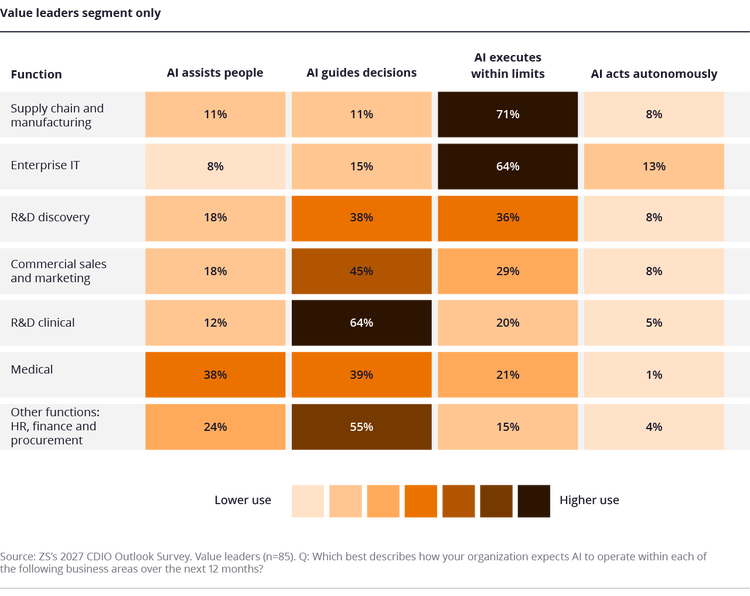
In supply chain and manufacturing, 71% of value leaders say AI executes decisions within defined limits, compared with 52% of others. Structured workflows and established controls give leaders a safer path to let AI act and capture efficiency.
Their approach changes in clinical and discovery workflows, where decisions are less repetitive, outcomes emerge over longer time horizons and the cost of error is substantially higher. In clinical work, for example, AI is more likely to guide decisions than execute them. Among value leaders, 64% say AI actively guides clinical decisions, compared with 48% of others. The distinction reflects a practical understanding that patient safety, regulatory evidence and clinical outcomes require greater human oversight.
The emerging model is autonomy designed within limits. As a CIO at a French biotech company put it, the shift is toward “AI capable of acting autonomously, within defined limits, rather than simple support tools.”
FIGURE 3: The emerging model is autonomy designed within limits
AI governance is moving from policy to practice
As AI demand increases, organizations won’t be able to meet it unless governance scales with it. Yet, across all respondents, AI governance is still maturing. Even among leaders, most say AI governance is defined or rolling out, but few say it’s fully operational across the enterprise.
What does separate leaders is what they have made operational and what they’re planning next.
Value leaders are defining ownership and validation requirements earlier, turning governance from a review gate into a capability by embedding risk controls, traceability, transparency and clear human accountability directly into the systems where agents operate.
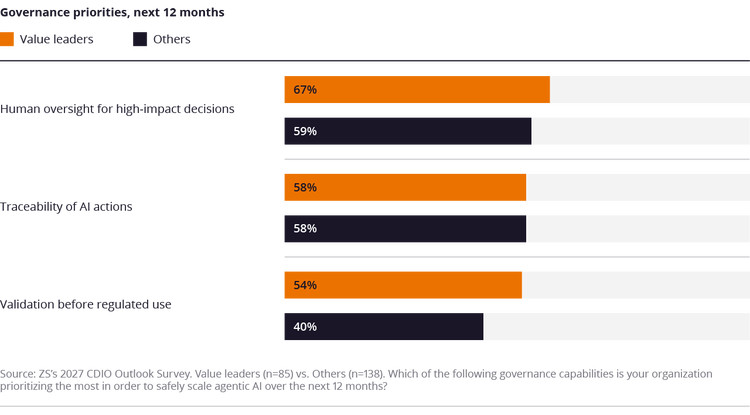
They’re also more likely to have fully defined, end-to-end accountability frameworks across partners, business units and IT (40% versus 25%). Clear accountability allows AI to scale safely. Without it, every new use case forces teams to decide who is responsible when something goes wrong.
For the next 12 months, value leaders are more likely to be placing regulatory compliance for AI use at the top of their agenda and focusing on creating trustworthy AI systems.
Specifically, they’ll be working through how to validate AI work for regulated uses (see Figure 4). The focus reflects a higher bar for production-scale AI. As a CIO at a large U.S. biotech company said this was his biggest shift from prior years: “We’re now moving beyond isolated pilot projects to demand enterprise-level reproducibility and governance, under which AI must meet the same evidentiary standards as our science.”
FIGURE 4: Governance priorities are focused on oversight, traceability and validation
The workforce question is now about the operating model
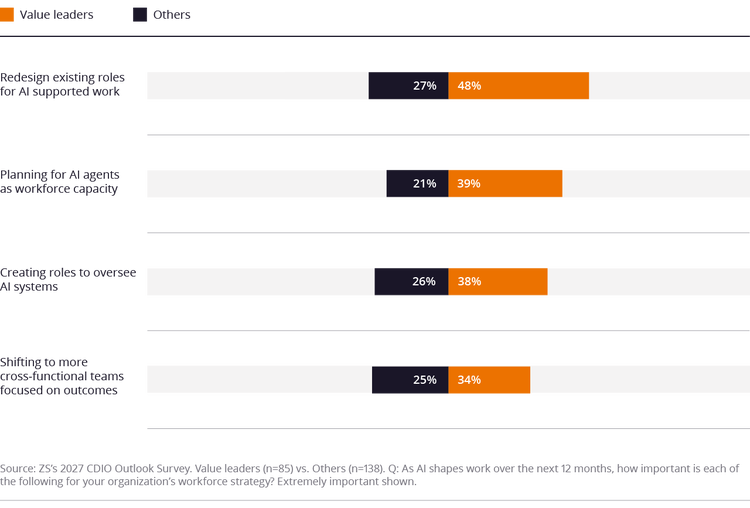
Leaders are thinking differently about who or what will do the work. Looking toward 2027, they’re more likely to prioritize role redesign and prepare for a future in which AI agents become part of how work gets done. At one midsize U.S. pharmaceutical company, leaders have "stopped asking whether AI is ready and started asking whether we are ready."
As AI takes on more routine work, workforce design becomes an operating model decision. Organizations must decide where human judgment creates the greatest value, how people and AI will work together and new capacity should be redirected. Those choices shape not only productivity and capacity metrics, but also the employee experience, shaping employees’ understanding of how their work is changing and where they can do their best work in the years ahead.
FIGURE 5: Value leaders are shaping AI-enabled work
Leaders plan to optimize economics as use expands
As AI use expands, companies need to source models and have cost structures that can keep pace. Value leaders are making clearer choices about what stays close to the organization and where external partners can accelerate scale.
While they keep the core of data engineering closer to the organization, they’re more likely than others to use hyperscalers for AI-assisted development tools (48% versus 32%).
They’re also more likely to design their partner agreements for scale. Seventy-six percent pursue strategic coinvestment or outcome-based agreements, compared with 61% of others. And 75% are planning to use usage- or token-based AI services, compared with 63% of others, making consumption and value easier to connect as adoption grows.
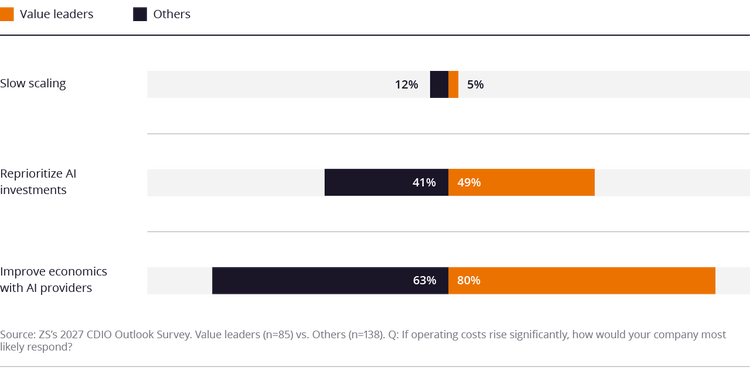
That discipline matters when costs rise. If AI operating costs increase significantly, 80% of value leaders would optimize models, vendors, infrastructure and workflows, compared with 63% of others. Their plan for cost pressure is to improve the economics, not reduce the ambition.
FIGURE 6: When AI costs rise, value leaders look first to optimization
5 areas that determine your own timeline for value
Leaders are confident that AI value will keep building across two tracks: faster-moving areas where value is already easier to show, and longer-cycle domains where value still needs to be proven against higher evidence bars. That confidence is encouraging, but it doesn’t mean the work is finished. It simply raises the competitive pressure to close the gaps between ambition and reality and keep improving.
To keep both tracks moving, you need to know which conditions are helping AI value take hold and which ones are still slowing it down.
These five areas can help shape your own timeline to value:
Bring AI economics into the capital-allocation conversation. AI is becoming a strategic use of capital, spanning compute, inference, governance and partner models. Weigh it as deliberately as traditional growth priorities and structure coinvestment or outcome-based agreements for measurable value.
Make value accountability the baseline. Use a clear value framework to show which teams are managing AI for outcomes. With that transparency, you can defend which projects to champion, scale or end based on expected business value, not potential or momentum alone.
Control the data you trust while you build for scale. Don’t wait for perfect architecture to prove value. Move quickly with targeted solutions but keep control of the data that matters most: its quality, lineage, access, sovereignty and use. This discipline allows AI to scale without losing the trust or enterprise control it depends on.
Embed reusable guardrails in shared platforms. Decide which security, access, data-use, model-risk and audit controls should be built into shared platforms. With those guardrails in place, teams can spend less time rebuilding the governance layer and more time proving value.
Set the operating model for humans and agents. Lead decisions where AI should advise, where it should act with supervision and where it can operate on its own. That takes enterprise alignment, plus leaders who can turn those choices into new roles, decision rights and guardrails that work.
ZS can help you sort through the choices, build the right capabilities and turn AI momentum into measurable value. Contact us or a member of your ZS team to start the conversation.
Frequently asked questions
ZS’s 2027 CDIO Outlook Survey also answers some of the questions we hear most often about AI. Consider this a quick bonus to the main findings: a practical FAQ for the state of AI from decision-makers in the industry.
About ZS’s 2027 CDIO Outlook Survey
The Harris Poll conducted an online survey on behalf of ZS from June 9 to July 7, 2026. The survey received responses from 223 technology executives at pharmaceutical and biotechnology companies who are decision-makers for their companies’ technology infrastructure, analytics and technology strategy. Respondents were geographically distributed across the U.S. (116), U.K. (20) and EU-4 markets, with 21-22 respondents each from Italy, France, Spain and Germany. Half (53%) of respondents are executive-level titles (CDIO, CIO, CTO) and the rest are senior level decision-makers. One third of respondents (32%) represent companies with U.S. $30B in annual revenues. Thirty-eight percent of surveyed organizations qualified as AI value leaders, defined as organizations reporting measurable outcomes from AI in at least three of four core business areas: R&D and discovery, enterprise IT, commercial sales and marketing, and supply chain and manufacturing. The 2025 study by The Harris Poll on behalf of ZS included 115 U.S. technology executives at pharmaceutical, biotechnology and life sciences companies who are decision-makers for their companies’ technology infrastructure, analytics and technology strategy.
Related insights
zs:topic/data-digital-and-technology,zs:topic/ai-and-analytics,zs:topic/research-and-development,zs:topic/marketing,zs:topic/supply-chain-and-manufacturing