From barriers to benchmarks: Redefining measurement in the new era of personalization
Key takeaways:
- Pharma commercial teams need earlier signals that show where engagement is driving impact before adoption appears in sales data.
- The next era of measurement should focus on how quickly the organization acts to address customer barriers and the impact of steps taken to progress along the adoption journey.
- The value is not just in measurement; it is better real-time feedback, more purposeful engagement and a clearer link between customer context and the P&L.
In most aspects of our daily life, progress is shaped by continuous feedback. We taste food as we cook and adjust seasoning in real time. We check a map while hiking to understand how far we’ve come and what lies ahead. We rarely commit to a plan without intermediate signals that tell us whether we are on the right path. In contrast, many pharma go-to-market (GTM) models still measure progress only after the journey is complete with limited visibility into where engagement is stalled, which barrier slowed momentum or whether an intervention changed the customer’s path.
Key performance indicators (KPIs) in today’s healthcare GTM models are anchored to two primary signals: activity and adoption. The ultimate success metric is often a binary outcome; did a patient start treatment? Is the healthcare provider (HCP) a writer of our product? A “yes” or “no.” A one or a zero.
This framing has shaped organizations’ scorekeeping and models of success. But in today’s healthcare ecosystem, that binary outcome is only the final step in a long, non‑linear journey to overcome roadblocks and friction points that delay care. In a world where customer engagement excellence is evolving, barriers-driven engagement™ gives companies two new anchor points:
- When we identified a barrier, how quickly did it take for us to run a play to overcome it?
- Did that play resolve the barrier and move customers closer to adoption?
While measurement in pharma continues to treat success as a discrete event rather than a journey, there’s a broader set of signals to track along the way.
From share of voice to sales effectiveness: The history of measurement in pharma
To understand why current measurement approaches persist, it’s important to consider where they started.
The earliest measurement was driven by sales force share of voice, focused on sales calls; reach and frequency; and resulting sales volume. This is because historically, pharma reps were “messengers” repeating a message to drive clinical conviction, when HCPs were the sole decision-maker and products were less complex. As competition intensified and analytical sophistication increased, measurement also evolved with an eye toward early sales channel effectiveness and promotion response, giving us a baseline mental model: direct activity with HCPs yields returns on a curve. Organizations further introduced customer tiering, targeting and call planning to help prioritize that overall effort.
The sophistication of therapies also evolved, as small-molecule, mass-market drugs made way for large-molecule, complex, specialized therapies. While reach and frequency measurements are an appropriate metric to contextualize share of voice and promotion at scale, success drivers shifted with more advanced treatments. It became more important to understand complex patient journeys and customer buying processes as new barriers across the patient funnel shaped treatment choices.
FIGURE 1: Measurement eras and the shift in the customer decision question
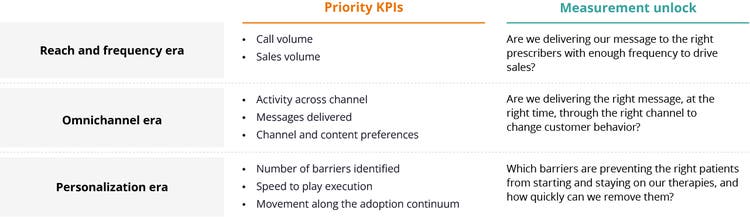
Across the reach and frequency and omnichannel eras, the core success signal remained largely unchanged: activity linked to end adoption. Activity is treated as a proxy for effectiveness, but misses the actual reasons for when the prescription gets written and why. The redefined measurement in the personalization era begins to change that.
Anchoring measurement to barriers-driven engagement, adoption metrics and patient outcomes
If earlier measurement eras were built around effort and outcome, the next must focus on the barriers that determine whether a customer can move forward. The measurement question shifts from “Did we engage?” to “What’s preventing progress, and how well are we resolving it?”
A simple example makes the shift tangible. Imagine a strategy organized around “Test. Treat. Maintain.”
- Key account managers are accountable for enabling testing by removing account workflow barriers and improving testing rates.
- Sales representatives are accountable for driving treatment choice by helping HCPs build confidence in the therapy for the appropriate patient types.
- Patient services teams are accountable for initiation and maintenance by reducing time to fill, improving onboarding and supporting adherence or persistence.
Each role owns a different barrier and is measured against a different success benchmark. Instead of a standard KPI around “number of touch points” that leads to internal competition for access, measurement tracks how each role contributes to removing a customer’s barrier. The concept is familiar, but the operating discipline is still rare. Few organizations consistently connect barriers, plays, role accountability and measurement at scale, especially at earlier stages of the funnel.
Designing new KPIs, mapped to the barriers and plays executed to overcome them, provides the real-time feedback needed to understand progress being made across the adoption continuum with each role’s objectives in getting there. Designing new KPIs, mapped to the barriers and plays executed to overcome them, provides the real-time feedback needed to understand progress being made across the adoption continuum with each role’s objectives in getting there.
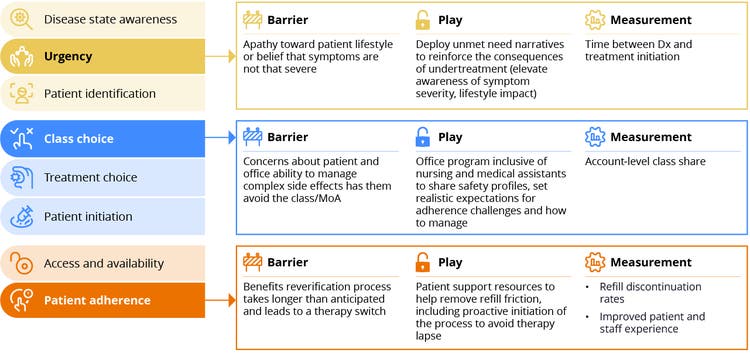
FIGURE 2: Examples of barriers, plays and measurement KPIs across the adoption continuum
What better measurement unlocks for customer engagement
Evolving measurement beyond binary outcomes requires changing the operating rhythm.
- It helps teams see which small decisions are moving the customer forward and which aren’t. Organizations can begin to understand whether they are appropriately identifying barriers, effectively sequencing interventions and quickly responding to signals along the customer journey.
- It gives teams feedback while there’s still time to adjust. Rather than waiting for downstream outcomes, teams can learn while acting, adjusting messaging, role or channel mix and timing based on signals of progress or stagnation.
- It enables better focus on improved results for customers and patients.
Ultimately, this shifts measurement from a static scorecard to a benchmark that can be strived for and delivered upon. For example, a team could state, “It took the team 21 days to resolve all barriers to first fill across the FRM and patient support and hub; let’s see if it can be done in 15 days the next time by applying the new learnings.” The objective is no longer to measure more KPIs, but to create real-time markers that allow organizations to adjust while the journey is still in motion. In this model, measurement becomes an enabler of smarter decisions, not merely a record of past performance. This is a shift from measurement as a means of telling us how we performed to measurement as a means of improving performance.
The industry benchmark becomes “For this customer barrier, what does good look like in terms of speed to identify, address and overcome?” This measurement approach highlights where teams are strong in delivering customer value and provides real opportunities for coaching and engagement strategy adaptation where barriers persist.
Unlocking broader business value through measurement
The business value of barrier-based measurement is realized when benchmarks inform resourcing, execution and strategic choices—not just reporting out the numbers. As an example, a launch team that knows large community accounts will have more top-of-the-funnel customer barriers should not measure success in those places via uptake and volume at launch (and plan for a rep-intensive resource strategy). Instead, barriers can define a different view of progress for each customer—in this case, increase in patient diagnosis rates—and guide how to resource, engage and set expectations accordingly.
The business case becomes clear when barrier-based measurement changes where the organization spends time. A top pharma company recently took a deeper look at their engagement impact, going beyond delivered activity. Despite the volume of touch points being made to high potential HCPs, the expected growth was missing. In taking a barriers-driven engagement approach to measurement and prioritization, 10%-15% of field team selling capacity was freed up by removing planned effort to HCPs whose barrier was not going to be addressed via sales focus. That improved customer intelligence closes the loop to the P&L and changes how the organization makes decisions. This real-time orchestration and feedback is becoming an increasing reality with next-gen CRM platforms.
Where to begin: Turning barriers into benchmarks
Gone are the days when reach, frequency and downstream sales outcomes should dominate the measurement conversation. Modern commercial organizations no longer need to measure activity as a proxy for impact. They can instead measure whether the engagement achieved its goal, what is likely to happen next and which barrier must be resolved to create progress.
The starting point is simple:
- Identify the customer barriers for your brands and where they appear across the adoption continuum.
- Identify the signals that would indicate each barrier has been resolved.
- Set benchmarks for speed, quality and impact—not as static targets, but as adaptive goals based on the context.
- Use timely feedback to refine engagement, role by role and cycle by cycle. Your benchmarks can be learning standards that improve with every launch wave, customer segment and engagement cycle.
Organizations that take this approach will learn faster, coordinate more effectively and move from measuring activity to improving adoption. The next era of pharma measurement will be defined not by more activity and engagement dashboards, but by the ability to convert customer barriers into benchmarks for better decisions, better execution and better outcomes.
Related insights
zs:topic/ai-and-analytics,zs:topic/marketing,zs:topic/sales,zs:topic/data-digital-and-technology