2026 drug development industry pulse: What we’re hearing from R&D leaders
Key takeaways
- ZS recently hosted R&D Leaders Exchange roundtables, where industry leaders reported that disconnected operating models are limiting AI’s impact on drug development.
- Connected data, digital twins and mission-control oversight can improve drug development economics, according to pharma R&D leaders.
- Organizations should aim to simplify workflows, embed governance and scale AI through one coordinated transformation portfolio.
R&D has become more technologically capable, but not more connected.
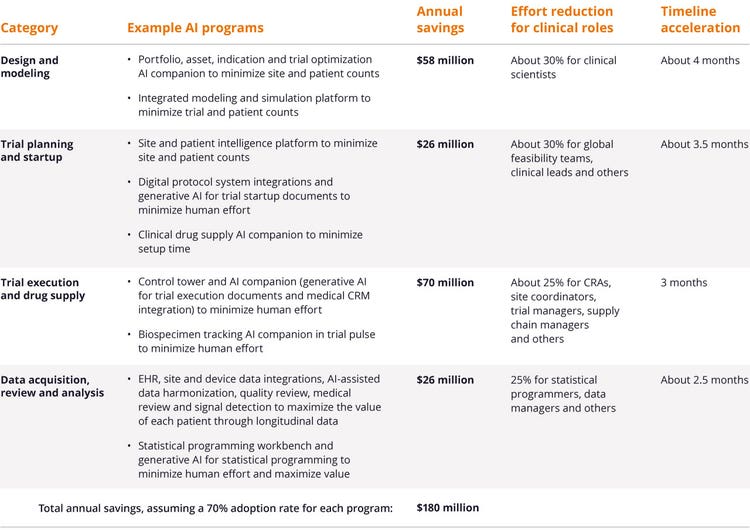
Biopharma companies are investing in AI, advanced analytics and digital tools, and some teams are achieving significant gains in speed and productivity. We’ve learned about AI programs capable of delivering more than $180 million in annual value. Other organizations are using AI to shorten key clinical activities by up to four months and significantly reduce effort in key R&D functions.
Yet development costs and timelines at many organizations have been slow to improve as gains remain isolated. Scientific decisions, operational processes, data, systems and roles still move through an operating model built for a simpler era. Automating within that model often produces a modified version of the same fragmented result, without getting to the goal faster.
5 observations from the ZS R&D Leaders Exchange roundtables
These challenges aren’t confined to a single company or function within pharma R&D. We heard that loud and clear during this year’s six ZS R&D Leaders Exchange roundtables, which brought together leaders from more than 20 biopharma companies across regulatory affairs, technology, clinical innovation, clinical operations, biostatistics and other functions. In each discussion, five observations surfaced repeatedly.
Observation 1: Science is outpacing the operating model
It’s not usually capacity that constrains large biopharma companies. Instead, it’s the complexity of drug development science and the challenges of operating at scale. Here are just two examples of what this dynamic looks like today:
- Oncology portfolios are increasingly spanning diverse therapeutic modalities, including bispecific and multispecific antibodies, next-generation antibody-drug conjugates (ADCs) such as dual-payload ADCs, radioligand therapies and cell therapies. Many of these therapies require specialized sites, supply chains and manufacturing coordination well before a trial begins.
- Chronic disease portfolios are becoming more mechanism-driven, with a single biological pathway potentially supporting several indications. And the evidence bar continues to rise, as accelerated pathways face greater scrutiny.
Meanwhile, operating models have failed to keep pace with scientific gains. Target product profiles, evidence plans, clinical development plans and protocols are often developed as separate artifacts. Operational feasibility, patient burden and payer needs are considered too late.
Leaders at our roundtables repeatedly returned to the same idea: The highest-leverage decisions now sit upstream, with trial design and its metadata shaping downstream documents, system configurations, recruitment assumptions and site burden. When organizations fail to resolve trade-offs early, scientific ambition becomes operational rework.
Observation 2: Operations are straining under scientific complexity
Not surprisingly, scientific complexity makes it more challenging to conduct a clinical trial. In the real world, this looks like:
- Segmented populations, complex endpoints and longer follow-up periods that shrink eligible patient pools and extend recruitment.
- Specialized modalities that add site qualification, supply and manufacturing dependencies.
- A single protocol choice affecting per-patient cost, the number of eligible participants, site startup and the probability of meeting enrollment targets.
Clinical operations leaders at our roundtables described how these challenges multiply rather than remain confined to one part of a study. Still, the work required to manage these challenges remains fragmented. Monitoring, data review, vendor oversight and quality management often run through separate teams, systems and risk processes. One function may optimize its own work while shifting cost or delay elsewhere.
Better tools can make those problems more visible, but visibility alone does not resolve duplicated checks, unclear accountability or disconnected decisions. As programs become more complex, inefficiencies that were once tolerable are now amplified across studies and portfolios.
FIGURE 1: The compounding effect of connected systems
Observation 3: As AI moves beyond pilots, scaling remains challenging
Like other industries, drug development leaders are moving beyond AI pilots to focus on how they can scale the technology. Participants in our roundtables detailed some of the AI-driven gains they’ve seen at their organizations, including sharp time reductions in activities such as drafting clinical study reports and protocols.
Another win they shared: Business teams are using natural-language tools to create requirements, prototypes and working code at speeds that challenge traditional development models.
But these gains are often isolated, failing to translate into lower costs and shorter timelines across the organization.
The challenge is more organizational than technical. Existing workflows contain redundant reviews, sequential handoffs and roles designed around document production.
The leaders added they’re confronting a harder question than which model to deploy: How much of the underlying work, accountability and workforce model must change before AI can create value at scale?
Observation 4: Data maturity is the ceiling on everything else
AI and workflow redesign expose the limits of the data beneath them. Some examples we heard about:
- Clinical, regulatory, operational and commercial information is often spread across systems, documents and local conventions.
- Regulatory functions must interpret decades of records shaped by acquisitions, divestitures and system migrations.
- Clinical teams have current data but lack common definitions that allow it to move cleanly from study design into execution, analysis and submission.
“I think it is a misnomer when we say ‘turning documents into data,’” one leader at a roundtable said. “What we really mean is defining exactly what our process is, and the data that is utilized in that process.”
The roundtable participants also discussed when data is “good enough” to start leveraging AI. They warned against waiting for a multiyear data cleanup before using AI, arguing that live use cases can reveal where targeted improvement is most important. While the leaders stressed that some data (such as dose or experimental conditions) must be handled carefully, a shared view emerged that organizations shouldn’t wait for all their data to be perfect before pursuing AI.
Observation 5: The external environment is tightening
It’s not breaking news, but the leaders all agreed R&D is transforming against a backdrop of increasing regulatory, economic and geopolitical pressure. To focus on regulators, they’re the ultimate consumers of the evidence package, which means new approaches to data collection, AI-assisted analysis and automated content must support validation, explainability, traceability and auditability from the beginning.
Health authorities are increasingly supporting the use of AI, with joint guidance from the European Medicines Agency and FDA establishing 10 core principles for good AI practice across the life cycle, including clinical trials and drug development. And the FDA is taking a major step to implement real-time clinical trials by allowing organizations to report endpoints and safety signals as they happen.
Still, industry leaders said they face challenges with differing regulatory expectations across markets and uncertainty about how quickly health authorities will accept new evidence models. As biopharma companies reorganize how they execute data collection and submission, roundtable participants said the regulatory landscape must evolve in parallel.
What these 5 observations have in common
When you zoom out and look at these five observations together, you start to see connected challenges. Scientific complexity magnifies operational strain. AI exposes weak processes. Fragmented data and tighter regulatory scrutiny raise the cost of mistakes.
Organizations have often addressed these challenges separately, which helps explain why the cost curve has barely moved. But if organizations start viewing these challenges as truly connected, improvements in one area start to reinforce the others, reducing downstream rework, helping AI deliver greater value and improving portfolio economics across programs.
The ZS point of view: How you can transform your drug development program
What does real drug development transformation look like? Our point of view combines what we’ve heard from industry leaders plus our 10+ years of experience helping R&D organizations redesign processes, data foundations, technology and roles.
We previously argued that connected data, advanced AI and a willingness to disrupt established ways of working are the formula for a faster, more adaptive clinical development model. Looking ahead at the future of drug development transformation, two questions will determine if your initiatives will succeed or stall in an AI-enabled environment.
- Have you redesigned the work?
- Have you connected the data beneath the processes?
Redesigning the work for an AI-enabled environment
As drug development organizations transform to succeed in an AI-enabled environment, the temptation is to convert a legacy workflow directly into a digital one. Much of drug development still operates through linear processes, document-based handoffs and function-specific decisions. Instead, in an AI-enabled environment, work should instead be designed as a connected ecosystem of decisions, extending from asset strategy and the clinical development plan through trial design, execution, analysis and submission.
When planning your AI investments in clinical development, know that orchestration is what turns individual capabilities into an ecosystem that can continuously sense, predict and guide action. We want to change how information moves, when decisions are made and how one action triggers the next. This is a more worthwhile goal than simply trying to complete each task faster.
What you need to know about an AI-enabled environment
In an AI-enabled environment, leverage moves upstream. Instead of waiting until a protocol is fixed, teams can use simulations to test population, endpoint, dose, feasibility, patient burden and evidence assumptions before committing significant capital. In silico methods and digital twins can expose trade-offs earlier, while a traceable probability of technical and regulatory success makes uncertainty visible and connects evidence generation to specific program decisions.
Human expertise remains central in an AI-enabled environment. Technology can take on routine synthesis, coordination and execution, but people must remain accountable for scientific judgment, ethical considerations, risk thresholds and difficult decisions. This means it’s important to redesign roles around the future workflow rather than adjust roles based on today’s organization chart.
Governance should also be embedded in the AI-enabled environment, with clear boundaries for what agents can perform, what requires human review and what must be escalated.
Connecting the data for a connected operating model
Redesigned work can only scale when data flows with it. To ensure data can be reused, scientific and operational decisions should be captured as structured data at the source, supported by shared metadata, ontologies and lineage. That information can then flow into documents, systems, analysis plans and submissions without being repeatedly interpreted and reentered.
Organizations should strive for a standards-first data backbone in which information moves from trial design through execution and submission. In this model, data becomes the engine for decisions, automation and continuous learning.
Starting with available data does not mean treating all data equally. Critical scientific facts must be correct at the source.
In other areas, live use cases can reveal where targeted quality improvements, standards and semantic alignment will create the most value. A shared knowledge layer can preserve meaning across functions while supporting a more composable technology architecture consisting of a stable core, low-latency access to company-owned data and replaceable tools selected for specific jobs.
What connected drug development looks like
This is what the connected operating model makes possible:
- Scientific and design decisions are captured once, upstream, as structured data. They then flow into operational systems, datasets, analysis plans and submissions.
- Teams use in silico models and digital twins to stress-test study designs before major capital is committed, while agentic workflows extend capacity across startup, monitoring and data review.
- Quality, monitoring and vendor oversight operate through a shared risk model rather than parallel tracks.
- Documents become outputs of structured knowledge instead of the primary system of record.
And at the portfolio level, leaders steer programs using outcomes, cycle time and probability of success, allowing each program to strengthen data, models and decision-making.
6 practical actions R&D leaders can take now
Transforming drug development with AI won’t happen overnight. But R&D organizations don’t need to wait for perfect data, settled regulation or a fully redesigned, connected operating model to start. Following the roundtables, we outlined six actions that can create value now while establishing the conditions for larger change.
It’s tempting to begin with a long inventory of AI use cases. Don’t.
Instead, select a few journeys that cross functional boundaries and carry meaningful cost, timing or decision risk. For each journey, you’ll want to define the business outcome, workflow owner, data requirements and adoption plan before selecting a technology. This helps you capture the compounding effect described by clinical operations leaders in our roundtables, which happens when one single improvement reduces costs, widens the eligible population and accelerates recruitment. We’ve seen a number of capabilities become more valuable once they’re connected.
We recommend bringing patient, site, operational and regulatory perspectives into asset strategy and clinical development planning before the protocol is fixed. It is becoming increasingly common to use in silico models and trial simulations to test population, dose, endpoint, recruitment and site assumptions while decisions are still less expensive to change.
When trial design choices and their metadata are captured as structured data at the source, they can support protocols, feasibility activities, system configurations, analysis plans and submissions. This is the foundation of Data at the Speed of Light, where information is designed for reuse rather than repeatedly interpreted and reentered.
As we know, it’s easier to automate simple work than complex work. Mapping the workflow and challenging every review, check, handoff, assessment and content requirement is vital before automating. You can simplify work by removing duplicate controls and low-value steps before deciding what AI should handle and what humans need to manage.
Leaders at our roundtables said that manual process improvements made before introducing AI saved money. They also noted that risk-proportionate regulation provides another reason to retire inherited practices that no longer improve quality.
“The only way I see us getting to an ROI state is if we really redesign processes,” one leader said.
A multiyear enterprise data cleanup doesn’t have to be the price of entry.
How can you get your data ready? To start, it’s important to identify the critical scientific facts that must be correct at the source, then use live workflows to reveal where targeted work will produce the most value. Add shared semantics, metadata and lineage so information retains meaning across functions.
You’ll want to build the architecture with the same discipline:
- Buy stable capabilities for common processes but build where proprietary data or insight creates differentiation.
- Preserve low-latency access to company-owned data.
- Layer replaceable, best-fit tools on a stable core rather than depending on one closed end-to-end vendor.
This approach allows R&D organizations to move quickly while retaining control as technologies change. Data at the Speed of Light shows how a standards-first data backbone can support this model.
Governance should help teams move safely, rather than act as a final approval gate. It’s vital to build access rules, traceability, validation, model triage and escalation paths directly into AI-enabled platforms. Monitored sandboxes, meanwhile, can give teams a place to test ideas within defined limits while preserving visibility and control.
For each new workflow, specify what AI can perform, what requires human review and who remains accountable for the output. Then design roles around the new work. Domain fluency, scientific judgment and the ability to challenge machine outputs should carry more weight as routine execution shifts to agents. Treat adoption as part of value realization by involving end users in workflow design, creating safe opportunities to experiment and using peer advocates and practical examples to build confidence in new ways of working.
Raw usage counts don’t tell the whole story. You’ll want to track measures that show whether work and decisions have improved. These can include cycle time, protocol amendments, non-enrolling sites, workflows changed/eliminated and the time from signal to action. These measures reveal whether AI is changing the operating model rather than simply attracting users. Drug development mission control offers one approach for connecting insight, ownership and execution across programs.
It’s important to measure the full cost of your transformation. You can do this by:
- Accounting for compute and repeated model calls, validation, monitoring, data maintenance, specialized talent and adoption.
- Using the least complex model that can perform each task safely and reliably, since smaller, task-specific models may deliver better quality at lower cost.
- Moving beyond per-seat licenses or digital-worker equivalents and toward consumption, transaction or outcome-based pricing in your vendor-provided solutions.
Managing these six actions as one portfolio
These actions should be managed as one coordinated portfolio, not six separate programs. Progress in one should strengthen the others and move the entire R&D organization closer to a connected operating model.
Drug development transformation: Turn today’s actions into lasting R&D impact
The path forward is becoming clearer. R&D organizations don’t need to wait for perfect data, settled regulation or a fully connected operating model to begin. They can start by redesigning high-value workflows, strengthening the data those workflows depend on and embedding governance and human accountability from the outset.
Success, however, is not a collection of isolated improvements. It’s a connected clinical development ecosystem where data flows from design through submission. In silico models and digital twins test decisions before capital is committed, while mission control-style oversight turns signals into coordinated action across programs. Better upstream decisions reduce downstream rework, stronger data makes AI more reliable and redesigned roles turn faster execution into better judgment.
By bringing together data, science, technology and human ingenuity, R&D organizations can help more therapies reach more patients sooner.