AI in medical affairs: 5 investments to win in an AI-driven healthcare ecosystem
Medical affairs must move beyond AI pilots
For decades, medical affairs has evolved incrementally within a relatively stable scientific ecosystem. Evidence was generated through controlled trials, translated into scientific communications, disseminated through congresses, medical engagement, scientific exchange and acted upon by medical stakeholders.
But things are changing. As healthcare enters a new AI-driven era, medical affairs stands at a critical inflection point, as the scale and speed of disruption demands a structural shift. Yet most organizations have responded by focusing inwards, using AI to drive productivity and efficiency through multiple siloed pilots. As agentic AI begins to operate alongside people, the real shift is not deploying tools but redesigning how decisions and execution work together so intelligence can scale reliably across the enterprise.
Our CDIO research on scaling AI in pharma and biotech highlights how, despite a flood of pilots, only 40% of them make it to scaled deployment, resulting in just pockets of excellence and a persistent gap between experimentation and enterprise reinvention. Data readiness, technology layered onto legacy operating models, uneven leadership buy-in and budget pressures all continue to roadblock adoption at scale. And as valuable as proof of concepts are, they only optimize fragments of the operating model.
As AI accelerates, medical affairs must advance beyond pilots
Pharma’s progress toward future readiness is stalling at precisely the wrong moment, just as AI adoption is rapidly accelerating across the healthcare ecosystem. Payers and providers are deploying AI initiatives, physicians are using large language models (LLMs) daily to assist decision-making processes and patients are asking ChatGPT for health advice.
Meanwhile, macroeconomic pressures intensify this inflection point. In this context, medical affairs is expected to demonstrate quantifiable value, support complex portfolios while operating within tighter cost envelopes and function within legacy operating models.
As we look ahead, the question is no longer whether medical affairs can optimize existing processes and capabilities. It’s whether the function should be fundamentally redesigned to ensure it remains an engine of clinical practice change. A critical set of questions are emerging for medical affairs executives:
- How can medical affairs remain relevant as external stakeholder behavior, expectations and influence models change?
- How should evidence be designed and shared to inform the tools clinicians use daily, support pathway inclusion and guideline alignment, all while meeting payer requirements?
- How should medical engagement models evolve to address health system priorities?
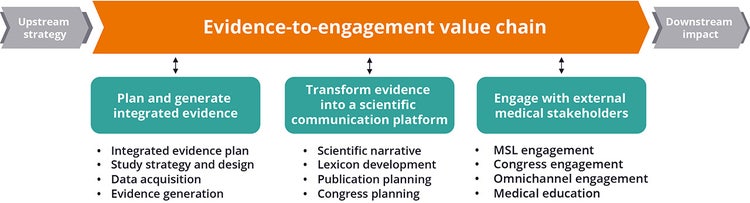
Today, the evidence-to-engagement value chain (see Figure 1) remains linear while the wider ecosystem rapidly shifts toward AI‑enabled, dynamic decision‑making.
FIGURE 1: The current evidence-to-engagement value chain
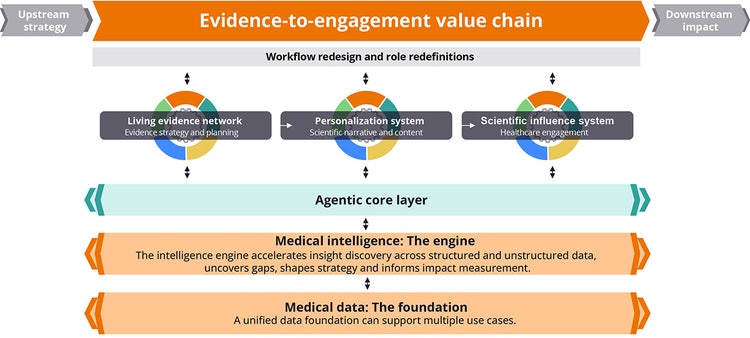
The future of medical affairs will not be defined by functional excellence alone, but by the ability to act as the enterprisewide intelligence engine. Medical affairs must act now and invest in integrated value streams to remain a strategic player, redesigning end-to-end value streams around critical decisions so intelligence can operate reliably, be governed clearly and scale across the enterprise.
FIGURE 2: The future evidence-to-engagement value chain in an AI-driven healthcare ecosystem
Five investments executives need to drive for medical affairs transformation
Medical affairs has a clear opportunity to re-architect the evidence-to-engagement model for an AI-driven healthcare landscape. Leaders should first focus on what matters most: Accelerating patient access, enabling confident clinical adoption and strengthening scientific trust. To deliver this, medical affairs executives must build a set of system-level capabilities that can drive these five investments:
- Move from “dark” data to a unified knowledge foundation
- Become a medical intelligence function
- Design an AI-enabled generation capability
- Reimagine medical content as a personalization system
- Reinvent medical engagement with agentic AI
Medical affairs investment 1: Move from ‘dark’ data to a unified knowledge foundation
Pharma’s ambition to scale AI is increasingly constrained not by algorithms, but by legacy data foundations that were never designed for real-time, AI-driven decision-making. The opportunity is no longer just to build data products, but to shift toward a unified knowledge foundation, turning fragmented data into contextualized, decision-ready intelligence that directly informs core medical decisions. These include evidence prioritization, scientific narrative development, engagement planning and more. This shift becomes the backbone of an AI-native medical affairs function.
What’s happened so far
By 2025, most organizations recognized the strategic importance of data, yet few translated this into true competitive advantage. As ZS has previously highlighted, while many organizations aimed to modernize data strategies, only 35% believed they achieved differentiation—revealing a persistent gap between AI ambition and data readiness. Here’s why the reality remained constrained:
- Organizations focused on building medical data products, yet data remained siloed across systems—including clinical, real-world evidence (RWE), publications and medical science liaison (MSL) insights—limiting interoperability and reuse
- Data strategies were designed for reporting, compliance and storage, but not for decision-making
- A vast amount of unstructured and underutilized “dark data” remained inaccessible
- Up to 80% of available data (such as clinical trial data) was not fully analyzed
- Accessing and integrating data required significant manual effort
- AI ambition outpaced data readiness
What needs to happen next
Medical affairs must shift from fragmented data products to a unified, AI-enabled knowledge layer, where outside-in foundation connects structured and unstructured data into contextual, decision-ready intelligence. This means:
- Transforming “dark data” into “bright data” by systematically capturing, structuring and contextualizing unstructured sources, such as congress outputs, publications and field insights
- Building a knowledge layer that integrates data with meaning, linking evidence, context and relationships through ontologies, metadata and semantic models
- Leveraging AI for data by using generative and agentic AI to automate data ingestion, curation, enrichment and discoverability to dramatically reduce the effort required to make data usable
- Enabling natural language access and reasoning across complex, heterogeneous datasets, making data directly usable for decision-making
Crucially, this is not just a data transformation but an operating model shift. It’s anchored in key medical decisions, with governance, traceability and compliance embedded by design.
What impact medical affairs executives can expect
The result is a step-change from fragmented data aggregation to a unified, decision-grade intelligence foundation. Medical affairs can move from retrospective, manual analysis to real-time, AI-enabled decision-making, unlocking the full value of both structured and unstructured evidence.
By turning data into knowledge and knowledge into action, medical affairs becomes faster, more adaptive and more precise, powering continuous decision-making across the evidence-to-engagement value chain.
Medical affairs investment 2: Become a medical intelligence function
Medical insights have been a major investment area in recent years, but in most organizations, they remain episodic and descriptive, capturing what happened rather than shaping what’s next. In an AI-driven healthcare environment, medical affairs must evolve from an insights function into an intelligence engine.
By activating their unified knowledge foundation, organizations can continuously sense critical signals such as shifts in healthcare provider (HCP) beliefs, emerging evidence and evolving treatment paradigms, all in real time. This enables medical affairs to proactively identify risks and opportunities and dynamically inform decisions across the entire evidence-to-engagement value chain. This is how medical affairs transitions from an insight generator to a strategic sensing and decision engine.
What’s happened so far
By 2025, leading organizations invested in medical insights mining capabilities, with a strong focus on extracting signals from MSL notes and medical information inquiries. However, this approach demonstrated some limitations:
- Most insights remained fragmented, qualitative and episodic
- Unstructured insights were rarely connected to structured data—such as publications, claims, EMR and trial data—or external signals
- Translation into action was inconsistent, with weak links to strategy (and listening priorities) or evidence generation strategies and engagement planning
- AI improved insight generation, but not decision-making
What needs to happen next
Medical insights must evolve into true intelligence systems, capabilities that don’t just aggregate information, but actively shape decisions. Powered by agentic AI, these systems continuously interpret signals, anticipate shifts and proactively surface risks and opportunities. They move beyond synthesis to simulation. They’re testing scenarios, recommending actions and enabling near driverless decision support across the evidence-to-engagement value chain.
This transformation requires a fundamental operating model shift. Intelligence must be embedded directly into medical workflows, with human-AI collaboration at the core. Medical teams transition from insight generators to strategic orchestrators, focusing on judgment, oversight and guiding AI-driven decisions.
What impact can medical affairs executives expect
Medical affairs will be able to create additional value through stronger signal detection and prioritization, faster and more confident translation of insights into action and true cross-functional alignment. Moving from periodic insights meetings to continuous intelligence enables medical affairs to influence clinical adoption, evidence strategies and patient access in real time—positioning it as a true healthcare integrator in an increasingly AI-driven healthcare system.
Medical affairs investment 3: Design an AI-enabled evidence generation capability
Evidence generation must shift from slow, static and reactive to an AI-enabled integrated evidence generation and planning engine. This requires an operating model shift from episodic, sequential planning and execution toward an enterprise decision capability that continuously governs evidence priorities, study choices and how evidence is generated, updated and applied.
In this model, strategy, planning and execution are dynamically connected. AI continuously senses emerging signals, supports their interpretation and enables prioritization and orchestration of evidence decisions.
Execution becomes faster and more targeted in this decision model. Rather than optimizing a fixed plan, medical affairs operates a decision flywheel that separates signal detection, scientific interpretation and decision rights. Signals from trials, RWE, publications, safety, policy and field inputs are continuously sensed and triaged into actions such as initiating focused analyses, reshaping study design or redeploying investment to the highest‑impact gaps.
“Stop” decisions occur earlier when evidence is no longer useful in decision-making. This could include when endpoints or comparators are misaligned for health technology assessments (HTAs), the likelihood of shifting the adoption barrier is low or rising operational risk undermines credibility.
What’s happened so far
By 2025, AI had begun to support targeted use cases in the evidence life cycle, including literature reviews, protocol design and observational analytics. However, AI’s value was not fully realized:
- Evidence generation remained slow, resource-intensive and largely reactive
- Integrated evidence plans were largely static, defined annually and disconnected from evolving scientific, clinical and market dynamics
- AI use cases were isolated and did not fundamentally reshape evidence generation strategy and decision-making
- Investment decisions were often reactive, based on precedent rather than forward-looking, scenario-based insights
What needs to happen next
Medical affairs must operate as a decision system that tightly connects strategy, data and execution to enable better, faster decisions that can be acted on at scale. This requires:
- Always-on scientific surveillance explicitly wired to decisions so that medical affairs can decide which evidence to invest in, which activities to stop, what to change while work is already underway and what additional evidence is required. In this model, monitoring and prioritization happen together, so insights are translated directly into a continuously updated, decision‑ready evidence plan, rather than sitting in reports or dashboards waiting to be acted on.
- Predictive, model-driven prioritization to replace static evidence using simulations to stress-test evidence strategies, quantify trade-offs and forecast impact on regulatory, HTA and clinical adoption outcomes.
- Scalable, execution architectures that are designed to accommodate different levels and rates of acceptance of AI‑derived evidence across regulators, HTAs and payers. Architecture must support parallel evidence pathways, allowing the same underlying data and analyses to be operationalized differently. For example, an organization should use fully AI‑enabled approaches where acceptance is high, and more traditional or human‑validated approaches where there is a lot of scrutiny. This enables timelines to be compressed where possible without forcing uniform deployment or compromising credibility in environments that require greater evidentiary caution.
- Integrated evidence architectures that connect internal and external data into governed, reusable data products that solve current fragmentation and enable multiuse, cross-functional value.
To achieve this, decision rights and signoff models must evolve. Routine prioritization and execution decisions should be delegated to the agentic system within defined guardrails, while human oversight focuses on strategic intent, threshold setting and escalation where risk or lack of precedent is highest.
In parallel, the evidence strategist’s role evolves from designing individual studies to orchestrating an end‑to‑end, agentic evidence engine, while ensuring that output remains credible, decision‑ready and aligned to real‑world impact.
What impact can medical affairs executives expect
Instead of reacting to evidence gaps late, organizations can continuously identify what evidence matters, where and why by using AI to integrate data across trials, RWE, publications and stakeholder signals. This enables earlier, smarter investment decisions while also reducing wasted expenditure on low‑impact studies.
The result is a faster, more targeted evidence portfolio. Priorities are dynamically adjusted, resources are redirected in real time and critical evidence is generated ahead of regulatory, payer and clinical decision points.
Ultimately, this shifts medical affairs from managing studies to running a continuous decision system that improves return on investment, accelerates time to access and ensures evidence directly supports real‑world adoption and patient impact.
Medical affairs investment 4: Reimagine medical content as a personalization system
Medical affairs has long produced scientific content, but in an AI-driven healthcare system, content must evolve into a structured, reusable system that can be dynamically activated across the evidence-to-engagement value chain. This means shifting from managing static documents to orchestrating modular, governed scientific content that continuously flows into engagement, insights and decision-making. For example, instead of managing static PDFs and slide decks, medical affairs breaks down science into governed, reusable content modules such as mechanism of action (MoA) claims, efficacy data and safety narratives.
These modules dynamically power MSL engagements, medical responses and insight capture. They’re continuously updated as new data emerges, so that evidence, engagement and decision‑making stay connected in near real time.
What’s happened so far
By 2025, some medical affairs organizations invested in generative AI to accelerate the drafting of medical content, including first draft for publication and standard response documents. However, some pain points remained:
- Most implementations remained asset-centric, with content locked in static formats such as slides, PDFs and publications
- Reuse was limited, leading to duplication across global/country and geographies
- Personalization at scale was difficult, as content lacked structure and interoperability
- Downstream use cases such as field engagement were constrained by unstructured content
- Evidence dissemination in digital channels was cost prohibitive and lacked agility
- AI improved content speed, but not content scalability or activation
- Copyright and legal constraints limited AI access to large portions of the scientific record, while publisher resistance to AI‑generated content reflected unresolved legal and governance ambiguity in medical publishing
What needs to happen next
Medical content must evolve into a modular, human and machine-readable personalization layer. Core scientific narratives should be decomposed into reusable components, enriched with standardized metadata, taxonomies and medical ontologies.
AI-enabled workflows can then automate tagging, assembly, localization and adaptation, dynamically generating fit-for-purpose content tailored to specific audiences and contexts, while remaining anchored to approved source material. Governance is embedded by design, with AI-assisted review, automated compliance checks and full traceability, ensuring content is always audit-ready. The AI-enabled medical content transformation approach should turbo-charge a global-local operating model for medical content that’s taking shape in medical affairs organizations.
This transformation also requires an operating model shift: Medical writers become architects of modular, structured scientific content, while reviewers move from line-by-line editing to overseeing scientific accuracy, contextual coherence, compliance and ethical integrity across a complex content ecosystem.
What impact can medical affairs executives expect
This will allow medical affairs to change the way they disseminate evidence by having the ability to generate personalized, context-aware scientific engagement at scale, with consistent messaging across channels and geographies. Content becomes a reusable strategic asset rather than a one-time deliverable, reducing duplication, accelerating time to dissemination and enabling medical intelligence to flow seamlessly into execution.
Medical affairs investment 5: Reinvent medical engagement with agentic AI
Medical engagement is being fundamentally reshaped by the opportunity to move beyond static, episodic interactions and toward intelligence-led orchestration. In this model, medical affairs is becoming an AI-augmented scientific partner, delivering continuous, contextual and decision-relevant scientific exchange at the point of care.
What happened so far
By 2025, medical affairs made meaningful progress in applying AI to engagement—but this happened primarily through isolated, use case-driven pilots. For example, MSL assistants enabled the preparation of MSL engagement with KOLs to synthesize notes from previous engagements, while suggesting topics for the next engagement. However, this approach has clear limitations:
- AI was deployed in silos without integration across the engagement ecosystem
- Engagement models remained episodic, driven by static engagement plans and manual workflow
- Insights were generated but not systematically connected to decisions
- Medical engaged with community HCPs, but engagement wasn’t personalized enough to drive clinical behavioral change. The engagement requires more targeted, data‑driven approaches to accelerate physician learning
- AI improved individual tasks, but not engagement outcomes
What needs to happen next
Medical engagement must shift from fragmented pilots to AI-enabled, outcome-oriented decision systems built around a continuous sense-decide-act-learn loop that’s embedded into day-to-day workflows. This means orchestrating a network of agentic capabilities that:
- Continuously senses the ecosystem by integrating signals from scientific data, field insights, healthcare system dynamics and prior interactions
- Proactively decides by synthesizing these inputs into insights, predictions and recommended next-best scientific actions
- Seamlessly acts by activating personalized, context-aware engagement across channels
- Continuously learns by capturing feedback, refining models and improving future interactions
These systems are enabled through scaled, interconnected solutions:
- AI-enabled MSL assistants and copilots that augment the full engagement life cycle, from preparation to in-call support to structured insight capture that embeds within MSL CRMs
- A data and AI-led approach to HCP barriers and context determination, allowing medical affairs to personalize engagements based on HCP needs, learning journey stages and preferences
- Medical HQ assistants that synthesize ecosystem signals to guide strategy, resource allocation and performance tracking
- Agentic advisory boards that simulate diverse expert personas, enabling rapid, low-cost testing of scientific hypotheses, messages and engagement strategies before real-world deployment. This complements, but doesn’t replace, traditional KOL engagement
- AI-driven orchestration of medical engagements through multiple channel modalities, incorporating HCP context and decision parameters that affect clinical change
At the core is the augmented scientific partner: an agentic system that synthesizes account history, healthcare priorities, real-world context and prior interactions to dynamically guide engagement, replacing static plans with adaptive, intelligence-led orchestration.
What impact can medical affairs executives expect
Medical affairs is moving from reactive interactions to proactive influence, engaging clinicians and patients with the right evidence, at the right moment, in the right context. This not only expands reach and efficiency, but also more importantly, it strengthens clinical decision-making, accelerates clinical adoption and positions medical affairs as a central orchestrator in an AI-driven healthcare ecosystem.
Future evidence to engagement value chain for medical affairs executives
The future value of medical affairs will be defined by how reliably scientific meaning is embedded into the decision pathways that increasingly shape clinical practice, access and care delivery. In an AI-driven healthcare ecosystem, evidence that is late, fragmented or unstructured becomes effectively invisible regardless of its scientific rigor.
Today, most organizations remain stuck in pilot mode. While AI has demonstrated clear productivity gains, the issue is not the technology. The challenge is that AI is being layered onto existing workflows instead of redesigning how decisions are made, connecting data, redefining roles and reinventing value streams.
By committing to the five shifts and rearchitecting the evidence-to-engagement value chain, medical affairs executives can help their organizations evolve into a function that operates at the speed and precision of modern healthcare systems. These shifts propel:
- Reductions in evidence planning, generation and dissemination
- Earlier detection of scientific risks
- Improvements in launch scientific readiness
- Dynamic, real-time adjustments of medical priorities and engagement strategies
Ultimately, the shift to an AI-driven medical affairs function requires a structural transformation of how decisions are made. High-impact decisions become continuously orchestrated through integrated decision flywheels, with signals are persistently captured across the healthcare ecosystem, translated into decision-ready intelligence, executed seamlessly across the organization and refined through real-world feedback. Organizations that make this transition will shape the future of medical affairs.
Daniel Blessing, Rachel Dalton, Bora Erdemli, Rohan Fernando, Krutika Gohil, Jones Jaick, Malik Kaman, Rishi Mehra, Aaron Mitchell, Waldemar Ockert and Kelli Simms contributed to this article.